
Blue limestone coastal Chandler designs demand more precision than most landscape architects initially anticipate — the material’s natural blue-gray tonality creates genuine coastal atmosphere, but only when you coordinate slab finish, grout joint color, and plant palette with deliberate intent. You’re not just selecting a stone color here; you’re engineering a sensory environment that competes with Arizona’s intense desert backdrop. The gap between a themed landscape that feels contrived and one that genuinely transports visitors comes down to a handful of specification decisions that happen long before installation day.
Why Blue Limestone Works for Coastal-Themed Landscapes
The material properties of blue limestone make it a legitimate anchor for coastal landscaping in Arizona’s desert climate — not just a visual choice. Its naturally cool gray-blue surface tones absorb less radiant heat than warmer-spectrum stones, which means your outdoor living areas stay more comfortable during afternoon peak temperatures. That thermal behavior isn’t incidental; it’s a core reason blue-gray paving has become the go-to material for Chandler beach-inspired design.
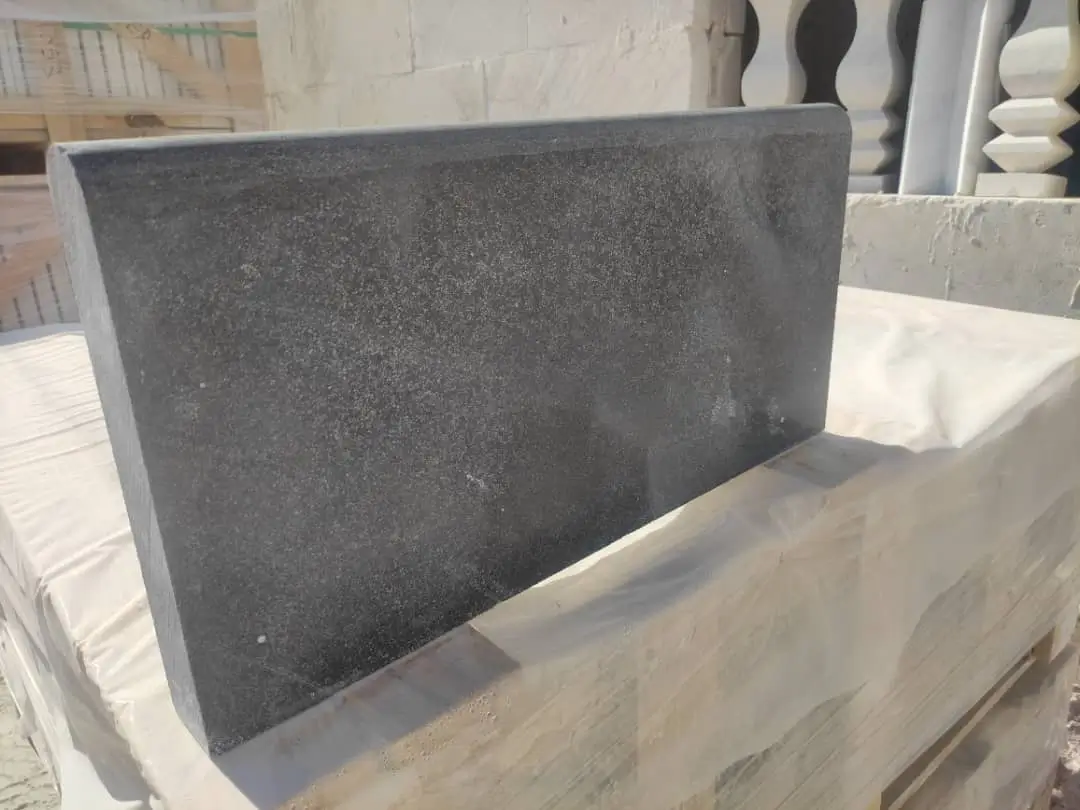
Blue paving ocean themes depend heavily on the stone’s surface finish to read convincingly. A tumbled finish introduces the worn, wave-smoothed quality that connects visually with shoreline aesthetics, while a honed finish leans toward the refined, nautical-resort direction. Your design intent should dictate the finish selection before you evaluate anything else — material thickness, size format, and jointing details all flow from that foundational decision.
- Tumbled finish creates organic, high-character surfaces ideal for casual coastal garden paths
- Honed finish delivers resort-level refinement suited to pool surrounds and entertainment terraces
- Sawn finish provides consistent geometry for contemporary maritime-inspired grid layouts
- Surface coloration intensifies slightly when wet, amplifying the ocean-inspired palette during irrigation or rainfall
Design Framework for a Coastal Aesthetic in Chandler
Pulling off a credible Arizona seaside style requires you to think in layers — hardscape, softscape, water features, and furniture all need to reinforce the same narrative. The paving is your largest horizontal surface, so it establishes the foundational color story. Your blue limestone field should read as the “water plane” — the element that all other design decisions reference. Working outward from that anchor, you introduce warm sand-toned planters, bleached timber pergolas, and salt-tolerant plant species even though you’re 400 miles from any coast.
Joint color matters more in coastal themes than in most other design vocabularies. A white or near-white joint sand emphasizes the grid lines and creates a nautical, dock-plank visual rhythm. A buff-toned joint reads warmer and blends the slabs into a continuous surface that mimics calm water. You’ll need to mock up both options on-site before committing — the 11 a.m. Chandler sun will reveal qualities in joint color that morning or late afternoon light completely hides.
- White joint sand enhances nautical grid patterns and brightens the overall palette
- Buff or silver-gray joint sand creates continuous water-surface illusions across the paved field
- Avoid warm terracotta or brown joint materials — they pull the palette toward desert vernacular
- Polymeric sand in white or gray tones locks joint color permanently while resisting ant infiltration
Material Specification for Blue Limestone Coastal Chandler Projects
Blue limestone paving in Arizona needs to be specified with desert climate performance as the primary constraint — the coastal aesthetic is the goal, but the physics of the installation happen in a high-UV, high-heat environment. Your slab thickness for pedestrian areas should be a minimum 30mm (approximately 1.2 inches) for standard patio and walkway applications, stepping up to 40mm for areas that receive vehicle overhang or heavy furniture with concentrated point loads.
Compressive strength for blue limestone typically ranges between 8,000 and 14,000 PSI depending on quarry origin and density grade — you want to be sourcing toward the upper half of that range for Chandler’s conditions. Request third-party test certificates with each order; quarry-issued figures can reflect best-case samples rather than production averages. At Citadel Stone, we check density and water absorption on incoming shipments at the warehouse before material ships to your project, which eliminates the field surprise of receiving underperforming stone.
- Minimum 30mm thickness for pedestrian paving; 40mm for mixed-use or vehicle-adjacent areas
- Compressive strength: specify 10,000 PSI minimum for Arizona outdoor conditions
- Water absorption rate should not exceed 3% — lower absorption reduces staining risk from pool chemicals
- Source slabs with consistent blue-gray coloration through the full thickness, not surface-applied color
- Request freeze-thaw cycle test results if any portion of your project is in an elevation zone above 3,500 feet
Base Preparation: The Critical Variable for Coastal Pool Surrounds
The most common failure point in coastal-themed pool surround installations isn’t the stone — it’s the base. In Chandler‘s caliche-heavy soil profiles, moisture movement beneath a poorly designed base creates differential settlement that fractures your carefully laid stone field within 18 months. You need a minimum 6-inch compacted aggregate base (Class II road base at 95% compaction) for pool deck applications, and that depth assumes you’ve broken through any shallow caliche layer and addressed drainage geometry first.
Drainage slope is non-negotiable at 1% minimum (1/8 inch per foot) away from pool coping and building foundations. In coastal-themed designs, flat-plane aesthetics tempt designers to reduce pitch — don’t. Standing water on blue limestone accelerates calcium carbonate leaching from the stone matrix, producing white efflorescence blooms that destroy the clean coastal palette you’ve worked to establish. The drainage geometry needs to be engineered before your base goes in, not corrected after the fact.
- 6-inch minimum compacted Class II road base for pool surround applications
- 1% minimum slope across all paved surfaces — increase to 1.5% near pool equipment areas
- Install perimeter French drain if soil percolation tests show less than 1 inch per hour infiltration
- Allow base to cure 72 hours before beginning mortar bed or sand bed installation
Thermal Performance and Barefoot Comfort
Surface temperature performance separates good coastal theme specifications from great ones — nobody recreates a beach atmosphere if the paving surface hits 165°F at 2 p.m. Blue limestone reflects approximately 55–65% of solar radiation depending on surface finish and color density, which translates to meaningful surface temperature reductions compared to dark natural stone or concrete pavers. Field measurements near Peoria have documented surface differentials of 18–25°F between honed blue limestone and standard gray concrete under identical summer exposure conditions.
That thermal advantage depends on maintaining a clean, unsealed surface or using a breathable penetrating sealer rather than a film-forming topcoat. Film-forming sealers trap heat at the surface layer and can actually increase surface temperatures while simultaneously trapping moisture — a double liability in Arizona’s climate. For barefoot comfort in a coastal-themed design, specify a penetrating impregnator sealer that allows vapor transmission while protecting against pool chemical staining.
Shade structures that track afternoon sun angles further enhance comfort in any blue limestone coastal Chandler installation — western-facing paving runs hottest in summer months, and even 30 minutes of shade from a well-placed pergola significantly extends the usable comfort window of your coastal outdoor space. For projects requiring broader specification context, premium blue-gray limestone paving in Phoenix covers performance benchmarks relevant to comparable low-desert conditions throughout the region.
Coordinating Coastal Planting with Blue Limestone
Your plant palette is doing as much work as the stone in convincing the eye that you’re somewhere near water. The design vocabulary of coastal landscaping translates surprisingly well to Arizona climates when you substitute water-efficient species that carry the same visual signatures as their coastal counterparts. Ornamental grasses — fountain grass, muhly grass, blue grama — provide the wind-movement quality of dune grasses without demanding irrigation budgets that contradict Arizona’s water realities. This plant-forward approach is central to executing Chandler beach-inspired design that reads as authentic rather than forced.
Plant beds adjacent to blue limestone need a root barrier detail that most landscape plans skip. Aggressive root systems from mature agave, bougainvillea, or large ornamental grasses will undermine your base integrity within five to seven years without a proper 24-inch deep root barrier membrane at the paving edge. This detail costs almost nothing at installation but prevents thousands of dollars in edge repair down the line. Blue paving ocean themes look best when the boundary between stone and planting stays crisp — the root barrier detail preserves that visual edge long-term.
- Ornamental grasses (muhly, blue grama, fountain grass) for coastal dune-inspired movement
- Agave species provide sculptural quality reminiscent of coastal succulents — install root barriers at 24-inch depth
- Silver or blue-toned plant foliage extends the blue-gray color story into vertical planes
- White-flowering ground covers in planting pockets reinforce the sea foam visual narrative
- Avoid deep-red or orange flowering plants near blue limestone — the color contrast disrupts the palette coherence
Sealing and Maintenance Protocols for Long-Term Performance
Sealing blue limestone in coastal-themed designs involves one consideration that most generic maintenance guides miss entirely — pool chemistry. Chlorinated water splash and backwash runoff carry pH values that interact with limestone’s calcium carbonate matrix, progressively etching unsealed surfaces and creating micro-texture changes that alter the stone’s visual character over time. Your initial sealing specification should use a pH-neutral penetrating impregnator rated for natural limestone, and reapplication should occur every 24–30 months rather than the 36-month schedule that works for travertine or basalt.
In Flagstaff, the elevation-driven freeze-thaw cycle introduces an additional maintenance variable — moisture-saturated stone that freezes can produce surface spalling, which is why sealing schedules there run annually rather than biannually. Even for Chandler projects without that freeze-thaw concern, annual visual inspections of joint integrity and surface condition should be part of the maintenance program. Catching joint sand erosion at year two costs almost nothing to remedy; catching it at year five means repointing a significant percentage of the installation.
Ordering, Logistics, and Project Planning
Blue limestone coastal Chandler projects with complex pattern work — herringbone borders, radius cuts for curved pool edges, or mixed-size field patterns — require material overage calculations that go beyond the standard 10% buffer. For designs involving cuts at more than 15% of total slab count, size your order at 18–22% overage. Blue limestone’s natural color variation means replacement material ordered months after initial installation may not achieve a seamless match, so your initial truck delivery should include all material your project will consume through completion, including anticipated repairs.
Citadel Stone ships blue limestone on standard flatbed trucks with strapping and edge protection — confirm your site has adequate truck access and a clear unloading area before scheduling delivery. Tight residential streets in established Chandler neighborhoods sometimes require you to coordinate with the city for temporary no-parking zones on delivery day. Our warehouse maintains Arizona stock specifically to reduce the 6–8 week lead time that imported stone typically carries; most standard-specification orders ship within 7–12 business days of confirmation.
- Standard 10% overage for field-cut patterns with straight geometry
- 18–22% overage for radius cuts, herringbone borders, or mixed-size patterns
- Order all project material in a single truck delivery to ensure color batch consistency
- Confirm street access dimensions and unloading space before scheduling delivery
- Store pallets on level, covered ground — avoid direct soil contact that introduces moisture variation before installation
Elevation and Regional Considerations Across Arizona
The specification variables for blue limestone coastal themes shift meaningfully across Arizona’s elevation gradient. Chandler sits at approximately 1,200 feet, where UV intensity and sustained heat are the dominant performance stressors. Sedona, at around 4,300 feet, introduces moderate freeze-thaw exposure and dramatically different drainage dynamics due to its red rock terrain and higher annual precipitation. A specification appropriate for a Chandler pool surround needs recalibration for a Sedona courtyard installation — base depth, sealer type, and joint sand specification all change.
The Arizona seaside style aesthetic translates differently at elevation too. Sedona’s cooler temperatures extend the usable season for outdoor entertaining, but morning condensation on blue limestone can create temporary slip hazards that don’t exist at lower desert elevations. Specifying a light bush-hammered finish rather than honed for Sedona coastal-themed projects addresses that slip concern while preserving the blue-gray color story. Your slip resistance specification should reference ANSI A137.1 wet DCOF values above 0.42 for sloped pool surround areas, regardless of elevation.
Getting Blue Limestone Coastal Specifications Right
Executing blue limestone coastal Chandler specifications correctly means holding two parallel tracks simultaneously — the aesthetic decisions that create genuine coastal atmosphere, and the engineering decisions that protect that atmosphere from Arizona’s relentless climate pressure. The material is genuinely capable of delivering both, but only when you work through the detail sequence with the same rigor you’d apply to any high-performance exterior installation. The design vocabulary of Arizona seaside style is compelling precisely because it requires real specification discipline to execute convincingly.
Your project’s long-term success — the kind where clients are still delighted at year 15 rather than year 3 — comes from getting the base right, the drainage geometry right, the sealer type right, and the maintenance schedule documented and followed. None of those variables are complicated in isolation; they just require attention at the right moment in the sequence. For a complementary perspective on how similar blue limestone materials perform under intense desert exposure, Blue Limestone Paving Cool Tones for Mesa Desert Heat Reflection explores thermal performance considerations that inform low-desert installations region-wide. Our blue black limestone paving slabs in Arizona are available in single sizes for uniform grid layouts.