
Fossil inclusions in black natural limestone aren’t a defect — they’re a stratigraphic record that took 300 to 500 million years to form, and they’re precisely what gives Marana projects a visual character no manufactured product can replicate. Black natural limestone fossils Marana specifiers are selecting today carry crinoid stems, brachiopod shells, and coral fragment imprints that were compressed into the matrix during the Carboniferous and Devonian periods. Understanding what you’re actually looking at when you examine a slab face — and how those inclusions behave under Arizona thermal and UV conditions — separates a confident specification from an anxious one.
What Fossil Inclusions Actually Are in Black Limestone
The dark coloration in black limestone comes primarily from organic carbon and finely distributed iron sulfide compounds locked into the calcite matrix during diagenesis. The fossil inclusions you see are calcite replacements — the original shell or skeletal material dissolved over geological time, and crystalline calcite precipitated in its place. That’s why many inclusions appear lighter or have a slightly different reflectivity than the surrounding stone: you’re looking at a secondary mineral infill, not the original organism.
Field performance data on black natural limestone paving in Arizona shows that these calcite infills are structurally integrated — they don’t create weak planes the way sedimentary bedding discontinuities do. Your concern should be weathering rate differential, not structural integrity. Calcite replacement fossils weather at roughly the same rate as the surrounding matrix in dry climates, which is why Arizona installations tend to preserve their inclusion character far longer than comparable European installations exposed to acid rain.
- Crinoid columnals appear as circular or oval discs, typically 3–15mm in diameter, often with a central canal visible
- Brachiopod outlines show bilateral symmetry and can span 20–60mm across the slab face
- Coral fragment sections reveal radial or tabulate internal structures when cross-sectioned by the quarry cut
- Bryozoan mesh patterns create fine lacework textures that become more pronounced after light honing
- Shell hash zones — densely packed micro-fossil fragments — produce textural variation that reads as natural pattern movement
Fossil Density and Visual Character Across Slab Batches
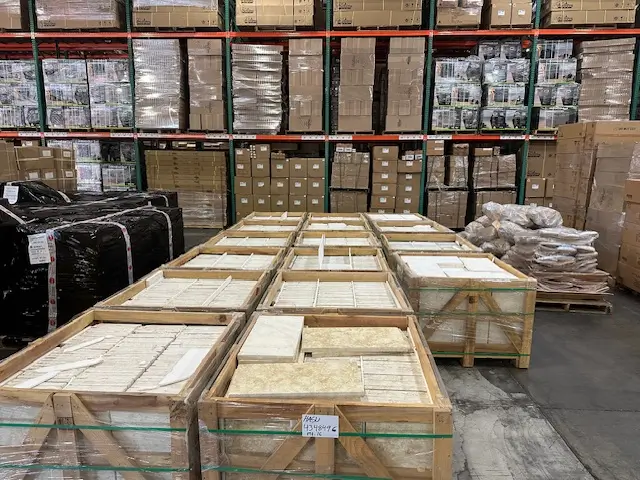
The fossil density in black limestone varies by quarry depth and by the specific stratigraphic layer being worked. Higher-density reef facies produce slabs with dramatic, almost encyclopedic fossil content. Deeper basin facies yield cleaner stone with isolated inclusions that read as deliberate focal points rather than overall texture. You need to know which facies your supplier is sourcing from before you commit to a full project quantity, because the character difference between a reef-facies and a basin-facies batch is significant enough to affect design intent.
At Citadel Stone, we examine slab batches directly at intake and document fossil density ranges so you’re not making decisions from a 12-inch sample tile. What you see at warehouse inspection — across multiple full slabs laid side by side — is what your installation will look like once the stone is down. That kind of pre-order review matters especially for larger feature areas like courtyard floors or entry plazas in Marana, where visual consistency across 500 to 1,500 square feet makes or breaks the finished result.
- Reef facies: fossil content covering 40–70% of slab face, high visual complexity
- Basin facies: fossil content covering 5–20% of slab face, refined and restrained appearance
- Transition zone batches: intermediate density with natural gradient character — often the most architecturally versatile
- Sorting by fossil density at warehouse level prevents awkward visual mismatches between slab runs on the same project
How Arizona Climate Affects Black Limestone Natural Inclusions Over Time
Here’s what most specifiers miss about black limestone natural inclusions Arizona sun exposure reveals over time: UV cycling doesn’t bleach the inclusions selectively, but thermal expansion cycles at Arizona magnitudes — surface temperatures routinely reaching 150°F on dark stone in direct exposure — can create micro-differential movement at the fossil-matrix boundary. This isn’t cracking. It’s a subtle surface relief shift that actually makes inclusions MORE visible over 5 to 10 years as the matrix weathers fractionally faster than the denser calcite replacement.
In Yuma, where ambient temperatures and direct radiation intensity are among the most extreme in the continental United States, uncoated black limestone surfaces develop this enhanced fossil relief character within 3 to 5 years. The result is a stone that grows more distinctive over time rather than fading toward uniformity — a performance attribute worth building into your client narrative for high-sun installations where Arizona distinctive appearance is a stated design goal.
- Sealed surfaces slow the differential weathering process — appropriate when you want to preserve the as-installed appearance
- Unsealed surfaces in high-UV zones develop enhanced fossil relief — appropriate when natural aging character is the design intent
- Penetrating sealers that don’t form a surface film allow normal weathering while protecting against staining
- Re-application every 18 to 24 months maintains protection without masking the natural inclusion character
Fossil Characteristics and Finish Selection
Your finish selection directly controls how fossil characteristics read in the final installation. Sawn or honed finishes reveal the internal cross-section of fossils — you see the cut through the shell or skeletal structure, which produces geometric precision and geological clarity. Brushed or antiqued finishes follow the natural surface relief, letting the raised fossil margins cast micro-shadows that make inclusions pop visually from a distance.
The finish that best serves black limestone natural inclusions depends on lighting conditions at your specific installation. For covered outdoor spaces or interior features where light is controlled and often directional, a honed finish delivers better fossil definition. For full-sun outdoor installations in Marana — where overhead light is near-vertical from 10am to 3pm — a brushed finish creates shadow-play that maintains inclusion visibility even under flat midday illumination. This is a detail that changes how the stone reads at 30 feet versus 5 feet, and it’s worth prototyping on-site with actual samples before finalizing your specification.
- Polished: highest fossil contrast at close range, reduces at distance, shows fingerprints and dust more readily
- Honed: balanced fossil definition, manageable slip resistance, most versatile for mixed interior/exterior transitions
- Brushed: enhanced tactile texture, superior slip resistance in wet zones, maximizes distance readability of inclusions
- Natural cleft: unpredictable fossil exposure, highest character variation, lower slip resistance predictability
Sourcing and Thickness Specifications for Marana Projects
For black natural limestone fossils Marana projects require, the standard commercial thickness specifications run 3cm (1.2 inches) for pedestrian applications and 4cm (1.6 inches) where occasional vehicular access occurs. The fossil inclusions themselves don’t influence thickness selection — base preparation quality and expected load are the controlling variables. What the inclusions do influence is your cutting sequence: fossil-dense slabs have slightly higher waste factors because inclusion clusters near slab edges can create fragile margins during cutting to final dimensions.
Specifying a 10 to 15% overage on fossil-rich black limestone is standard practice when the cutting pattern requires tight dimensional tolerances. Truck delivery logistics should account for slab weight — 3cm black limestone runs approximately 18 to 20 lbs per square foot, and full crates typically weigh 2,500 to 3,500 lbs. Your site access needs to accommodate a standard flatbed truck with lift gate or forklift capability. In residential Marana neighborhoods with restricted street access, coordinating delivery timing and staging location ahead of the truck arrival date prevents costly repositioning delays.
Installation Variables Specific to Fossil-Rich Limestone
Fossil-dense black limestone requires more deliberate layout planning than uniform stone. Experienced installers dry-lay full sections before committing to mortar or sand-set base to confirm that inclusion clusters are distributed in a way that matches design intent. Rotating slabs 90 or 180 degrees during dry layout redistributes the visual weight of inclusion clusters without needing to pull additional material — you don’t want three heavily fossiled slabs grouped together and the rest of the field visually quiet, because that reads as a mistake rather than natural variation.
Projects in Mesa with large continuous floor areas benefit from pre-sorting slabs at the staging area into low, medium, and high fossil density groups, then distributing them in a planned sequence across the installation. This is time investment that pays off in client satisfaction scores, especially for luxury residential projects where the fossil characteristics were part of the original design pitch. The dry-layout step adds roughly 15 to 20% to installation labor but eliminates nearly all post-install complaints about visual inconsistency.
- Dry-lay minimum 40 square feet at a time before committing any slabs to mortar
- Photograph dry-layout for client approval on feature installations before setting begins
- Rotate slabs to distribute inclusion clusters — avoid grouping high-density slabs in one zone
- Mark slab orientation with chalk during dry-layout so installers don’t lose the approved arrangement
- Joint width consistency (typically 1/8 to 3/16 inch for honed black limestone) protects the fossil margins at slab edges
For detailed product specifications and current availability, review our natural black limestone slabs to assess which thickness and finish options align with your Marana project requirements.
Arizona Distinctive Appearance in Marana’s Design Context
Marana’s design context blends Sonoran Desert vernacular with contemporary residential and commercial development — a combination that creates an ideal environment for the Arizona distinctive appearance black fossil limestone delivers. The contrast between the stone’s dark matrix and light-toned calcite fossil inclusions echoes the visual language of the desert itself: dark basalt outcrops veined with lighter mineral intrusions, cholla skeletons bleached against shadowed rock faces. This isn’t a coincidence — it’s why fossil limestone reads as regionally appropriate rather than imported and contextually alien.
The Marana unique features that make this material work architecturally come down to scale and adjacency. Against the buff and tan of regional stucco and masonry, black fossil limestone creates the depth of contrast that prevents exteriors from reading as monochromatic. As a paving material in entry courts, pool surrounds, or covered outdoor living areas, the inclusions provide enough visual complexity that the space doesn’t require additional decorative elements to feel finished. The stone does compositional work that simpler materials can’t.
Project Planning and Supply Logistics
Planning your quantity take-off for black limestone with fossil characteristics requires accounting for layout waste, cut waste at field edges, and the density-sorting overage mentioned earlier. A realistic combined waste factor for complex layouts with fossil-dense stone runs 12 to 18% above net square footage. Simple grid layouts with minimal cuts drop that range to 8 to 12%. Locking in your warehouse quantity reservation early matters — black natural limestone with strong fossil character is not a stocked commodity item in every grade and thickness, and lead times from quarry to warehouse can run 6 to 10 weeks for imported material.
In Gilbert and across the broader East Valley, project schedules are typically compressed between the summer heat moratorium on outdoor hardscape installation and the November through March peak season. That seasonal pressure means ordering decisions need to happen 8 to 12 weeks before your installation window opens, not at the point when you’ve finalized design drawings. Confirming truck delivery access and on-site stone storage conditions — covered, off soil, with adequate ventilation — should be part of your pre-construction checklist to protect the material quality through any staging period.
- Confirm warehouse stock levels and batch fossil character before submitting final order
- Request slab photographs or arrange in-person warehouse review for feature-quality projects
- Schedule truck delivery to align with site readiness — stone staging on unprepared ground risks moisture absorption and surface staining
- Verify that all slabs in the order come from the same or adjacent quarry batches for consistent fossil character
Black Natural Limestone Fossils Marana: Professional Summary
Black natural limestone fossils Marana specifiers choose bring geological authenticity that manufactured alternatives categorically cannot provide — and understanding the specific characteristics of those inclusions allows you to use them intentionally rather than just accepting them as a feature. Finish selection, layout sequencing, batch review at the warehouse stage, and sealing strategy all interact with fossil characteristics in ways that determine whether the final installation reads as deliberately designed or accidentally variable. Getting those details right is the work that separates a project people photograph from one they simply live with.
The fossil character in black limestone isn’t static — Arizona’s thermal environment and UV intensity evolve it in ways that can work for or against your design intent depending on whether you’ve planned for that trajectory. Sealed versus unsealed decisions, high-sun versus shaded placement, and finish selection each shape how the inclusion character develops over a 5 to 20-year performance cycle. Those are decisions worth making explicitly, not by default. As you finalize your material specification, exploring related stone applications can expand your design toolkit — Black Natural Limestone Paving Eco-Friendly Choice for Laveen Green Projects covers another dimension of black limestone performance worth understanding alongside your Marana fossil limestone specification. We offer unique cuts of limestone black slabs in Arizona.