

Surface temperatures on black limestone paving in Gilbert have been recorded at 140°F and above during peak afternoon hours in July — a figure that surprises most specifiers until they understand why dark stone absorbs and retains radiant energy the way it does. Black limestone heat absorption Gilbert projects need to account for far more than surface aesthetics; you’re managing a thermodynamic system that interacts with your subbase, your joint material, and the microclimate immediately above your paving surface. Understanding the heat transfer mechanics before you finalize your specification is what separates a comfortable, long-performing installation from one that becomes a liability by the third summer.
How Black Limestone Absorbs and Retains Heat in Arizona Conditions
The dark pigmentation in black limestone — typically the result of bituminous inclusions or elevated organic mineral content — gives the material a solar absorptance coefficient that typically ranges between 0.85 and 0.92. Compare that to white travertine at 0.30–0.45, and you start to see why Gilbert dark stone temperature readings diverge so dramatically from lighter alternatives on the same afternoon. Your paving surface isn’t just getting warm — it’s storing thermal energy and radiating it back into the surrounding environment for hours after sunset.
Heat transfer characteristics in dense limestone are driven by the material’s thermal conductivity, which typically sits around 1.5–2.0 W/m·K for quality black limestone. That conductivity means heat moves efficiently from the surface down through the stone slab and into the base course. On a properly compacted aggregate base, this creates a thermal mass effect — the entire paving system acts as a heat battery, charging during daylight and discharging overnight. For covered or partially shaded installations, this can actually work in your favor, moderating ground-level temperature swings. In full Arizona sun exposure, you need to manage it deliberately.
Gilbert’s Climate Profile and What It Means for Dark Stone Specifications
Gilbert sits in the eastern Valley at roughly 1,150 feet elevation, which means it gets marginally more thermal relief overnight compared to central Phoenix, but daytime peak temperatures during June through August regularly exceed 110°F. Your paving specification needs to account for that sustained heat load, not just the peak number. The combination of high ambient temperature, strong direct solar radiation, and low humidity creates a heat transfer environment that pushes dark natural stone harder than almost any other climate in North America.
Black paving summer heat Arizona conditions also mean your installation will experience extreme thermal cycling — sometimes a 50°F swing between 4:00 AM and 3:00 PM on the same day. That cycling creates expansion and contraction stress in the stone and across your joint system. For black limestone specifically, you’ll want to specify expansion joints every 12 to 15 feet rather than the 18 to 20 feet that works fine in milder climates. The cost difference is minimal; the performance difference over a 15-year horizon is substantial.
- Solar absorptance coefficient of 0.85–0.92 drives peak surface temperatures well above ambient air temperature
- Thermal mass effect extends heat radiation several hours past sunset, affecting barefoot comfort and adjacent plantings
- 50°F+ daily thermal cycles require tighter expansion joint spacing than temperate climate specifications
- Low desert humidity prevents surface evaporation from offsetting absorbed solar gain the way it would in coastal climates
Heat Transfer Characteristics That Define Performance in Practice
Most specifiers focus on surface temperature, but the more critical heat transfer characteristics to understand are thermal diffusivity and emissivity. Thermal diffusivity describes how quickly temperature changes propagate through the material — black limestone’s relatively high diffusivity means the slab heats uniformly, which is actually better for long-term dimensional stability than a material that stays cool at the core while the surface expands. Emissivity governs how efficiently the stone radiates absorbed heat back out as infrared energy; black limestone’s high emissivity (approximately 0.95) means it does release stored heat relatively quickly once solar input decreases.
Projects in Chandler share almost identical solar exposure profiles with Gilbert, and field observation across both cities confirms that properly sealed black limestone surfaces typically register 15–20°F cooler than unsealed surfaces under identical exposure — not because of the stone itself, but because the sealer fills surface micro-porosity that would otherwise trap and hold radiant heat in the pore structure. Your sealing specification isn’t just about stain resistance; it’s a thermal management decision that directly affects Gilbert dark stone temperature outcomes across your full installation.
- Thermal diffusivity controls uniform heat distribution through the slab — high diffusivity minimizes stress concentration at surface
- Emissivity near 0.95 means the material releases stored energy efficiently after solar exposure ends
- Sealed surfaces measure 15–20°F cooler than unsealed equivalents in direct Arizona sun exposure
- Conductivity of 1.5–2.0 W/m·K means base course selection directly affects system-level heat storage
Slab Thickness and Base Depth: Tuning the Thermal System
Your slab thickness choice affects heat performance more than most clients realize. A 30mm black limestone slab has roughly 40% less thermal mass than a 50mm slab, which means it heats faster, cools faster, and creates less sustained heat radiation after sunset. For pool surrounds and entertainment areas used in the evening, thinner slabs actually perform better thermally for occupant comfort. For driveways and high-load applications where structural performance drives specification, the 50mm thickness is appropriate — just go in knowing you’re accepting more persistent nighttime heat output.
Base depth also matters in ways that aren’t obvious. A deep, well-drained compacted aggregate base allows heat to dissipate downward more effectively than a shallow base over dense native soil. In Gilbert’s clay-influenced soils, you’ll often encounter an expansive sub-layer in the top 24 inches that restricts downward heat transfer and amplifies the thermal mass effect in the paving system above it. Specifying a minimum 150mm compacted base over a geotextile separator addresses both the structural and thermal performance requirements simultaneously — and it’s one of the most cost-effective Arizona heat management decisions you can make at the specification stage.
Practical Mitigation Strategies for Managing Sun Exposure
Understanding black limestone heat absorption Gilbert conditions means confronting a straightforward reality: you can’t change the material’s solar absorptance, but you can design around it intelligently. Shade structure placement, orientation of paving runs, and strategic use of lighter accent materials at high-traffic zones all contribute to a comfortable installation without abandoning the material’s undeniable aesthetic appeal.
In Tempe, projects near Arizona State University’s campus demonstrate how east-west oriented paving runs with shade canopies positioned to block the 10:00 AM to 3:00 PM sun window reduce peak surface temperatures by 25–35°F compared to fully exposed installations. You don’t need full shade coverage — strategic 40% shade coverage during peak solar hours dramatically changes the thermal load. Pergola placement, sail shades, and mature tree canopy all qualify, and the most successful black limestone projects integrate hardscape and landscape planning from the beginning rather than treating shade as an afterthought.
- East-west paving orientation reduces direct perpendicular solar exposure during peak afternoon hours
- 40% shade coverage during 10:00 AM to 3:00 PM window reduces peak surface temperature by 25–35°F
- Light-colored grout and joint material reflects some radiation back upward, marginally reducing average area temperature
- Water features and adjacent planted zones introduce evaporative cooling that can reduce ambient microclimate temperature by 5–10°F
- Raised pergola placement should prioritize the afternoon western sun angle rather than overhead noon coverage
For the material supply side of your project planning, verifying warehouse stock availability before finalizing your installation schedule is worth doing early. Kilkenny black limestone available in Peoria gives you access to premium quality black limestone with warehouse inventory positioned to support Valley projects without the 6–8 week import lead times that can disrupt installation timelines.
Sealing and Surface Treatment for Arizona Heat Conditions
The sealing protocol for black limestone in Arizona differs from what you’d apply in a temperate climate, primarily because the combination of UV intensity and thermal cycling degrades sealers faster. A high-solids penetrating sealer rated for UV resistance should be your first choice over topical film-forming products — film-forming sealers tend to blister and delaminate when the slab surface approaches 140°F repeatedly across a summer season. The penetrating product bonds within the pore structure and doesn’t create a surface film that can fail under extreme thermal stress.
Reapplication frequency in Gilbert should be on an 18-month cycle for heavily exposed areas, compared to the 24–36 month cycle that applies in less demanding climates. You’ll know resealing is needed when water no longer beads on the surface after a light spray — if the stone darkens immediately on contact with moisture rather than shedding it, the sealer has broken down. Delaying past that point not only increases stain risk but also costs you the 15–20°F surface temperature benefit that a proper sealer provides. Staying on schedule with reapplication is one of the simplest black paving summer heat Arizona management steps available to any property owner.
Slip Resistance, Barefoot Comfort, and Safety Considerations
Bare feet on black limestone in July at 2:00 PM is genuinely hazardous if the surface has been in full sun. This isn’t a deterrent to using the material — it’s a design parameter. Pool surround areas and primary pedestrian paths benefit from a honed or brushed finish rather than a polished one, both for slip resistance (honed limestone should be verified against 0.42, the ANSI A326.3 wet DCOF threshold) and for marginally lower surface temperature due to increased surface texture scattering some incident radiation.
Thermal comfort studies on natural stone consistently show that surface texture affects perceived temperature more than measured temperature. A brushed finish creates micro-shadows across the surface that reduce the contact area between the sole of a foot and the stone, making it feel noticeably cooler than a mirror-polished surface at the same measured temperature. For any area where barefoot traffic is expected — pool surrounds, outdoor shower areas, garden paths — specifying a brushed or tumbled finish adds meaningful real-world comfort without changing the material’s fundamental thermal physics.
- Honed finish should be verified against the 0.42 wet DCOF minimum of ANSI A326.3
- Brushed texture reduces effective contact area, improving perceived thermal comfort by foot
- Polished finishes maximize solar absorption and should be reserved for covered or shaded areas
- Anti-slip sealers are available but tend to trap more surface heat than standard penetrating products
Ordering, Logistics, and Project Planning for Valley Installations
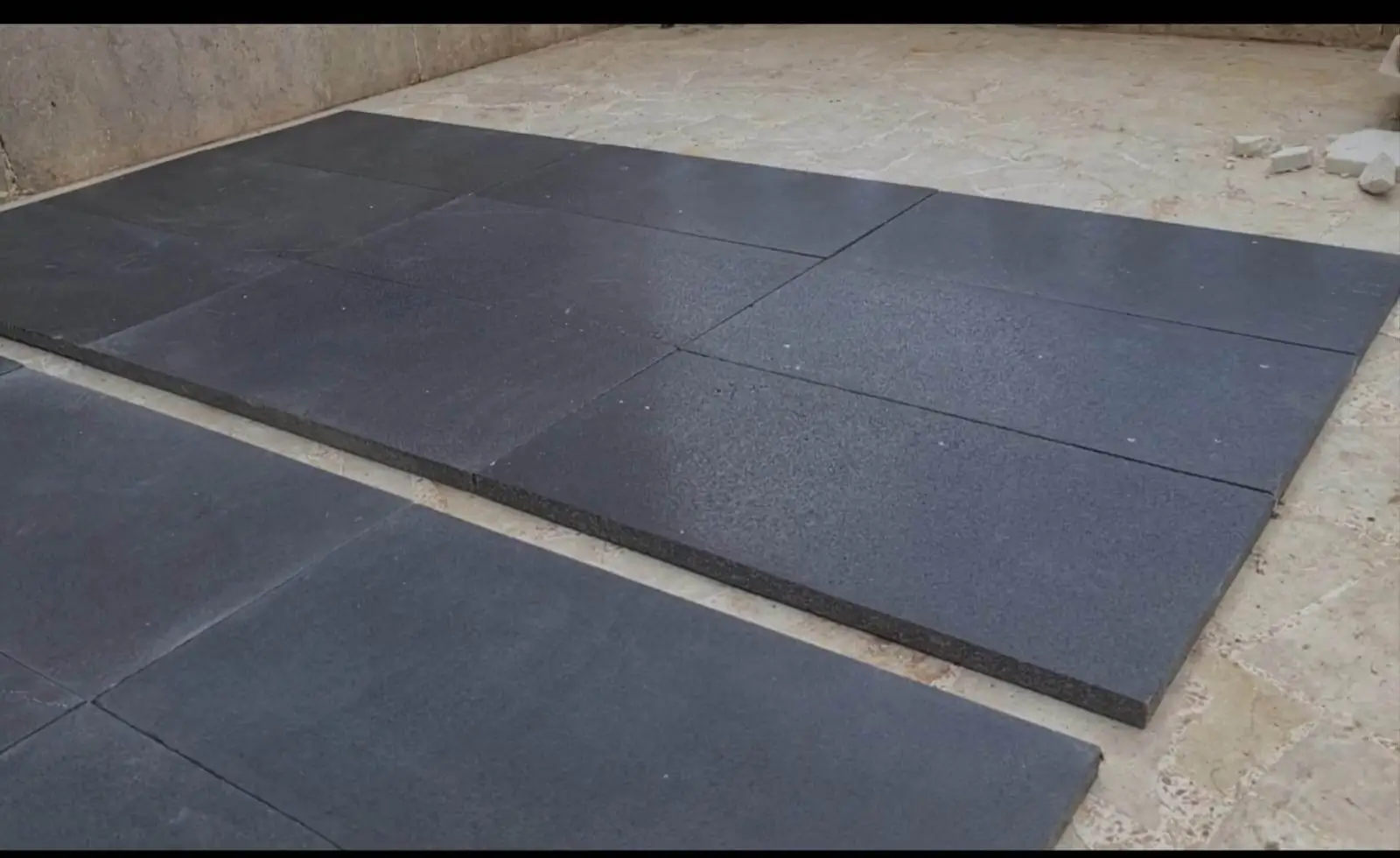
Coordinating black limestone paving in Arizona delivery around your installation window requires more lead time planning than most residential projects allow for. Truck delivery scheduling in summer months across the Valley often faces 1–2 week delays as demand peaks between March and May when contractors are racing to finish before the extreme heat window. Your best strategy is to order material with warehouse confirmation in hand before your installation crew is committed to start dates — avoid the situation where your crew is mobilized and your material is still en route.
Projects in Surprise on the northwest end of the Valley face slightly longer truck transit times from central distribution points, which can add a day or two to delivery windows compared to more centrally located sites. Factor that into your scheduling if you’re working the northwest corridor. At Citadel Stone, we recommend confirming material availability and reserving your allocation at least three to four weeks before your target installation date for any project exceeding 500 square feet — it protects your timeline and ensures you’re getting matched lot numbers across your full material order.
- Order with warehouse stock confirmation before committing installation crew start dates
- Matched lot numbers across the full order are essential for consistent color in black limestone — request this explicitly
- Truck delivery scheduling should account for 1–2 week peak season delays between March and May
- Allow 72 hours of acclimation time for material delivered in summer heat before beginning installation
- Northwest Valley projects may require additional truck transit time — confirm with your supplier at time of order
Spec Wrap-Up
Black limestone heat absorption Gilbert specifications come down to designing for the thermal reality of the low desert rather than fighting it. You’re working with a material that absorbs aggressively, stores efficiently, and releases on a schedule that can either complement or conflict with how the space gets used — and the specification decisions you make around thickness, finish, sealer type, shade integration, and joint spacing are what determine which outcome you get. The material itself performs reliably when you give it the right system around it.
For projects that combine outdoor paving with water features, our technical team advises reviewing how adjacent installations perform in similar conditions. As you finalize your Gilbert project scope, complementary applications are worth understanding — Black Limestone Paving Pool Surrounds for Chandler Luxury Homes explores how the same material performs in a pool surround context, where heat management and wet-surface safety specifications intersect. We define quality in natural black limestone paving in Arizona.