
Your limestone inspection checklist Gilbert process needs to start before a single slab leaves the warehouse — because surface defects, dimensional variance, and density inconsistencies are far easier to catch at the point of selection than after delivery. A thorough slab evaluation in Gilbert’s desert climate matters more than most buyers expect: the combination of intense UV, alkaline soils, and thermal cycling exposes any material weakness within the first two seasons. Understanding what to look for — and in what order — separates a 25-year installation from a frustrating replacement cycle.
Why Gilbert Conditions Demand Rigorous Slab Evaluation
The Sonoran Desert environment surrounding Gilbert isn’t just hot — it cycles between extreme daytime highs and surprisingly cool nights, sometimes spanning 40°F in a single day. That thermal swing forces every material joint, pore, and surface coating to contract and expand on a daily basis. Limestone that tests poorly under a basic scratch test at a showroom will fracture at those joint interfaces within two years under Gilbert conditions.
Arizona purchase verification for limestone isn’t a bureaucratic step — it’s a performance filter. You’re screening for material that can survive not just the heat load, but the alkaline caliche soils that underlie most Gilbert residential and commercial properties. Those soils introduce salt migration that attacks poorly sealed, high-porosity slabs from below, causing spalling that looks like surface weathering but originates at the base. Your inspection checklist needs to address both surface and structural characteristics to catch this risk early.
Visual Surface Inspection: What to Look for First
Start every slab evaluation under natural light, not warehouse fluorescents. Artificial lighting flattens surface relief and conceals hairline fractures that show clearly in raking sunlight. Tilt each slab at a 30–45-degree angle to the light source and scan systematically from edge to center.
- Check for bedding plane cracks running parallel to the slab face — these indicate the stone was cut too close to a natural cleavage plane and will delaminate under load
- Look for iron oxide staining concentrated in veins or clusters, which signals high ferrous mineral content that will oxidize and bleed through sealers in high-moisture environments
- Assess surface texture consistency — patches of unusually smooth or polished-looking areas within a honed or tumbled finish indicate differential hardness zones that will wear unevenly
- Examine edges for micro-chipping patterns — uniform edge integrity indicates consistent compressive strength throughout the slab, while irregular chipping suggests density variation
- Identify any fill repairs — legitimate factory fills use color-matched epoxy and are acceptable for minor voids, but fills covering cracks longer than 3 inches are a disqualifying defect
The slab inspection points that matter most in this visual pass are the ones most buyers skip: the back face of the stone. Flip every slab you’re considering. Bedding plane inconsistencies, moisture staining from improper storage, and drill-hole damage from quarry extraction all show on the back face first. Slabs stored flat on wet ground in a poorly ventilated warehouse will show white efflorescence bloom on the back face even before it appears on the front.
Dimensional Verification and Thickness Tolerance
Dimensional variance in natural limestone is expected — the question is whether it falls within an acceptable tolerance range for your application. For field-cut installations in Gilbert, a thickness tolerance of ±1/8 inch across a nominal 2-inch slab is workable. For mortared installations or elevated deck applications, that tolerance tightens to ±3/32 inch because the mortar bed can only compensate for so much variation before you create lippage.
Measure thickness at four points: both short-edge centers and both long-edge centers. Don’t measure corners — corner thickness is affected by edge dressing and gives you misleading data about the body of the slab. Calculate the average and the range. A range greater than 3/16 inch within a single slab indicates a problem with the sawing process at the quarry — the blade was deflecting, meaning the stone’s hardness was inconsistent. Flag the entire batch for closer review, not just the individual slab.
- Nominal 1.25-inch slabs: acceptable thickness range 1.125–1.375 inches
- Nominal 2-inch slabs: acceptable thickness range 1.875–2.125 inches
- Nominal 3-inch slabs: acceptable thickness range 2.875–3.125 inches
- Length and width tolerance: ±1/4 inch for natural cleft, ±1/8 inch for gauged or calibrated
- Warpage tolerance: no more than 3/16 inch bow across a 24-inch slab measured diagonally corner to corner
Porosity and Absorption Testing On-Site
A simple water drop test gives you actionable porosity data during a slab inspection without any laboratory equipment — results arrive within 30 seconds. Place a 10mm water droplet on the surface of an unsealed slab and start a timer. Absorption within 0–5 seconds indicates high porosity (above 8%), which means aggressive sealing schedules and vulnerability to sub-slab salt migration in Gilbert’s alkaline soil profile.
Limestone evaluation criteria Arizona buyers should apply include this absorption rate test as a baseline screen. Absorption at 15–30 seconds indicates medium porosity (4–8%), which is the practical sweet spot for outdoor applications — the stone breathes enough to prevent moisture trapping but doesn’t absorb so rapidly that it requires quarterly sealing maintenance. Absorption beyond 60 seconds signals dense, low-porosity limestone with absorption below 3%, which is excellent for structural applications but may require specialized breathable sealers to prevent moisture trapping in humid microclimates.
For projects in Chandler, where irrigation-heavy landscaping pushes ground moisture levels higher than the surrounding desert average, targeting that medium-porosity range is especially important — high-porosity slabs adjacent to turf areas or drip-irrigated planters will show efflorescence within the first rainy season.
Structural Integrity and Resonance Testing
The tap test is one of the most reliable field methods for detecting internal fractures that visual inspection won’t catch. Strike the center of each slab with a rubber mallet or the handle of a screwdriver — you’re listening for the quality of the resonance. A solid, dense limestone produces a clear, ringing tone that sustains for a second or more. A hollow, dull thud indicates either internal delamination or a significant void, both of which are disqualifying defects for load-bearing applications.
Here’s what most specifiers miss: the tap test needs to cover the entire slab surface in a grid pattern at approximately 6-inch intervals, not just a single strike in the center. Internal fractures are often localized — a slab can resonate clearly at the center and show a hollow response 8 inches from the edge, indicating a fracture plane that runs parallel to one face. That fracture won’t be visible until the slab is installed and load-cycling begins.
- Clear, sustained ring: dense, structurally sound limestone — suitable for all applications
- Slightly dampened tone: minor density variation or surface micro-porosity — acceptable for pedestrian paving, not for vehicular or heavy structural use
- Hollow thud in any location: internal fracture or delamination — reject the slab regardless of price
- Irregular pitch variation across the slab: mixed density zones — flag for quarry batch review
At Citadel Stone, we conduct resonance screening on every pallet of limestone slabs before warehouse release — not as a formality, but because we’ve seen how batch-level density variation from certain quarry runs creates field failures that look like installation errors rather than material defects.
Color Consistency and Batch Matching
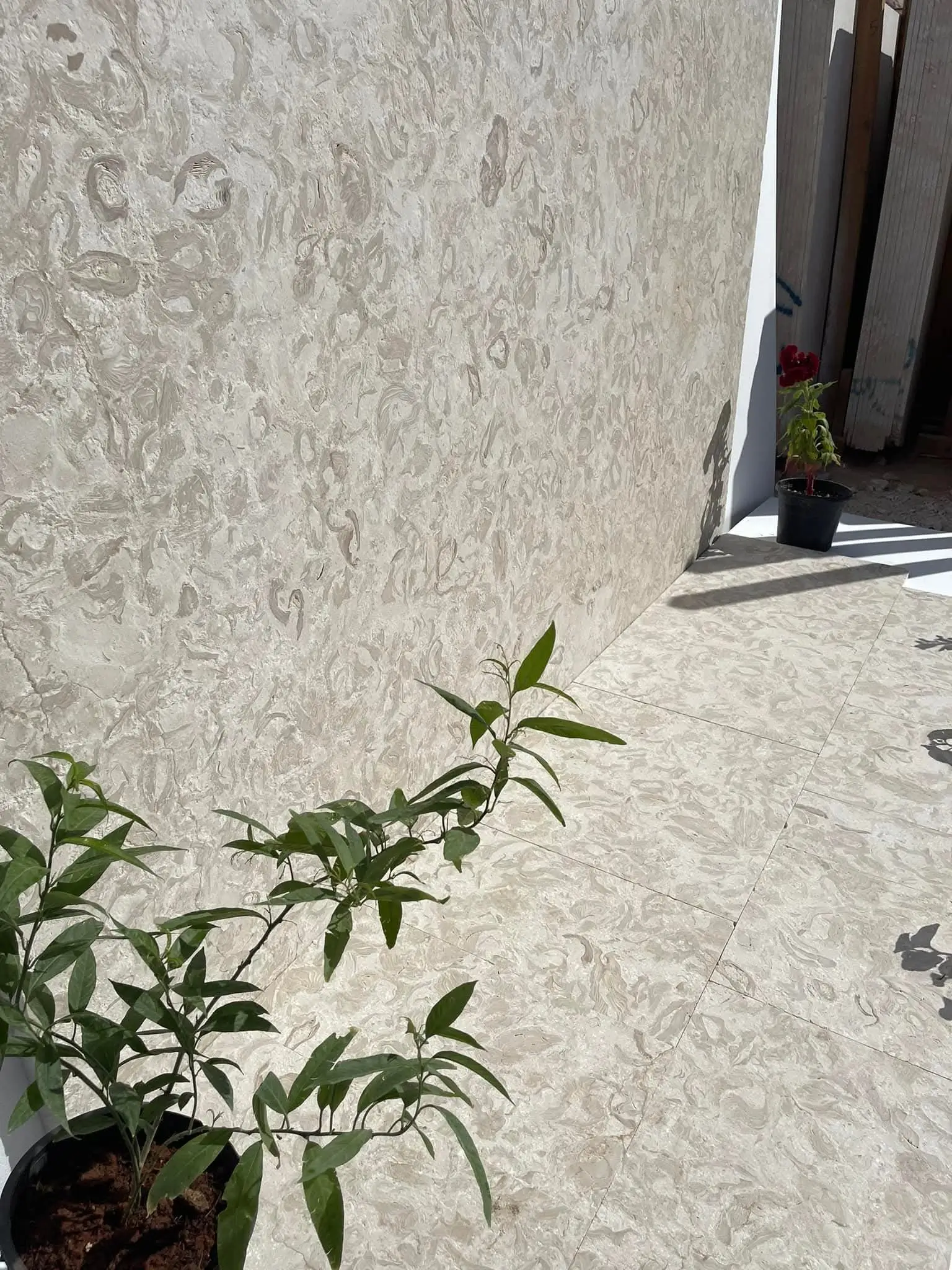
Natural limestone color varies by quarry bed, and that variation is part of the material’s character. The inspection concern isn’t variation itself — it’s whether the variation within your order exceeds the visual range your design intent can accommodate. For large continuous field applications in Gilbert, pull slabs from multiple pallets and arrange them in a mock layout before committing to the order.
Gilbert quality checks for color should include assessment under both direct midday sun and shade conditions. Limestone that reads as uniformly buff in shade can display strong cream-to-gold variation in direct Arizona sun, which may or may not align with your design intent. This isn’t a defect — it’s a characteristic — but it needs to be evaluated as part of your selection process rather than discovered post-installation.
Your limestone inspection checklist Gilbert process should include a batch number verification step: confirm that all slabs in your order originate from the same quarry extraction batch where possible. Mixing batches — even from the same quarry — introduces color temperature shifts that become visible over time as the slabs weather at different rates. For projects where color uniformity is critical, request a certificate of origin that identifies the quarry bed designation and extraction date.
Slip Resistance and Finish Verification
For outdoor applications in Gilbert — pool surrounds, patios, walkways — your slip resistance requirement under ANSI A137.1 is a Dynamic Coefficient of Friction (DCOF) of 0.42 or higher for wet conditions. Most limestone finishes achieve this when properly specified, but the finish type matters significantly. A highly polished limestone that reads 0.65 DCOF dry can drop to 0.38 DCOF wet, falling below the threshold and creating a liability exposure.
Projects in Tempe with commercial or multi-family applications need to pay particular attention to this — local building departments in the East Valley are increasingly requiring DCOF test certificates with permit applications for outdoor stone installations. Your slab inspection points should include a finish verification step that confirms the stated finish matches what was ordered: honed, sandblasted, bush-hammered, and flamed finishes all produce meaningfully different DCOF values even on identical limestone stock.
For Arizona purchase verification in commercial contexts, request the manufacturer’s DCOF test data for the specific finish you’re ordering. Don’t rely on generic product literature — test data must correspond to the specific finish designation and surface texture of the slabs you’re receiving.
Delivery Inspection and Logistics Verification
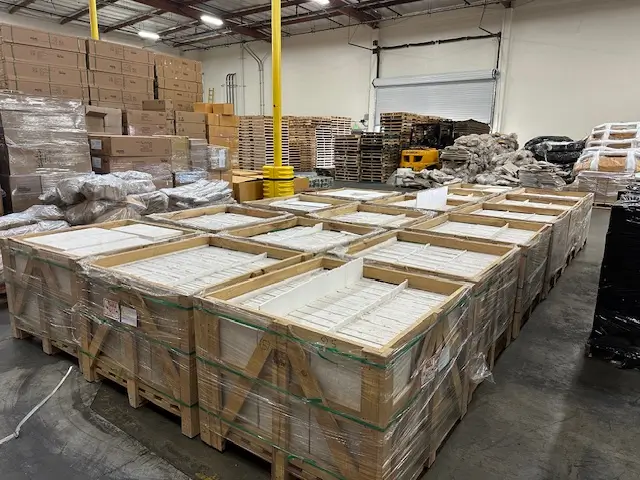
Your slab inspection points don’t end at the yard — delivery condition is part of your quality assurance protocol. Limestone shipped on a truck without proper edge-blocking will develop corner and edge damage during transit that only becomes visible after unpacking. Specify that all slabs be delivered with foam edge protection and that pallets be wrapped with stretch film to prevent lateral movement during transport.
Verify warehouse documentation when your order arrives: the packing slip should match the quarry batch numbers you confirmed at ordering. Discrepancies between ordered and delivered batch numbers are more common than suppliers typically acknowledge — mixing batches during a warehouse pick is an easy logistical error that creates significant field problems. Reject any delivery where batch numbers cannot be confirmed, regardless of how visually similar the material appears.
For orders involving Surprise and the northwest Valley delivery zones, truck scheduling typically runs 2–3 days behind the central Phoenix corridor — factor that lead time buffer into your project schedule. Citadel Stone’s Arizona warehouse stock for limestone slabs generally turns around within 5–7 business days for in-stock material, but confirm available quantities before finalizing your project timeline, particularly for large-format slabs above 24×48 inches. For your reference on consistent supply quality, our coursed limestone block supply page details the inventory depth we maintain for Arizona projects.
Documentation and Acceptance Criteria
A complete limestone inspection checklist Gilbert workflow includes a written acceptance record for every order. Document the following before signing off on any delivery:
- Quarry batch numbers for all pallets received — photograph the pallet labels before unpacking
- Measured thickness range from your four-point sampling of at least 10% of the delivered slabs
- Water absorption test results from a minimum of 5 randomly selected slabs across different pallets
- Resonance test pass/fail ratio — flag any batch where more than 3% of tested slabs produce a hollow response
- Color range documentation — photograph a representative sample array under natural light conditions
- Finish verification confirmation against the specification sheet and purchase order
- Physical count verification against invoice quantities before the truck departs
Slab inspection points captured in your acceptance record become your protection if installation problems develop later. Without this documentation, distinguishing between a material defect and an installation error becomes nearly impossible — and the liability question usually resolves against whoever has the least documentation. Your written acceptance record, with photographs, is a 20-minute investment that protects against months of dispute.
The Bottom Line
A rigorous limestone inspection checklist Gilbert protocol isn’t excessive caution — it’s the baseline quality standard that Gilbert’s climate demands. You’re working in an environment that stress-tests every material decision you make, and the defects you catch during inspection are the ones that won’t become $15,000 remediation problems three years into the installation. Your evaluation criteria should cover visual surface quality, dimensional tolerance, porosity, structural integrity, finish verification, and delivery documentation as a complete system — not as individual checkboxes.
Every step in your limestone evaluation criteria Arizona process should trace back to a specific performance risk in the field. When you understand why each inspection point matters — what failure mode it prevents — the checklist becomes second nature rather than a burden. As you develop your full project procurement process, it’s worth reviewing Limestone Slab Return Policies for Chandler Customer Protection, which addresses the supplier accountability side of the quality assurance equation and covers what recourse you have when material defects are discovered post-delivery. Citadel Stone is dedicated to supplying limestone paving slabs in Arizona that are eco-friendly and sustainable.