
Limestone delivery logistics in Tucson demand a different level of planning than standard urban drop-offs — the combination of desert terrain, unpaved access roads, and site-specific load restrictions creates variables that catch even experienced contractors off guard. Getting material from a warehouse to a remote Tucson site requires you to think several steps ahead, well before the truck ever leaves the yard. The decisions you make around vehicle selection, delivery sequencing, and site preparation directly determine whether your project stays on schedule or loses weeks to access complications.
Why Remote Tucson Sites Change the Delivery Equation
Standard limestone delivery logistics in Tucson work fine for subdivision builds and established neighborhoods — paved streets, turning radius clearance, and predictable drop zones make scheduling straightforward. Remote sites operate under an entirely different set of constraints. Your access road conditions, overhead clearances, and ground bearing capacity all become load-bearing factors in the logistics plan, not afterthoughts.
The Sonoran Desert fringe around Tucson presents specific challenges that you won’t find in other Arizona regions. Caliche hardpan can give you false confidence — it looks firm until a loaded flatbed hits it at the wrong angle, and then you’re looking at a recovery operation that costs more than the stone delivery itself. Before committing to a truck size or delivery window, you need a thorough site assessment that goes beyond a quick visual inspection.
- Measure your narrowest access point and subtract 18 inches on each side for driver clearance and vegetation interference
- Check overhead utility line heights against the loaded truck profile, not just the cab height
- Test road compaction by driving a pickup along the full route — soft spots that sink under 4,000 lbs will absolutely fail under a 40,000-lb loaded delivery truck
- Identify your turnaround zone — flatbed trucks need a minimum 80-foot radius to turn without backing out on public roads
- Confirm gate widths accommodate mirrors and load overhang, not just the truck body
Matching Your Truck to the Terrain
The truck selection decision is where limestone delivery logistics in Tucson either succeed or create expensive problems. A full-size flatbed carrying 20+ tons of limestone paving slabs requires significantly more road infrastructure than most remote desert sites can support. Understanding your options — and their trade-offs — lets you match the vehicle to the reality of your site rather than defaulting to whatever the supplier dispatches.
For sites in Chandler and the broader Phoenix metro, limestone transportation routes are well-established and full-size deliveries are routine. Remote Tucson sites operate differently — the further you are from paved arterials, the more you need to consider smaller, more maneuverable delivery configurations even if that means additional trips and higher per-unit freight costs.
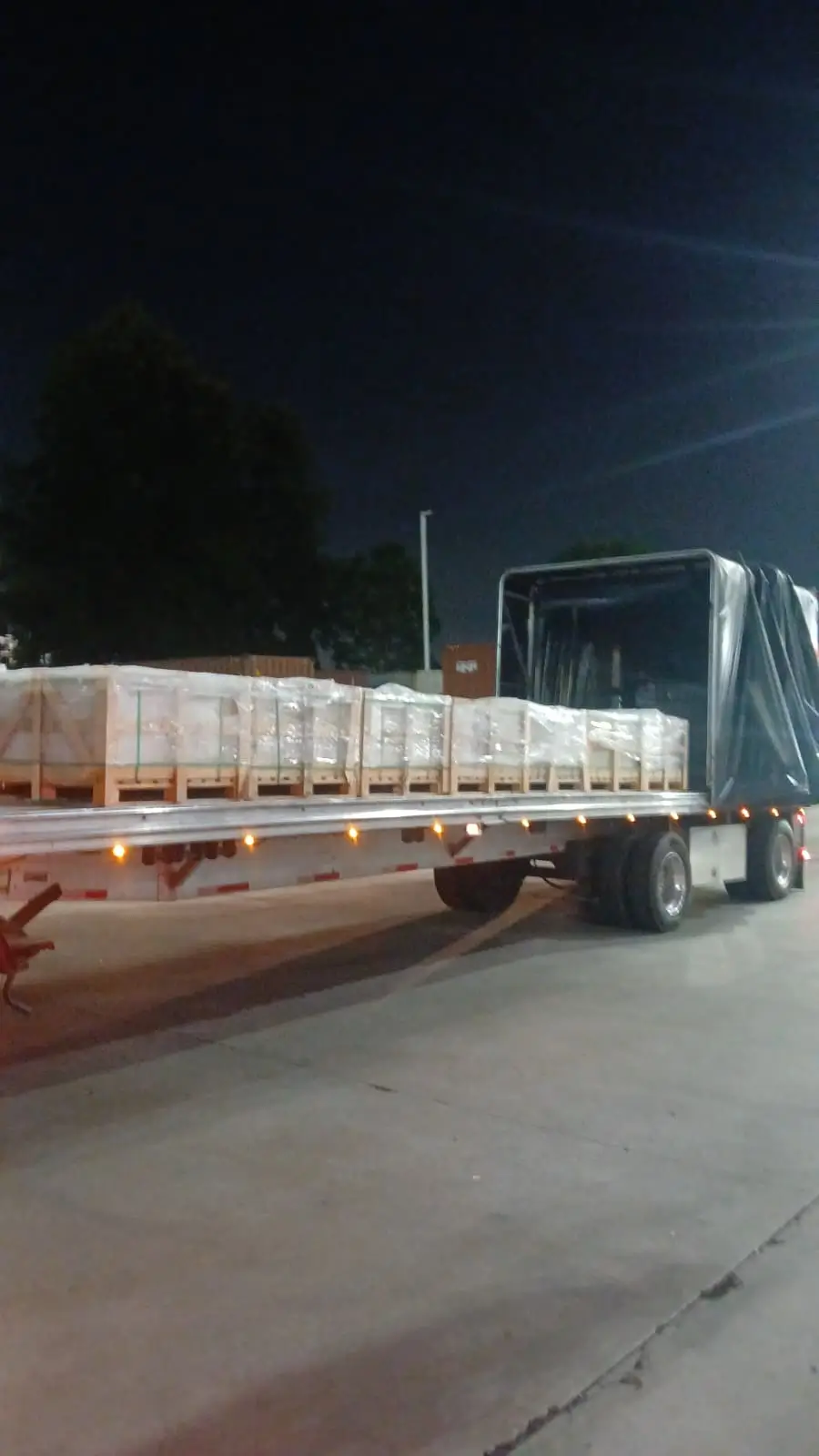
- Full flatbed (48-foot): maximum payload efficiency, but requires paved or heavily compacted access; minimum 14-foot clearance height loaded
- Short flatbed (24-foot): significantly better maneuverability, handles tighter radii, reduced ground pressure per axle
- Boom truck with crane delivery: ideal when you can’t get close to the drop zone; material can be offloaded over obstacles or across soft ground
- Split deliveries across two smaller trucks: higher freight cost but lower per-truck risk on compromised access roads
- Staging at a paved transfer point: truck delivers to a nearby staging area, and you move material to site with your own equipment
Understanding Lead Times for Limestone Shipping in Arizona
Limestone shipping in Arizona involves two distinct timelines that you need to track separately: warehouse availability and transportation scheduling. Confusing these two creates project delays that are entirely avoidable. Material may be in stock at the warehouse today, but if specialized delivery equipment isn’t available for your site type, your actual on-site date could be two to three weeks out regardless of stock levels.
At Citadel Stone, we maintain regional warehouse inventory specifically to reduce the gap between order confirmation and site delivery. Our warehouse operations in Arizona typically allow for 1–2 week lead times on stocked limestone paving slabs, compared to the 6–8 week import cycle you’d face ordering direct from overseas suppliers. That buffer matters enormously when you’re trying to align stone delivery with subcontractor schedules on remote sites where sequencing errors are costly.
The variables that most commonly stretch lead times on remote Tucson deliveries include:
- Specialized truck availability — boom trucks and short flatbeds book out faster than standard equipment
- Permit requirements for oversized loads on certain county roads approaching remote sites
- Monsoon season road softening between July and September that restricts heavy vehicle access
- Material volume — partial pallet orders often wait for consolidation with other deliveries to the same region
Site Preparation That Prevents Delivery Day Disasters
Your delivery window is too valuable to lose because the site wasn’t ready. Proper preparation work, done in the days before the truck arrives, is the single highest-return investment in your limestone delivery logistics in Tucson. The cost of having a driver wait while you scramble to clear an access path or stabilize a soft spot runs anywhere from $150–$350 per hour depending on equipment type — and that’s before factoring in rescheduling fees if the delivery can’t complete.
The drop zone preparation is as important as road access. Limestone paving slabs on pallets typically weigh between 2,200 and 3,000 lbs per pallet, and they need to land on ground that won’t allow the pallet to sink or tilt. A tilted pallet creates a cascade risk — if one shifts, adjacent pallets become unstable. Lay down compacted gravel or plywood sheeting across your drop zone if native soil is loose or sandy.
- Clear access roads of brush, low branches, and debris to the full width the truck will travel
- Mark your preferred drop zone with paint or flagging so the driver has a clear target from the road
- Pre-position a forklift or telehandler if you have one — waiting for equipment to arrive after the truck does wastes delivery time
- Identify a secondary drop zone in case your first choice has unexpected soft spots on delivery day
- Brief your site crew on the unloading sequence so the driver isn’t managing labor coordination on your behalf
For projects incorporating European limestone paving available in Yuma, the same site preparation principles apply — these materials arrive on standard pallets and require the same drop zone stability as domestic limestone products.
Delivery Coordination When Multiple Trades Are on Site
Delivery coordination becomes genuinely complex on remote Tucson sites where multiple subcontractors are operating simultaneously. Your limestone delivery arriving while excavation equipment is blocking the access road, or while concrete trucks are cycling through on a foundation pour, creates conflicts that can push your unloading window by hours. This isn’t a hypothetical — it’s one of the most common causes of delivery surcharges and failed drops on remote projects.
Effective delivery coordination requires a matrix built into your project schedule, not managed informally by phone the morning of delivery. Limestone delivery logistics in Tucson work best when you designate a 4-hour delivery window with clear access exclusivity — meaning no other large vehicles on the access road during that window. Communicate this in writing to every subcontractor involved in the project.
- Schedule stone delivery for early morning arrivals — drivers avoid peak heat, and site access roads haven’t been softened by afternoon temperature swings
- Confirm the delivery date and time in writing with the supplier at least 72 hours in advance, not just verbally
- Assign one person on-site as the delivery coordinator — someone who knows the drop zone, can direct the driver, and has authority to adjust the placement if conditions change
- Have a contact number for the driver, not just the dispatch office, so you can communicate directly if either party is running behind
Arizona Site Access Restrictions You Need to Know
Arizona site access regulations for heavy vehicles aren’t uniform across county lines, and what applies in Pima County may differ from Maricopa or Yavapai requirements. You’re responsible for knowing the restrictions that apply to your specific delivery route — the supplier delivers to your property line, but the road compliance between the nearest paved arterial and your site is entirely your problem if something goes wrong.
Projects in Tempe and established municipalities operate under well-documented permit systems for oversized deliveries. Remote Tucson sites often involve county-maintained or private roads where posted weight limits are lower than you’d expect — sometimes as low as 10 tons on unimproved county roads that look capable of handling much more. A fully loaded flatbed carrying limestone paving slabs can exceed 40 tons gross vehicle weight, which means you may be looking at overweight permits even on roads that appear entirely accessible.
Key access considerations that affect your limestone delivery logistics in Tucson:
- Posted weight limits on county roads between the paved highway and your site — verify with Pima County Public Works before scheduling
- Seasonal road restrictions that may be activated during monsoon season or after significant rainfall events
- HOA or community restrictions on delivery truck access hours in gated or semi-rural communities
- Bridge or culvert ratings on access roads — these are frequently the limiting factor on remote properties with seasonal washes
Managing Partial Deliveries and Staging Strategies
Staging limestone deliveries across multiple smaller truck runs is often the right call for remote Tucson sites, even when it costs more per ton. The math changes significantly when you factor in the risk of a stuck or damaged truck, failed delivery, and rescheduling costs. Tucson stone transportation costs on smaller vehicles may run 15–25% higher per ton, but that premium is a reasonable insurance policy against the downside scenarios that make remote delivery so challenging.
Staging at an intermediate point — a paved parking area, a nearby equipment yard, or even a concrete apron at the road entry — lets your full-size truck deliver efficiently while you shuttle material to the final drop zone with smaller equipment. This approach works particularly well when your limestone volume exceeds what a short flatbed can carry in a single run but your access road can’t handle a full 48-foot flatbed.
- Coordinate with the supplier on pallet sequencing — you want the first-use material on top for easy access, not buried under pallets you won’t open for weeks
- Cover staged material with UV-resistant tarps immediately — limestone paving slabs left exposed in Tucson summer heat can develop surface staining from dust and organic debris
- Mark staged material clearly so it isn’t confused with spoils or other material piles on active job sites
- Confirm insurance coverage for material staged at a location other than your final installation site
Handling and Storage of Limestone Paving Slabs on Remote Sites
Limestone paving slabs in Arizona face a specific post-delivery hazard that doesn’t get enough attention: thermal shock from temperature differentials between stored pallets and the installation environment. Material that’s been sitting in a shaded staging area and then gets installed directly onto a substrate that’s been baking in Tucson sun for six hours can develop micro-cracking at the bond interface. This isn’t a theoretical concern — it shows up as premature joint failure and grout cracking within the first two seasons.
Proper material handling between delivery and installation matters as much as the logistics that got it there. For limestone paving slabs destined for Surprise and similar desert projects, the handling and acclimatization protocol is the same regardless of how straightforward or complex the delivery route was.
- Allow palletized limestone to acclimate to site ambient temperature for at least 24 hours before installation begins
- Store pallets on level, stable ground with good drainage — do not allow pallets to sit in areas where water pools after irrigation or rain
- Inspect each pallet for shipping damage before the truck leaves — edge chipping and corner breaks that occur in transit are a supplier liability, not yours, but only if documented at delivery
- Do not stack pallets more than one high unless the supplier has specifically confirmed the pallet design allows for stacking
- Keep forklift tines below the center of gravity when moving pallets — overbalanced loads that tip during handling damage material in ways that aren’t always visible until installation
Before You Specify
The most effective limestone delivery logistics in Tucson start at the specification stage, not the scheduling stage. By the time you’re booking trucks and confirming delivery windows, the critical decisions that shape your logistics complexity — material volume, pallet configuration, delivery timing relative to other trades — should already be locked into your project plan. Retrofitting a logistics strategy onto a specification that was written without site access in mind is where most remote-site delivery problems originate.
Your specification should include explicit delivery requirements: access road minimum width, maximum vehicle length, required delivery equipment type, and acceptable delivery window hours. These parameters belong in the spec alongside material thickness, finish, and joint width — they’re equally consequential for project success. At Citadel Stone, our technical team regularly assists specifiers in building these delivery parameters into project documents before the order is placed, which eliminates the last-minute scramble that costs time and money on remote Tucson sites.
As you finalize your Arizona stone project planning, related material decisions can inform your overall approach. Limestone Paving Sample Selection for Prescott Homeowners explores how Citadel Stone materials perform across different Arizona site conditions — useful context as you confirm specifications for projects where limestone shipping in Arizona and on-site handling protocols intersect. We differentiate ourselves as a limestone paver supplier in Arizona by offering custom fabrication services.