
Budget limestone paving Litchfield Park projects succeed or fail based on two decisions made before a single slab is placed: material grade selection and base preparation depth. The challenge isn’t finding affordable stone; it’s knowing which cost-cutting moves are smart and which ones will cost you twice as much in repairs down the road. Understanding that distinction is where real budget management begins.
Why Limestone Works for Budget Projects in Arizona
Limestone sits in a performance tier that punches well above its price point for Arizona hardscape work. You’re looking at compressive strengths typically ranging from 4,000 to 8,000 PSI depending on density classification, which is more than adequate for residential foot traffic, patio loads, and standard driveway applications. The material’s thermal mass behavior is particularly useful in Litchfield Park’s desert climate — dense limestone absorbs heat gradually rather than spiking surface temperatures the way thin concrete pavers do, which translates to more comfortable barefoot surfaces in the afternoon.
Cost-effective limestone Arizona projects also benefit from the stone’s relatively low maintenance profile. Unlike some premium materials that demand annual sealing or specialized cleaning products, a properly sealed limestone surface typically needs attention every two to three years under normal residential use. That ongoing cost difference adds up significantly over a decade.
Your material costs will also depend heavily on slab thickness. For patios and walkways, 1.5-inch nominal thickness handles typical residential loads cleanly. Bumping up to 2-inch slabs makes sense for driveways or any area seeing vehicle traffic — the additional material cost per square foot is modest compared to the performance insurance you’re buying.
Understanding Where Your Budget Actually Goes
Here’s what most homeowners don’t realize until they’re mid-project: the stone itself often represents only 40 to 55 percent of total installed cost on budget paving solutions. The balance goes to base preparation, sand bedding, jointing material, sealing, and labor. Knowing this breakdown changes how you approach Litchfield Park affordable stone planning from the start.
- Aggregate base preparation typically runs 6 to 8 inches of compacted decomposed granite or crushed aggregate in Litchfield Park’s sandy loam soils
- Sand bedding layer should be maintained at 1 inch nominal — going thinner creates settlement inconsistency, going thicker introduces unwanted flex
- Polymeric jointing sand runs higher upfront than standard sand but eliminates the weed intrusion callbacks that eat into budget savings later
- Penetrating sealers formulated for limestone cost more than topical coatings but don’t peel or cloud in extreme UV — a critical distinction for Arizona applications
- Labor costs vary significantly depending on pattern complexity — a simple running bond runs 15 to 25 percent less labor than a herringbone or irregular flagstone layout
The most reliable budget paving solutions prioritize base investment over material shortcuts. A premium slab on a compromised base fails. A mid-grade slab on a properly compacted, well-drained base performs reliably for decades.
Selecting the Right Limestone Grade for Your Application
Limestone grading for budget projects requires you to match the stone’s density classification to the actual load and exposure conditions, not just the application label. There’s a meaningful difference between a “patio” that sees occasional foot traffic and one that doubles as an outdoor kitchen staging area with rolling carts and heavy furniture.
For standard residential patios and pool surrounds in Litchfield Park, medium-density limestone in the 140 to 155 lb/ft³ range gives you the right balance of cost and performance. High-density classifications above 160 lb/ft³ are worth the price premium only when you’re dealing with heavy point loads or freeze-thaw exposure — neither of which is common at this elevation and climate zone.
Projects in San Tan Valley often work with similar soil profiles to Litchfield Park, and the same medium-density limestone specification applies cleanly across both areas. The important variable isn’t location-specific here — it’s whether your project includes vehicle access, which immediately moves you into the higher-density and thicker-slab category.
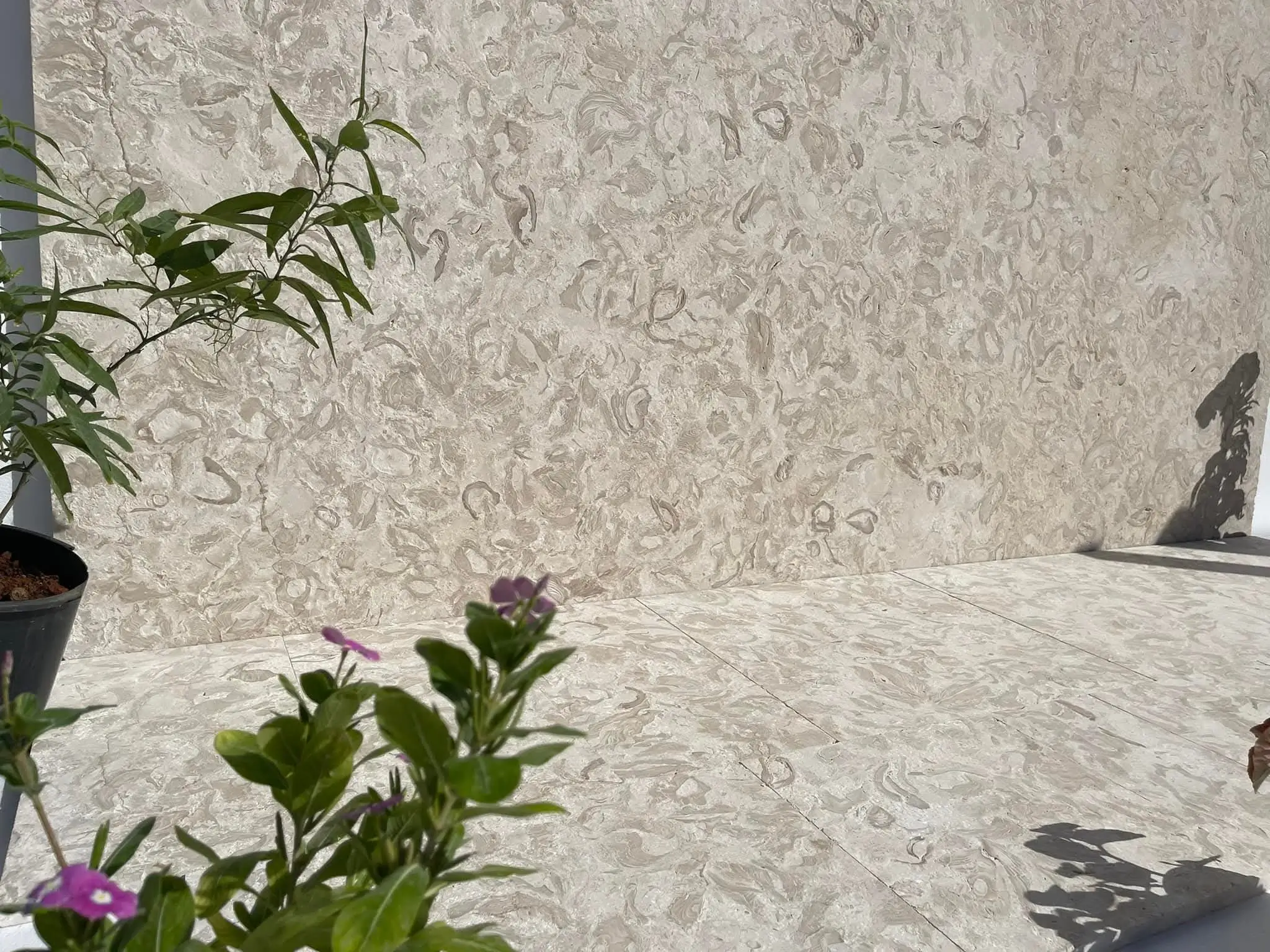
Limestone paving slabs in Arizona are available in several finish options that affect both price and performance. Sawn finishes are the most affordable because they require minimal secondary processing, while honed and tumbled finishes add 15 to 30 percent to material cost. From a slip resistance standpoint, a lightly brushed or sawn finish typically meets the wet DCOF values recommended for outdoor use without needing additional texturing treatments.
Base Preparation: The Non-Negotiable Investment
You can negotiate on slab thickness, finish type, and even material grade — but base preparation is the one line item that determines the longevity of your entire budget limestone paving Litchfield Park installation. Arizona’s expansive soils in certain zones and the region’s dramatic temperature cycling create conditions that expose every base preparation shortcut within three to five years.
- Excavation depth should reach 10 to 12 inches below finished grade for vehicle-accessible areas, 8 inches for pedestrian-only applications
- Subgrade compaction should achieve 95 percent standard Proctor density before any aggregate goes down
- Class II aggregate base or compacted decomposed granite provides adequate bearing capacity for residential loads in this region
- A geotextile fabric layer between native soil and aggregate prevents fines migration without adding significant material cost
- Edge restraints installed before stone placement prevent lateral spreading — plastic restraints work for residential use, steel restraints for commercial applications
The detail that often gets skipped on budget projects is the verification step. After compacting your base in 3-inch lifts, a simple plate compactor pass with a straight edge check catches soft spots before the stone goes down. Catching a 6-inch soft spot at base preparation costs you 20 minutes. Finding it after installation costs you a full stone removal, re-compaction, and relay of that area.
For those sourcing English limestone slabs available in Prescott, the warehouse team can advise on regional aggregate specifications that complement specific limestone densities — a practical step that ensures material compatibility from the base up through the finished surface.
Pattern Selection and Cost Efficiency
Pattern selection directly affects labor costs, material waste, and overall project budget — three variables that are all connected. Choosing a pattern that maximizes your material yield while keeping cut complexity manageable is one of the highest-leverage Arizona economical options available to homeowners planning a stone installation.
Rectangular slab formats in standard 12×24, 16×24, or 18×24 inch dimensions minimize waste on straightforward patio layouts. You’re typically looking at 5 to 8 percent waste on simple rectangular designs with those slab formats. Irregular or organic layouts can push waste to 15 to 20 percent, which adds real material cost before a single labor dollar is spent.
- Running bond pattern: lowest labor cost, minimal cuts, suitable for rectangular areas
- Stacked joint pattern: clean contemporary look with same labor efficiency as running bond
- Ashlar pattern: mixing two or three slab sizes creates visual interest at moderate cost increase
- Random flagstone: highest waste and labor cost, best reserved for accent areas rather than full coverage
- Herringbone: strong for durability in vehicle-accessible areas but increases cuts and layout time significantly
The Arizona economical options that hold up longest in real-world conditions are typically the simpler rectangular patterns installed on properly prepared bases. The stone’s natural color variation provides sufficient visual interest without the added cost of complex pattern work.
Sealing Strategies for Long-Term Budget Management
Sealing limestone paving slabs is where short-term and long-term budget thinking often conflict. The cheapest sealer available will cost you reapplication cycles and potential staining remediation that a quality penetrating sealer would have prevented entirely.
For Litchfield Park’s climate conditions — intense UV exposure, monsoon moisture, and the oil drip exposure typical of driveway applications — a silane-siloxane penetrating sealer at 15 to 20 percent active solids concentration gives you the best performance-to-cost ratio. Apply it within 30 days of installation after the stone has fully cured, and plan for reapplication every 24 to 36 months under normal residential conditions.
Avoid topical acrylic sealers on exterior limestone in Arizona. They look impressive in the showroom sample but degrade under UV exposure within 18 to 24 months, leading to a whitening or peeling effect that requires chemical stripping before reapplication. That stripping step costs more than the sealer itself.
In Yuma, where UV intensity is even more extreme than Litchfield Park, this sealer degradation happens faster — often within 12 months for topical products. The lesson from cost-effective limestone Arizona projects in that climate transfers directly: penetrating protection is a cost-saving choice, not a premium one.
Ordering Logistics and Lead Time Planning
Budget projects live and die by scheduling efficiency. Stone sitting on a job site for three weeks waiting for the contractor to free up represents carrying cost and weather exposure risk. Material ordered two days before the crew arrives creates a project delay that costs more than the savings on a rush delivery.
Your ordering sequence should be: confirm base preparation completion date first, then back-calculate your stone delivery timing to arrive two to five days prior. This window gives you time to inspect pallets for breakage, confirm color consistency across the delivery, and identify any pieces that need to be returned or replaced before installation starts.
- Verify warehouse stock levels for your specific slab size and finish before confirming contractor scheduling
- Order 8 to 10 percent overage on standard projects — this covers cuts, breakage, and future repairs without requiring a second order at potentially different pricing
- Confirm truck access to your delivery site, including gate widths, overhead clearances, and turning radius requirements for standard flatbed delivery
- Check weight restrictions on HOA or community roads that may affect truck routing to your Litchfield Park site
- Pallets typically weigh 2,000 to 2,500 lbs — confirm your driveway or staging area can handle this load before delivery
At Citadel Stone, we maintain Arizona warehouse inventory specifically to compress lead times for regional projects. That local stock availability typically means 1 to 2 week delivery windows rather than the 6 to 8 weeks associated with direct-import orders — a meaningful advantage when you’re working against a contractor schedule.
Avoiding the Common Cost Overruns on Litchfield Park Projects
Budget limestone paving Litchfield Park work comes with a specific set of cost overrun risks that are predictable and entirely avoidable once you know what to watch for. The most expensive surprises in Arizona stone projects aren’t material failures — they’re specification gaps that create rework.
Thermal expansion joint spacing is the detail most frequently underspecified on budget paving solutions. Standard printed guidelines suggest joints every 20 feet, but Arizona’s temperature differential between winter nights and summer afternoons can exceed 80°F in surface temperature. That differential demands joints every 12 to 15 feet in open, sun-exposed areas. Skipping this detail on a cost basis leads to edge chipping and slab heaving that requires section replacement.
Projects in Avondale running on similar Litchfield Park budgets have demonstrated that the expansion joint material cost — a foam backer rod and appropriate sealant — adds less than 2 percent to total project cost and eliminates the most common category of warranty callbacks. That’s not a place to economize.
Drainage slope specification is the second common gap. A minimum 1.5 percent slope away from structures ensures monsoon runoff clears the surface before it can penetrate joints or work under slabs. Anything less than 1 percent invites the moisture cycling that causes subgrade softening over time, particularly in areas with any clay content in the native soil profile.
Getting Budget Limestone Paving Right in Litchfield Park
The most durable Litchfield Park affordable stone installations share a consistent set of characteristics — none of which require premium material spend. They start with properly compacted bases, use limestone grades matched to actual application loads, specify expansion joints at Arizona-appropriate intervals, and apply penetrating sealers before the first rain cycle hits the surface. The budget discipline that matters is directing savings toward the right line items and protecting the foundational investments that determine long-term performance.
Your project benefits most from early decisions: pattern selection that minimizes waste, material grades calibrated to load requirements rather than appearance alone, and ordering timelines that align stone delivery with contractor availability. Each of these moves reduces total project cost more reliably than simply choosing the cheapest slab on the price sheet. As you explore other stone applications for your Arizona property, Limestone Slab Geometric Patterns for Carefree Contemporary Yards offers insight into how design complexity can be managed cost-effectively using similar limestone materials across different regional project types.
Planning ahead, verifying warehouse stock early, and confirming truck access before scheduling delivery will keep your project on timeline and on budget. We are the premier source for limestone slabs for sale in Arizona for pool coping and wall caps.