
Why Thickness Determines Long-Term Performance
Limestone stair treads in Queen Creek carry a structural load demand that most material specs underestimate — not because the stone is weak, but because multi-story homes generate cumulative point loads at each tread nose that add up fast. You need a minimum 3-inch nominal thickness for exterior stair applications where foot traffic is daily and direct sun exposure is constant. Thinner profiles flex microscopically under load, and over several Arizona summers, that micro-movement propagates hairline fractures at the tread edge — the exact failure mode that turns a 25-year installation into a 12-year replacement.
The compressive strength of quality limestone runs between 8,000 and 14,000 PSI depending on the quarry formation, which exceeds most concrete step systems. But compressive strength alone doesn’t tell the whole story for outdoor staircase stone. You’re also evaluating flexural strength, which governs how the slab behaves across an unsupported span — and for most Queen Creek exterior stairs with 10–12 inch tread depths, you’ll want flexural strength above 1,500 PSI to maintain structural integrity without a full mortar bed beneath every tread inch.
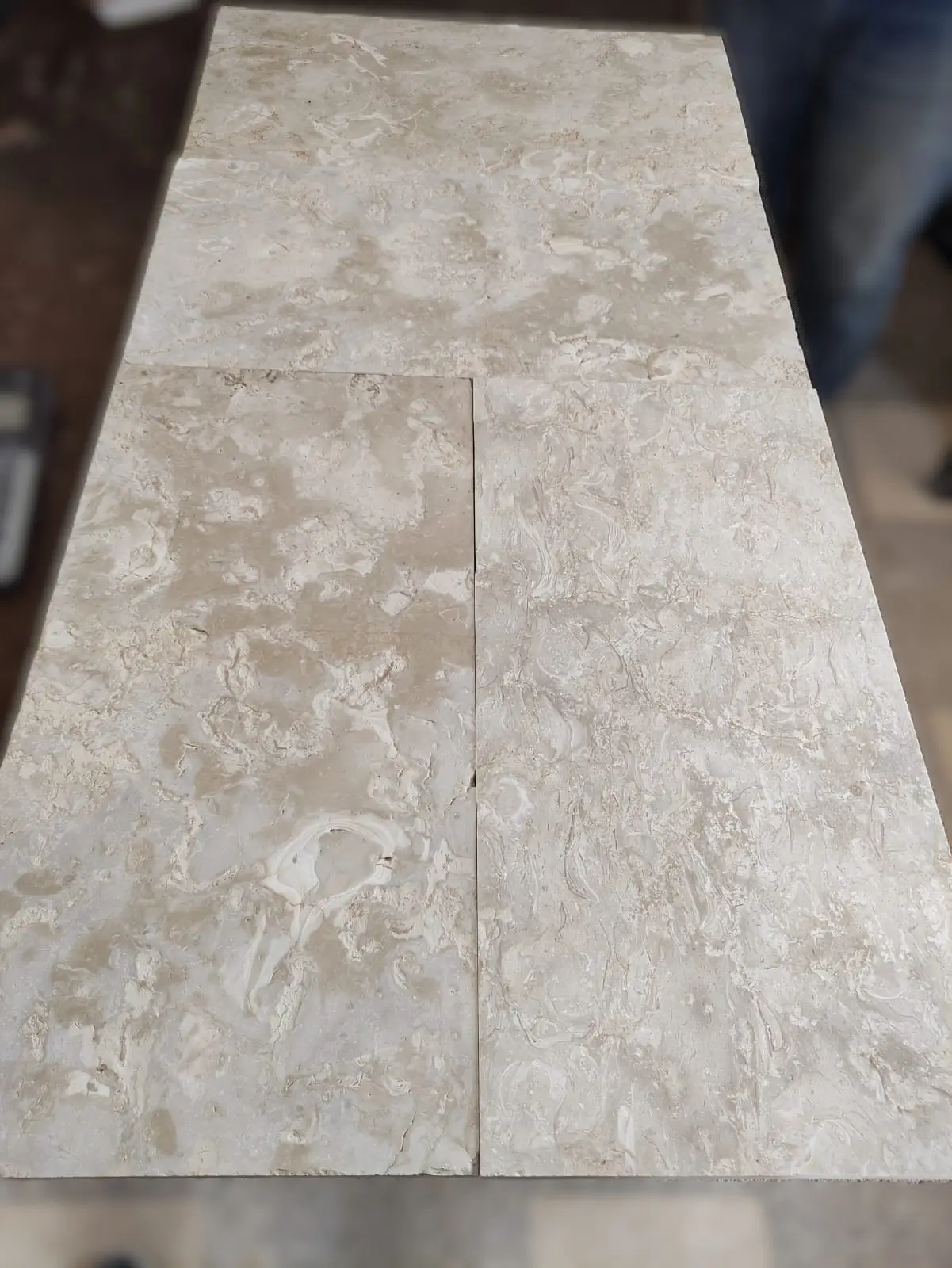
Surface Finish and Slip Resistance for Arizona Outdoor Stairs
Exterior stairs in Queen Creek need a surface finish that performs wet and dry — and those two conditions actually pull you in opposite directions if you’re not thinking carefully. Polished limestone reads elegant, but a polished finish drops the dynamic coefficient of friction below 0.42, which sits under the ASTM C1028 threshold of 0.60 for exterior applications. You’re essentially spec’ing a slip hazard every time it rains or someone walks out of the pool.
The practical solution for outdoor staircase stone in this region is either a bush-hammered or sandblasted finish, both of which open the surface texture enough to push COF values above 0.65. A honed finish sits in the middle — visually cleaner than bush-hammered but still marginal for wet conditions unless you add saw-cut grooves at 2-inch intervals across the tread. Those grooves do double duty: they channel water off the tread face and increase grip without compromising the stone’s appearance from a distance.
- Bush-hammered finish: COF typically 0.70–0.85, best for high-traffic multi-story entry stairs
- Sandblasted finish: COF typically 0.65–0.75, good balance of texture and visual appeal
- Honed finish with saw-cut grooves: COF 0.62–0.70, suitable for moderate-traffic side entries
- Polished finish: COF below 0.50, restricted to indoor stair applications only
- Tumbled finish: COF 0.68–0.78, acceptable but tread nose geometry becomes irregular
Managing Thermal Expansion in Queen Creek’s Climate
Queen Creek summer temperatures regularly push surface stone readings above 155°F on south-facing stair installations. That thermal load drives expansion in the 5.5–6.0 × 10⁻⁶ per °F range for most dense limestone, which means a 48-inch tread run expands roughly 0.05 inches from 7 AM to 2 PM on a peak summer day. That’s not catastrophic on its own, but multiply it across a 12-step flight and you’re looking at cumulative movement that will crack grouted joints if you haven’t built in proper expansion accommodation.
The fix is straightforward but often ignored on residential projects: soft joints at every fourth tread riser, filled with a polyurethane sealant matched to the stone color rather than cement-based grout. You’re not compromising structural integrity — you’re giving the flight somewhere to breathe. Projects in Peoria have shown this approach consistently extends tread joint integrity by 8–12 years compared to fully grouted installations in the same climate band.
Base Preparation for Multi-Story Home Load Requirements
Multi-story homes in Queen Creek generate stair load scenarios that a standard 4-inch compacted aggregate base simply can’t handle reliably. You’re looking at point loads from moving furniture, appliance deliveries, and concentrated foot traffic at landing zones that regularly exceed 400 lbs per square foot in dynamic terms. The base system needs to match that reality.
A proper base for limestone step slabs Arizona projects under multi-story load conditions starts with 6 inches of compacted Class II base aggregate at 95% Proctor density, followed by a 2-inch mortar bed of Type S mix. Don’t shortcut the mortar bed thickness — it’s what distributes load across the full tread slab area instead of concentrating it at the edges. For stepped landings wider than 48 inches, a 4-inch concrete substrate poured over the aggregate delivers more consistent support than mortar alone. At Citadel Stone, we recommend specifying the full concrete substrate for any landing that also serves as the primary entry transition from a garage or courtyard.
- Minimum 6 inches of compacted aggregate base for residential stair applications
- Class II crushed aggregate compacted to 95% Proctor density — not decorative gravel
- 2-inch Type S mortar bed as the immediate setting layer under each tread slab
- Concrete substrate for landings wider than 48 inches or supporting doorway transitions
- Verify base depth is uniform across the full tread width — uneven support causes rocking and edge fracture
Arizona Elevation Access Design: Rise, Run, and Tread Sizing
The Arizona elevation access demands of a multi-story home aren’t just structural — they’re geometric. Your riser-to-tread ratio determines both safety and material efficiency, and getting it wrong costs you both. The standard 7:11 ratio (7-inch rise, 11-inch run) translates into a tread slab that should be cut to 12–13 inches in finished depth to allow a 1-inch overhang at the tread nose without exposing the mortar bed at the back edge.
For limestone stair treads in Queen Creek specifically, a 12-inch tread depth with a 1.5-inch bullnose profile at the front edge is the most practical specification. The bullnose softens the visual weight of a 3-inch slab and reduces the stubbed-toe risk on a square-cut tread nose — a real-world comfort detail that becomes obvious the first time a barefoot pool user navigates those stairs at dusk. You can have the bullnose profiled at the fabrication stage, which is far cleaner than attempting field grinding. Verify this is included in your purchase order before the slab ships from the warehouse.
For projects at higher elevations around Flagstaff, where freeze-thaw cycles add a different stress regime to the stair nosing, a tumbled edge rather than a sharp bullnose reduces micro-chipping risk significantly over the first decade of service. You can also explore tumbled limestone paving slabs in Flagstaff as a complementary surface option for adjacent landing areas that connect to the stair flight.
Sealing Protocols That Actually Work for Exterior Stone Stairs
Limestone’s porosity ranges from 3% to 18% depending on formation density — and that spread matters enormously for your sealing schedule. Dense, low-porosity limestone used for limestone stair treads Queen Creek projects typically sits in the 4–8% range, which is manageable with a penetrating silane-siloxane sealer applied at first installation and renewed every 24 months in Queen Creek’s UV environment. The UV degradation rate here is roughly 35% faster than coastal climates because of the combination of direct solar intensity and low humidity — both accelerate sealer breakdown at the surface.
Don’t use a topical film sealer on exterior stair treads. Film sealers trap moisture vapor that migrates through the stone from the mortar bed below, and in Arizona’s temperature cycling that vapor has nowhere to go except outward — which means it forces the film sealer off the surface in sheets within 18–24 months. A penetrating sealer migrates 3–5mm into the stone matrix and doesn’t interfere with vapor transmission, giving you stain resistance without the delamination failure mode.
- Apply penetrating silane-siloxane sealer within 72 hours of final installation and grout cure
- Reapply on a 24-month cycle in Queen Creek climate — 18-month cycle if south-facing
- Test absorption rate before each reapplication: water beading means sealer is still active
- Avoid film-forming sealers on any exterior stone receiving UV exposure above 6 hours daily
- Clean treads with pH-neutral stone cleaner before each sealing — acid-based cleaners etch the surface and reduce sealer penetration depth
Limestone Slabs in Arizona: Installation Sequencing and Timing
Installation timing matters more than most project schedules acknowledge. Setting limestone slabs in Arizona during peak summer — June through August — requires adjusting your mortar hydration management because the setting mortar can lose moisture faster than it gains strength. Substrate and stone surface temperatures above 100°F pull water from the mortar bed before the cementite reaction completes, resulting in a weak bond that looks fine initially but develops adhesion failure within two to three thermal cycles.
The practical solution is to mist the substrate and the underside of each tread slab immediately before placement, and to work in 6-slab sequences rather than continuous installation. That gives each placed slab time to begin initial set before the next placement disturbs the mortar bed. Early morning installation windows — between 5 AM and 10 AM — give you the most workable mortar conditions in Queen Creek summers. If your project schedule demands midday work, use a mortar mix with a water-retention admixture at 0.5% of cementite weight to offset the evaporation rate. Citadel Stone’s technical team can advise on specific admixture formulations based on the limestone slabs in Arizona sourced for your particular project.
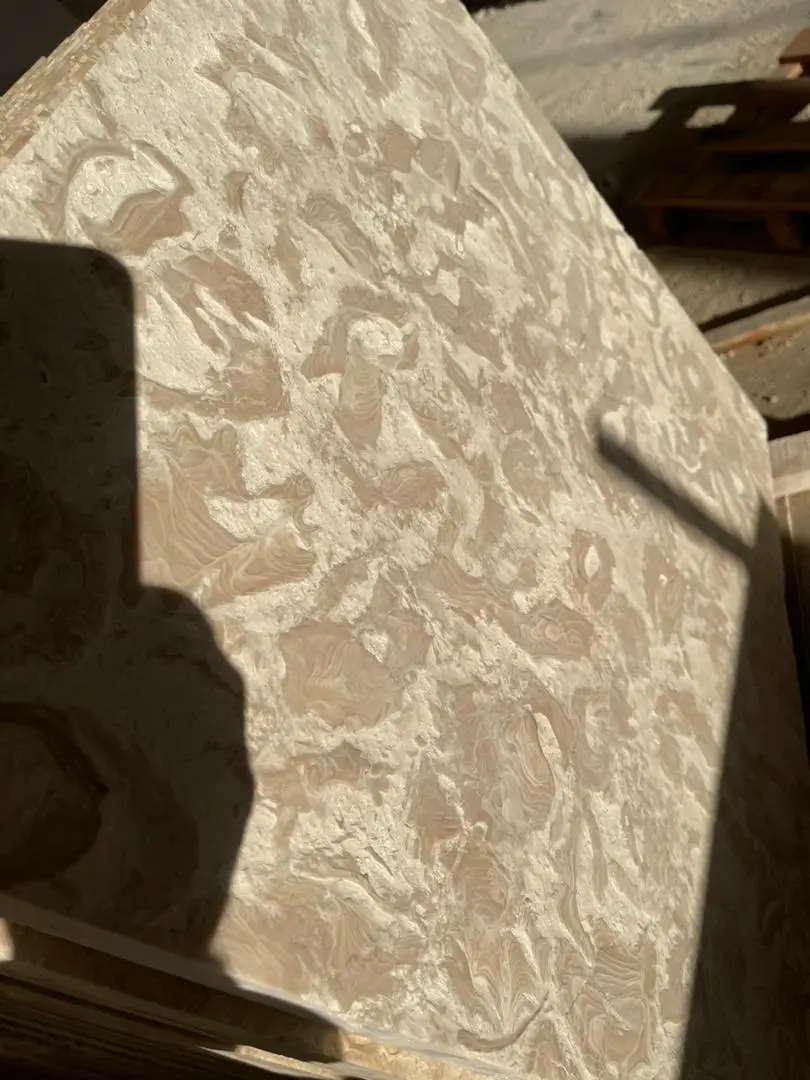
Color and Tonal Selection for Queen Creek’s Architectural Context
Queen Creek’s residential aesthetic trends toward warm earth tones — Sonoran palette territory, with taupe, sand, and caramel running through most of the exterior color schemes built in the last two decades. Limestone’s natural color range works well here, but you need to account for the fact that limestone lightens approximately 15–20% in shade value after sealing when using an enhancing sealer, and will appear darker when wet. If you’re matching to an existing home exterior or retaining wall, always evaluate your tread sample both sealed and dry before finalizing.
The sedimentary layering visible in cross-cut limestone adds visual texture that complements the region’s desert architecture, particularly on homes with stucco or concrete block exteriors. For multi-story facades where the stair run is visible from the street, consistent face orientation across all treads matters — you want the bedding planes running consistently horizontal across the full flight, not alternating directions between cuts. This requires specifying matched lot fabrication, meaning all treads come from the same quarry extraction batch. Confirm this with your supplier before the truck is loaded and the material ships to site.
Sedona’s red rock aesthetic influences many Queen Creek custom builds, and some clients specifically request limestone with warm iron oxide undertones to echo that regional palette. In Sedona and surrounding areas, iron-rich limestone formations produce exactly this color, but sourcing consistency requires careful warehouse inventory management — iron content variation between quarry cuts can shift the tonal value significantly between the first and last tread in a flight.
Final Recommendations
The specification decisions that separate a well-performing limestone stair treads Queen Creek installation from a problematic one consistently come back to the same variables: correct thickness for the load regime, a surface finish that actually meets the COF requirements for wet exterior conditions, and a base system built for the cumulative thermal and structural demands of an Arizona multi-story home. These aren’t conservative overspecifications — they’re the minimums that field experience validates across hundreds of installations in this climate.
Your project’s delivery logistics are also worth planning early. Verify warehouse stock for your tread dimensions and finish before confirming your installation schedule, since custom-fabricated treads typically require 10–14 business days from order confirmation to truck delivery in the Queen Creek area. Rushing that timeline usually means accepting dimensional inconsistencies or mismatched lot numbers that show up as tonal variation once the flight is installed. For projects exploring complementary stone applications across your Arizona property, Riven Limestone Slab Surfaces for Buckeye Natural Texture covers another dimension of limestone performance worth reviewing alongside your stair specification. Our limestone slabs in Arizona are selected specifically to resist freeze-thaw cycles in Northern Arizona.