
Travertine stepping stones in Arizona perform at a fundamentally different level than most homeowners expect — not because the material is exotic, but because its thermal expansion coefficient of roughly 4.7 × 10⁻⁶ per °F places it among the most dimensionally stable natural stones you can specify in a high-heat climate. The catch is that this stability only holds when you pair correct slab thickness with a properly drained aggregate base. Skip either variable and you’re trading a 25-year pathway for a 10-year replacement cycle.
Why Travertine Works in Arizona Heat
The interconnected pore structure that gives travertine its characteristic surface texture also drives its thermal performance in ways that plain concrete simply can’t replicate. Those voids — filling roughly 3–8% of the stone’s volume depending on the cut — act as micro-insulators, slowing heat transfer from the surface to the substrate beneath your feet. In practical terms, surface temperature readings on travertine stepping stones run 15–22°F cooler than adjacent concrete under identical midday sun exposure.
Natural travertine path pavers in Arizona also benefit from the stone’s relatively low thermal mass compared to dense basalt or granite. The surface cools rapidly after sunset, which matters significantly in residential settings where evening foot traffic is heavy eight months of the year. Your bare feet will notice the difference by 7:00 PM, even in July.
- Thermal expansion is low and predictable — expansion joints every 12–15 linear feet prevent buckling in extreme summer heat
- Compressive strength in the 8,000–12,000 PSI range handles normal pedestrian loading without edge chipping
- Natural surface texture provides traction coefficients above 0.6 wet — meeting or exceeding ADA slip-resistance thresholds
- Lighter travertine tones reflect solar radiation more effectively, contributing to cooler microclimate conditions around the path
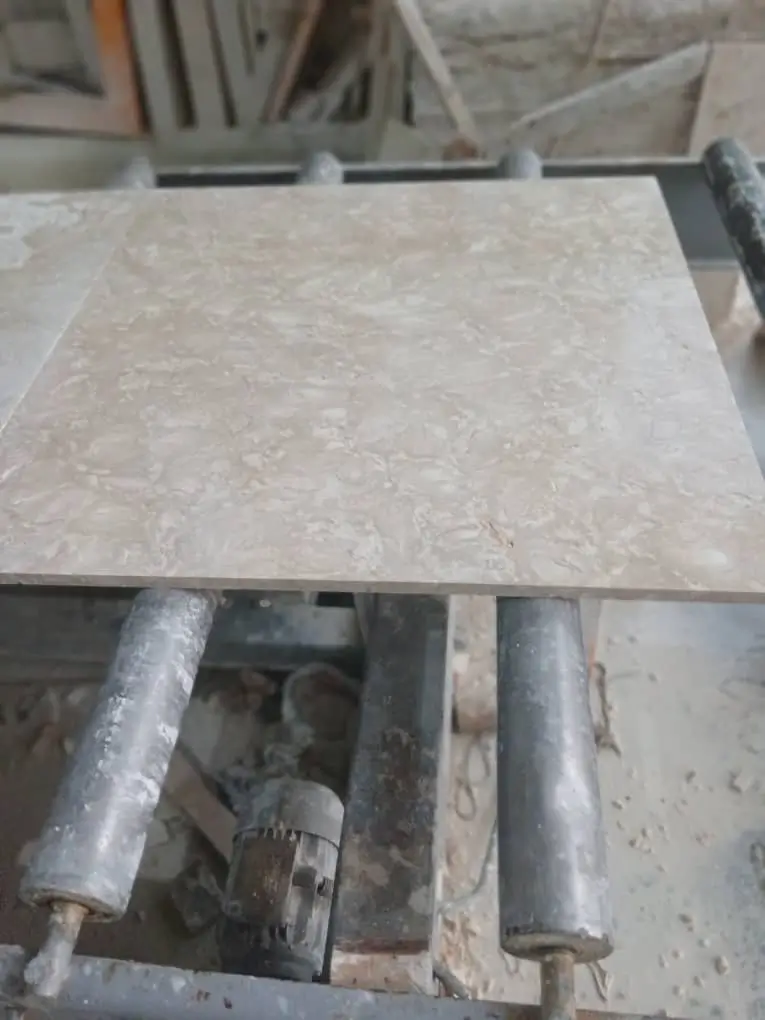
Thickness and Sizing: What the Numbers Actually Mean
Outdoor stepping stone slabs in Arizona spec ranges follow a fairly clear hierarchy based on application type. For a standard residential garden path with compacted decomposed granite base, 1.25-inch nominal thickness handles the load comfortably. Move into a pathway that crosses a driveway apron or sees any wheeled equipment, and you need to jump to 2-inch nominal — the thinner slabs will fracture under point loads that exceed roughly 400 pounds per square foot.
Slab sizing affects more than just aesthetics. Larger format stepping stones — 24×24 or 18×24 — require better base preparation because any differential settlement shows immediately across a single stone. Smaller formats like 12×18 are more forgiving on uneven terrain, but they increase the number of joints, which means more opportunities for weed intrusion and edge displacement over time.
- 1.25-inch thickness: appropriate for pedestrian-only paths with stable compacted base
- 2-inch thickness: required for mixed-use areas, vehicle crossings, or expansive clay soil zones
- Minimum 4-inch compacted aggregate base for residential; 6 inches for any vehicular crossing point
- Joint spacing of 1–2 inches between stepping stones allows for both visual separation and drainage flow
- Oversized formats above 24×24 benefit from a dry-set mortar bed rather than sand-set installation
Base Preparation: The Detail Most Projects Miss
Travertine landscape stepping pavers in Arizona fail almost exclusively for one reason — inadequate base preparation, not material deficiency. The desert Southwest creates a specific challenge because the native soil profile shifts dramatically between cities and even within the same lot. Flagstaff‘s higher elevation brings volcanic cinder and basaltic soils that drain exceptionally well but can shift during freeze-thaw cycles, which means your aggregate base needs to extend at least 6 inches with a compaction target of 95% Proctor density to prevent winter heave.
Desert-rated stepping stone pavers in Arizona should never be set directly on native soil, regardless of how stable that soil appears during the dry season. Arizona soils with any montmorillonite clay content — common across the central valley floor — can swell 3–8% by volume during monsoon season. That movement is enough to tilt a 24×24 slab by half an inch over a single wet season, which creates a trip hazard and accelerates edge cracking.
- Excavate to a minimum of 6 inches below finished grade for residential stepping stone paths
- Use Class II base aggregate (3/4-inch crushed stone or decomposed granite) compacted in 2-inch lifts
- Install a geotextile fabric layer between native soil and aggregate base in clay-heavy soil zones
- Allow 1–2% cross-slope for drainage — flat installations pond water at joint edges and accelerate efflorescence
- Verify compaction with a plate compactor, not just hand tamping — especially critical on paths wider than 24 inches
Color and Finish Selection for Arizona Climates
The finish choice on travertine stepping stones matters as much as thickness when you’re specifying for Arizona conditions. Tumbled travertine — the most popular residential finish — provides naturally rounded edges that resist chipping and a surface texture that maintains grip even when dusty. The tradeoff is that the tumbled surface accumulates fine desert dust more readily than a honed or brushed finish, which may require quarterly cleaning in areas with high wind exposure.
Color selection follows a practical logic in high-sun environments. Ivory and Noce tones in the lighter range reflect significantly more solar energy than darker walnut or gold varieties, keeping your surface temperatures lower and reducing the thermal stress on the stone itself. For projects in Yuma — where summer ground surface temperatures routinely exceed 160°F on dark materials — selecting a lighter travertine finish isn’t just aesthetic preference, it’s a performance specification that affects long-term joint stability.
- Tumbled finish: best grip retention, most forgiving on uneven bases, highest dust accumulation
- Brushed finish: good texture, easier to clean, maintains sharp edge detail longer than tumbled
- Honed finish: smooth surface, requires sealed maintenance every 18–24 months to prevent moisture absorption
- Ivory and Classic tones: surface temps run 12–18°F cooler than walnut or gold tones under direct exposure
- Avoid polished finishes entirely for exterior stepping stone applications — wet-weather traction drops below safe thresholds
Sealing Protocols for Desert Conditions
Outdoor stepping stone slabs in Arizona require a sealing approach calibrated to UV intensity rather than moisture exposure — the inverse of what most sealing guides written for humid climates recommend. Arizona’s UV index regularly hits 11+ from May through September, and unprotected travertine experiences accelerated color fade and surface pitting under that kind of radiation load. A penetrating silane-siloxane sealer applied at 200–250 square feet per gallon provides the right balance of UV protection without trapping vapor in the stone matrix.
The sealing schedule that works in Phoenix doesn’t automatically translate to higher elevation projects. In Sedona, the combination of UV intensity and occasional winter freeze events means you should target a sealing interval of every 18 months rather than the 24–36 month cycle appropriate for the low desert. Run a simple water bead test: if water absorbs into the stone surface within 90 seconds rather than beading, your sealer has worn through and it’s time to reapply.
- Apply sealer to clean, dry stone — moisture content above 5% prevents proper penetration
- Allow new travertine installations to cure for 28–30 days before first sealer application
- Two-coat application: first coat penetrates, second coat bonds to the first for enhanced protection
- Silane-siloxane penetrating sealers outperform topical film-forming products in extreme heat environments
- Reapply after any significant pressure washing — the mechanical action strips sealer even from properly cured surfaces
For detailed specification guidance on travertine pavers across Arizona applications, our Arizona travertine path paver research covers performance data across multiple finish types and installation conditions specific to this climate.
Ordering, Lead Times, and Delivery Logistics
Getting travertine paver suppliers in Arizona to deliver on your project timeline requires understanding how natural stone inventory actually moves through the supply chain. Travertine is quarried in Turkey, Italy, and Mexico, then shipped in containers that typically take 6–10 weeks from quarry to domestic port. From there, warehouse processing and distribution adds another 1–2 weeks. Your planning window needs to account for this cycle — specifying travertine two weeks before installation start is a common project management failure that delays completions by months.
At Citadel Stone, we maintain warehouse stock of the most commonly specified Arizona stepping stone sizes and finishes, which compresses that lead time to 1–2 weeks for standard orders. Truck delivery to residential sites does require some advance coordination — confirm your site has 14-foot clearance for the delivery vehicle and a staging area within 50 feet of the installation zone. Splitting a large order across two truck deliveries adds cost but is sometimes unavoidable on tight urban lots.
- Order a minimum 10% overage above your calculated square footage — cutting waste and breakage absorb the difference
- Verify warehouse availability before finalizing your installation contractor’s start date
- Palletized delivery protects corners and edges better than loose-stack loading — confirm this with your supplier at time of order
- Inspect each pallet on delivery before signing — color variation beyond 15% across the batch warrants discussion before installation begins
- Store unopened pallets in shade if your installation is delayed — UV exposure on bundled stone accelerates surface oxidation in the top layer
Installation Mistakes That Cost You Years of Service Life
The most expensive travertine stepping stone installation errors don’t show up on day one — they emerge in the third or fourth monsoon season when edge cracking, settling, and joint displacement become visible. The root cause traces back almost every time to one of three skipped steps: inadequate base compaction, missing edge restraints on the path perimeter, or improper joint treatment.
Edge restraints are particularly underspecified in residential projects. Natural travertine path pavers in Arizona rely on lateral confinement to maintain their position — without a proper plastic or steel edge restraint pinned at 12-inch intervals, the outer stones migrate outward under thermal cycling and foot traffic. You’ll see a gap open up along the edge within two years, and re-leveling the displaced stones requires pulling up and resetting the entire affected section.
- Never skip the edge restraint — budget for it from the start, not as an afterthought
- Use polymeric jointing sand rather than regular mason’s sand — the polymer binders resist erosion during monsoon rain events
- Allow 24–48 hours of cure time for polymeric sand before activating the path to foot traffic
- Check for high or low spots after the first significant rainfall — minor adjustments at week two are far easier than corrections at year two
- Avoid using a gas-powered plate compactor directly on installed travertine — the vibration frequency cracks thinner slabs; use a rubber compaction pad if consolidation is needed
Performance Benchmarks Across Arizona Climate Zones
Travertine landscape stepping pavers in Arizona don’t perform uniformly across the state — elevation and precipitation variance create meaningfully different performance profiles. The low desert corridor from Phoenix to Yuma runs travertine stepping stones hard: consistent 110°F+ air temperatures, UV index above 10 for six months, and near-zero rainfall most of the year. Under those conditions, the primary degradation mechanism is UV-driven sealer depletion and surface calcite oxidation at joint edges. Expect 18-month sealing cycles and minimal structural distress in well-prepared installations.
The Mogollon Rim transition zone introduces freeze-thaw cycling that changes the performance equation entirely. Desert-rated stepping stone pavers in Arizona’s higher elevation communities experience 30–60 freeze-thaw cycles per year, which demands fully hydrophobic sealing treatment and joint sand that can accommodate minor cyclical movement without cracking. The structural performance of properly specified travertine across both climate zones is strong — well-installed paths routinely deliver 20–25 years of service life without replacement, with periodic maintenance being the primary ongoing investment.
- Low desert (below 2,000 ft elevation): prioritize UV-stable sealing and heat-reflective finish selection
- Transition zone (2,000–4,500 ft): add freeze-thaw-rated sealer; extend base depth to 6 inches minimum
- High elevation (above 4,500 ft): specify 2-inch nominal thickness regardless of pedestrian load; use closed-cell foam backer at expansion joints
- Monsoon-prone areas: cross-slope drainage design is non-negotiable — pooling water at joints dissolves polymeric sand within two wet seasons
What Matters Most
Every specification detail discussed here connects back to a single underlying principle: travertine stepping stones in Arizona are a long-term investment that rewards proper upfront specification and punishes shortcuts in base preparation and sealing. The material itself is proven — it’s been used in outdoor applications across climates far more extreme than Arizona for centuries. The performance failures that show up in field reviews trace almost exclusively to installation and maintenance decisions, not material quality.
Your best path forward is to treat the base preparation and sealing schedule as non-negotiable budget line items, not optional upgrades. The cost differential between a correctly specified installation and a minimum-spec shortcut is typically 8–12% of the total project budget — but the service life difference is measured in decades. As you explore specific travertine product options for your Arizona project, the Shellstone Travertine Pavers: Arizona Buyer’s Guide provides a complementary perspective on a specific travertine variety that performs particularly well in Arizona’s outdoor environments. Citadel Stone tracks real-world travertine stepping stone outcomes across Arizona projects, giving homeowners in Sedona, Yuma, and Scottsdale reliable performance benchmarks for outdoor landscape decisions.