
When you design a stone slab pool deck in Fountain Hills, you’re working with one of Arizona’s most demanding outdoor environments. The combination of intense solar exposure, extreme temperature swings, and constant barefoot traffic creates performance requirements that generic pool deck materials simply can’t meet. Your material selection process needs to account for thermal mass properties, slip resistance coefficients that remain stable when wet, and porosity characteristics that prevent subsurface water accumulation.
The stone slab pool deck Fountain Hills projects demand requires you to understand how desert climate affects material performance over 20+ year lifecycles. You’ll encounter surface temperatures that regularly exceed 145°F during summer months, necessitating specific thermal conductivity ranges to maintain safe barefoot contact. Your specification must address how stone density interacts with ambient heat absorption, creating either comfortable walking surfaces or unusable heat sinks that force residents indoors during peak hours.
Thermal Performance in Fountain Hills Conditions
Fountain Hills pool surrounds face unique thermal challenges that distinguish them from standard Arizona installations. You need to specify materials with thermal conductivity values between 1.2-1.8 W/mK to achieve the balance between heat dissipation and thermal mass stability. Below 1.2 W/mK, you’ll see insufficient nighttime cooling that leaves surfaces uncomfortably warm even at sunrise. Above 1.8 W/mK, rapid heat absorption creates midday surface temperatures that exceed safe barefoot contact thresholds.
Your stone slab pool deck Fountain Hills specification should account for the 40-50°F diurnal temperature swings common to high desert microclimates. These rapid thermal cycles generate expansion and contraction forces that accumulate at material joints and edges. You’ll want to calculate thermal expansion coefficients specific to your selected stone type, typically ranging from 4.8 × 10⁻⁶ to 6.2 × 10⁻⁶ per °F for suitable pool deck materials.
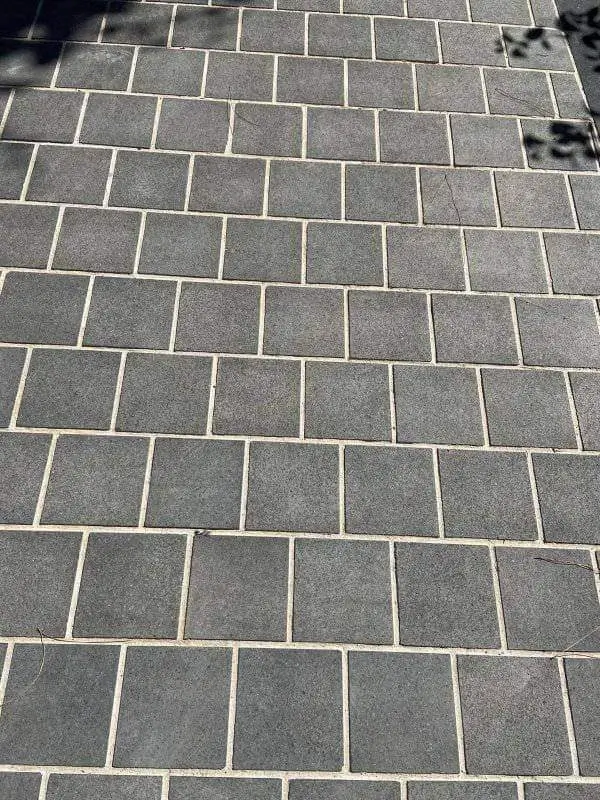
The relationship between surface albedo and thermal comfort becomes critical when you evaluate poolside stone flooring options. Light-colored stone slabs reflect 55-70% of incident solar radiation, reducing peak surface temperatures by 18-25°F compared to darker alternatives. You should verify that your selected material maintains consistent albedo performance after 5-7 years of UV exposure, as some stone types experience color degradation that compromises their thermal benefits.
- You need to specify expansion joints every 12-15 feet for adequate thermal movement accommodation
- Your base preparation must include drainage layers that prevent subsurface heat accumulation from trapped moisture
- You should account for thermal mass lag times of 3-4 hours between peak air temperature and peak surface temperature
- Your edge details require flexible materials that accommodate differential expansion between pool coping and deck surfaces
Slip Resistance and Wet Surface Performance
When you evaluate slip resistance for stone slab pool deck Fountain Hills applications, standard DCOF testing provides incomplete performance data. You’ll find that static coefficient measurements don’t predict real-world performance when surfaces remain wet for extended periods or accumulate sunscreen oils and organic residues. Your specification needs to address dynamic slip resistance under actual use conditions, which typically measures 0.12-0.18 lower than laboratory dry static values.
The surface texture you select creates a direct trade-off between slip resistance and barefoot comfort. Aggressive thermal finishes that achieve DCOF values above 0.60 when wet often create abrasive surfaces that become uncomfortable during prolonged contact. You should target DCOF ranges between 0.48-0.55 for wet conditions, which provide adequate safety while maintaining surface comfort for typical pool deck activities.
Your Arizona aquatic areas demand surface finishes that resist degradation from continuous wet-dry cycling. Polished or honed finishes that work well in interior applications often become dangerously slippery when you expose them to constant water contact combined with organic buildup. You’ll want to specify thermal or brushed finishes that create micro-texture patterns while avoiding excessively deep relief that traps debris and complicates maintenance protocols.
- You need to verify that warehouse inventory includes appropriate finish types before committing to delivery schedules
- Your maintenance specifications should address quarterly deep cleaning to preserve slip resistance performance
- You should test slip resistance at multiple points across large installations to ensure consistency
- Your edge transitions require special attention where deck surfaces meet smooth pool coping materials
Porosity and Drainage Requirements
The porosity characteristics of your stone slab pool deck Fountain Hills installation determine long-term performance in ways that aren’t immediately apparent during material selection. You’re looking for porosity ranges between 2-6% for optimal performance in continuously wet applications. Below 2%, surface water drainage becomes inadequate, creating standing water conditions that compromise slip resistance and promote organic growth. Above 6%, you risk subsurface water retention that leads to efflorescence, freeze-thaw damage during rare freezing events, and structural degradation over time.
When you evaluate slab deck installation Arizona projects, you need to understand how porosity interacts with base layer permeability. Your drainage design must ensure that base materials drain at least 3-4 times faster than surface materials to prevent subsurface saturation. This requires coordinating aggregate gradation, geotextile selection, and slope calculations to create positive drainage paths that function even when surface pores become partially occluded by mineral deposits or organic matter.
You should account for how installation methods affect field porosity compared to laboratory specifications. Wet-set applications can reduce effective surface porosity by 8-14% as mortar particles migrate into stone pores during installation. For guidance on selecting materials with appropriate porosity specifications and understanding their cost implications, see our wholesale slab pricing to evaluate options that meet your project requirements. Your specification should require verification testing on actual installed samples rather than relying solely on manufacturer laboratory data.
Thickness and Structural Considerations
Your stone slab pool deck Fountain Hills specification requires minimum thickness values that account for both structural loading and thermal stress resistance. You’ll find that 1.25-inch thickness represents the practical minimum for residential pool decks with standard foot traffic and lightweight furniture. Commercial applications or areas subject to vehicle access require 2-inch minimum thickness to prevent flexural failure and edge spalling under concentrated loads.
The relationship between slab thickness and base preparation quality creates performance interdependencies you need to address during specification. Thinner slabs demand more rigorous base compaction and flatness tolerances, typically requiring 98% Proctor density and flatness within 1/8 inch over 10 feet. Thicker slabs provide more tolerance for base irregularities but increase material costs and impose greater demands on truck access and installation logistics.
- You need to specify thickness tolerances that accommodate material variance without compromising structural performance
- Your edge details should account for visible thickness variations that affect aesthetic appearance
- You should verify that your selected thickness allows adequate embedment depth for stable installation
- Your structural calculations must include safety factors for thermal stress in addition to mechanical loading
Color Stability and UV Resistance
When you specify stone slab pool deck Fountain Hills materials, you’re exposing surfaces to UV radiation levels that exceed 7 kWh/m² daily during peak season. This extreme exposure creates photochemical degradation in certain stone types that manifests as color fading, surface chalking, or mineral oxidation patterns. You need to understand which stone compositions maintain color stability under decades of high-desert sun exposure versus those that experience significant appearance changes within 5-8 years.
Fountain Hills pool surrounds benefit from light-colored stones that provide thermal advantages, but these lighter tones often prove more susceptible to staining from organic matter, mineral deposits, and atmospheric pollutants. Your specification should address the trade-off between initial appearance and long-term maintenance requirements. Stones with tighter crystalline structures generally resist staining better than those with more porous or heterogeneous compositions, even when overall porosity percentages appear similar in laboratory testing.
You’ll encounter color variation within stone batches that becomes more apparent under the intense, direct lighting conditions typical of pool deck environments. Your material procurement should include provisions for viewing samples under outdoor sunlight conditions similar to the installation environment, as warehouse or showroom lighting fails to reveal subtle color variations that become obvious in bright desert sun.
Edge Detail Specifications
The edge details of your poolside stone flooring installation determine both safety performance and long-term durability. You need to specify edge profiles that eliminate sharp corners while maintaining clean visual lines appropriate for contemporary pool designs. Eased edges with 1/8-inch radius represent the minimum acceptable profile for barefoot safety, while 3/16-inch to 1/4-inch radius edges provide better impact resistance and reduced chipping potential during installation and use.
Your stone slab pool deck Fountain Hills edge specifications must address the transition between deck surfaces and pool coping materials. Differential thermal expansion between these materials creates shear forces at the interface that can cause grout joint failure or edge spalling if you don’t incorporate adequate movement accommodation. You should specify compressible joint materials rated for continuous water exposure and UV resistance, with replacement intervals clearly defined in your maintenance protocols.
- You need to detail how edges meet vertical surfaces like pool house walls or planters
- Your specifications should address drip edge details that prevent water migration under deck surfaces
- You should require edge protection during installation to prevent chipping and damage
- Your quality control protocols must verify edge consistency across the entire installation
Base Preparation Requirements
When you design slab deck installation Arizona base systems, you’re creating the foundation that determines whether your surface installation achieves 20+ year performance or requires remediation within 5-7 years. Your base specification must account for soil conditions specific to Fountain Hills, which typically include caliche layers, expansive clays, and highly alkaline pH values that affect material selection and preparation methods.
You need to specify base aggregate gradation that balances load distribution, drainage performance, and compaction stability. Well-graded crushed aggregate with maximum particle sizes between 3/4 inch and 1 inch provides optimal performance for most applications. Your compaction requirements should target 95-98% Modified Proctor density, with higher values required for commercial applications or areas subject to vehicular loading.
The base thickness you specify depends on soil bearing capacity, expected loading conditions, and desired service life. Residential pool decks typically require 6-8 inch compacted base thickness over stable soils, increasing to 10-12 inches where expansive clay soils create differential movement concerns. You should verify soil conditions through geotechnical investigation rather than assuming uniform site conditions based on regional generalizations.
Installation Timing and Seasonal Factors
Your Arizona aquatic areas installation timing affects both construction quality and material performance outcomes. You’ll achieve optimal installation conditions when ambient temperatures range between 50°F and 85°F, allowing proper setting material curing without thermal stress complications. Summer installations in Fountain Hills expose setting materials to temperatures that can exceed 110°F, accelerating curing rates in ways that compromise bond strength and increase shrinkage cracking potential.
When you schedule stone slab pool deck Fountain Hills construction, you need to account for material storage conditions before installation. Stone slabs stored in direct sunlight can reach surface temperatures above 130°F, creating thermal shock risks when you place them on cooler base materials or apply water-based setting beds. Your logistics planning should include shaded storage areas and material conditioning time to bring temperatures within acceptable ranges before installation begins.
- You should plan installations during fall or spring months when possible to optimize curing conditions
- Your crew scheduling needs to account for reduced productivity during extreme heat periods
- You need to specify material protection requirements during storage and staging
- Your quality control should include temperature monitoring of both materials and setting beds
Joint Spacing and Movement Accommodation
The joint spacing you specify for poolside stone flooring directly determines whether your installation accommodates thermal movement without distress or develops progressive cracking and displacement over time. You need to calculate joint spacing based on thermal expansion coefficients, expected temperature ranges, and material restraint conditions. For typical stone slab pool deck Fountain Hills applications, this translates to expansion joints every 12-15 feet in both directions, with closer spacing required in areas subject to maximum solar exposure.
Your joint design must address both vertical and horizontal movement while maintaining water-resistant integrity. Joint widths between 3/8 inch and 1/2 inch provide adequate movement capacity for most applications while remaining narrow enough for comfortable barefoot traffic. You should specify compressible backer rod materials sized to fill 50-60% of joint depth, leaving appropriate room for sealant application without three-sided adhesion that restricts movement capability.
When you detail joint locations, you need to coordinate with pool coping, deck drains, and architectural features to create visually coherent layouts that also function mechanically. Random joint spacing creates visual confusion and complicates installation, while overly rigid grid patterns may conflict with drainage slopes or architectural geometries. Your plans should clearly indicate all control joints, expansion joints, and construction joints with specific material and installation requirements for each type.
Maintenance Protocol Development
Your stone slab pool deck Fountain Hills maintenance specifications determine whether the installation maintains performance and appearance characteristics over its intended service life. You need to develop protocols that address routine cleaning, periodic sealing, joint maintenance, and damage repair in ways that property owners can realistically implement. Overly demanding maintenance requirements lead to deferred maintenance and accelerated deterioration.
You should specify cleaning methods that preserve surface texture and slip resistance while removing organic buildup, mineral deposits, and chemical residues from pool treatments. Pressure washing at 1200-1500 PSI with appropriate nozzle standoff distances provides effective cleaning without damaging stone surfaces or eroding joint materials. Your maintenance schedule should require deep cleaning at 3-4 month intervals during pool season, with additional attention after dust storms or unusual contamination events.
- You need to specify sealer types that maintain breathability while providing stain resistance
- Your resealing intervals should account for actual wear patterns rather than arbitrary time schedules
- You should detail joint sand or sealant inspection and replenishment requirements
- Your protocols must address efflorescence removal methods that don’t damage stone surfaces
Common Specification Errors
When you write specifications for Fountain Hills pool surrounds, several common errors create performance problems or installation complications that become apparent only after construction begins. One frequent mistake involves specifying generic slip resistance requirements without addressing wet dynamic conditions specific to pool deck use. You need to explicitly require testing under wet conditions with methods that simulate actual use rather than accepting dry static laboratory values.
Another common error occurs when you fail to coordinate stone thickness, base preparation depth, and finished elevation requirements. This oversight forces field modifications that compromise installation quality or create conflicts with pool coping elevations, deck drains, and door thresholds. Your drawings should include complete elevation coordination with all interfacing elements clearly dimensioned and verified before material procurement begins.
You’ll also encounter problems when specifications don’t address material selection coordination with truck access limitations and site conditions. Large-format slabs that look impressive in samples may prove impossible to deliver or install efficiently given actual site access constraints, crane reach limitations, or crew capabilities. Your specifications should require contractor verification of logistics feasibility before finalizing material selections.
Best Stone Slabs for Yard in Arizona — Citadel Guidance for Hypothetical Projects
When you consider Citadel Stone’s stone slabs for yard in Arizona for your pool deck project, you’re evaluating premium materials engineered for extreme desert climate performance. At Citadel Stone, we provide technical guidance for hypothetical applications across Arizona’s diverse microclimates, helping you understand how material properties interact with regional conditions. This section outlines how you would approach specification decisions for three representative cities, illustrating the site-specific factors you need to consider when designing Arizona aquatic areas.
Your material selection process would begin with climate analysis specific to each location, examining not just temperature extremes but also seasonal precipitation patterns, soil chemistry, and local water quality characteristics that affect long-term stone performance. You would evaluate how thermal cycling intensity varies across different elevation zones and urban heat island conditions, adjusting your specifications accordingly to ensure optimal material performance throughout the installation’s service life.
San Tan Valley Considerations
In San Tan Valley, you would need to account for extreme summer temperatures combined with expansive clay soils that create unique base preparation challenges. Your specification would address soil stabilization requirements that prevent differential movement from compromising your stone slab pool deck installation. You’d want to verify that base aggregate materials provide adequate drainage while resisting displacement from seasonal soil volume changes. The area’s lower elevation and basin topography create conditions where summer temperatures regularly exceed 115°F, requiring you to prioritize materials with optimal thermal conductivity values for barefoot comfort.
Yuma Climate Factors
Your Yuma pool deck specification would address the combined effects of extreme heat and minimal rainfall that create distinct performance requirements. You would select materials that maintain structural integrity despite prolonged UV exposure and thermal stress without benefit of regular precipitation for surface cleaning and cooling. The region’s dust conditions would require you to specify surface textures that resist wind-blown particle accumulation while maintaining slip resistance. You’d need to account for how continuous high temperatures affect setting material curing rates and adjust installation protocols to ensure proper bond development.
Avondale Urban Conditions
In Avondale, you would factor urban heat island effects that amplify already extreme desert temperatures, potentially adding 8-12°F to peak surface temperatures compared to less developed areas. Your material selection would prioritize high-albedo stones that minimize heat absorption while coordinating with architectural aesthetics appropriate to residential pool environments. You’d need to address how proximity to agricultural areas affects dust and organic debris accumulation, specifying maintenance protocols that preserve appearance and slip resistance. The area’s developing infrastructure would require you to coordinate material delivery timing with warehouse availability to avoid project delays during peak construction seasons.
Professional Considerations
Your stone slab pool deck Fountain Hills specification process requires balancing multiple competing priorities while maintaining focus on long-term performance outcomes. You need to evaluate how material costs interact with installation complexity, maintenance requirements, and expected service life to determine true lifecycle value rather than making decisions based solely on initial procurement costs. This analysis becomes particularly important when you compare premium materials that deliver 25+ year performance against economy alternatives that may require replacement or significant remediation within 12-15 years.
When you coordinate with suppliers and contractors, you should establish clear communication protocols that ensure all parties understand performance expectations and quality standards. Your specifications need to include measurable acceptance criteria for material properties, installation tolerances, and finished appearance rather than relying on subjective assessments that create disputes during final inspection. You’ll find that detailed specifications supported by reference standards prevent misunderstandings and provide clear resolution paths when field conditions require interpretation.
Your professional development in this specialty area benefits from ongoing education about material innovations, installation technique refinements, and evolving industry standards that affect specification practices. You should maintain relationships with technical representatives who can provide detailed product information and application guidance specific to challenging installation scenarios. For complementary design approaches that integrate natural aesthetics with performance requirements, review Natural edge flagstone slabs enhance authentic Arizona landscape designs before you finalize your project approach. We provide wholesale stone slabs in Arizona to fabricators across the state.