

When you source granite wholesale suppliers Arizona direct, you’re navigating a complex supply chain that stretches from quarries in Brazil, India, and China to your Arizona job site. The difference between a successful procurement and costly delays often comes down to understanding import logistics, factory relationships, and quality control protocols that most distributors won’t explain in detail. You need to know how container routing, customs clearance timelines, and warehouse staging affect your project schedule — because a two-week delay in Phoenix summer heat can derail your entire installation window.
Your decision to work with granite wholesale suppliers Arizona direct versus retail channels fundamentally changes your cost structure and material access. Direct sourcing eliminates 30-40% of markup layers, but you’re taking on responsibilities most contractors don’t anticipate. You’ll coordinate container shipments, verify ASTM compliance documentation, and manage inventory risk. The trade-off makes sense for projects exceeding 3,000 square feet, where volume justifies the coordination effort and your cost per square foot drops from $18-24 retail to $11-16 wholesale.
Import Logistics and Container Routing
Your granite arrives in 20-foot or 40-foot containers from overseas fabrication facilities, and the routing decisions you make affect both cost and delivery timelines. Most granite wholesale suppliers Arizona direct maintain relationships with freight forwarders who specialize in stone logistics, but you need to understand the decision points. Container shipments from Indian quarries typically route through Long Beach or Houston, with inland transport to Arizona adding 7-12 days. Brazilian material often arrives through Port of Baltimore or Savannah, extending transit by 4-6 days but sometimes offering better freight rates during off-peak seasons.
The reality of container logistics creates planning requirements most specifiers overlook. You can’t simply order material and expect delivery in two weeks. Here’s what your timeline actually looks like:
- You place your order with factory specifications and receive production confirmation within 3-5 business days
- Factory production and quality control consume 3-4 weeks for standard colors, extending to 6-8 weeks for exotic varieties
- Ocean freight requires 4-6 weeks from Asian ports, 3-4 weeks from South American origins
- Your material clears customs in 2-5 days if documentation is proper, but USDA agricultural inspections can add 3-7 days randomly
- Inland transport from port to Arizona warehouse takes 5-12 days depending on routing and season
When you coordinate with Wholesale Granite Arizona factory partners, your container specifications matter more than most buyers realize. A 20-foot container holds approximately 18-22 tons of granite slabs, while 40-foot containers accommodate 25-28 tons. The weight distribution inside the container affects inland freight costs — improperly loaded containers risk rejection by trucking companies or damage during transport. Professional granite wholesale dealers Arizona verify load distribution before containers leave origin ports, a detail that separates experienced importers from amateurs.
Factory Relationships and Quality Control Protocols
Your access to competitive granite wholesale price Arizona depends heavily on the strength of factory relationships your supplier maintains. Direct importers who’ve worked with the same quarries for 10+ years negotiate better slab selection, priority production scheduling, and more flexible payment terms. You benefit from these relationships through improved material consistency and reduced lead times, but you need to verify your supplier’s actual factory connections rather than accepting claims at face value.
Quality control happens at three critical checkpoints, and your involvement at each stage determines final material quality. First, factory inspection occurs during production — your Natural Stone Importer & Distributor Arizona should photograph each bundle before crating, verifying color consistency, finish quality, and dimensional tolerances. You should request these pre-shipment photos for projects where color matching is critical. Second, container inspection at port of entry catches damage during ocean freight. Third, your on-site inspection before installation represents the final quality gate.
The inspection criteria you establish with granite wholesale suppliers Arizona direct should address specific technical parameters:
- You verify thickness tolerance stays within ±2mm across the slab, as variances beyond this create installation complications
- Your finish inspection checks for consistent polish level, typically measuring 85+ gloss units for polished granite
- You examine edge quality for chips, cracks, or spalling that occurred during fabrication or transport
- Your color evaluation compares bundles against approved samples under natural daylight conditions, not warehouse lighting
- You check for resin fill applications, which are acceptable but must be disclosed and evenly distributed
What separates professional granite wholesale dealers Arizona from importers who simply move containers is their willingness to reject substandard material before it reaches your warehouse. Rejection rates for experienced importers run 2-4% of total shipments — low enough to maintain factory relationships but high enough to demonstrate quality standards. If your supplier claims zero rejections, they’re either extremely fortunate or not inspecting carefully.
Pricing Structures and Payment Terms
When you evaluate granite wholesale price Arizona options, you’re looking at pricing tiers that reflect material rarity, logistics complexity, and market demand. Standard colors like Absolute Black, Kashmir White, or Tan Brown typically range $11-14 per square foot at wholesale, while exotic varieties like Blue Bahia or Van Gogh reach $28-35 per square foot even at direct import prices. Your cost per square foot includes slab material, crating, ocean freight, customs duties (currently 3.9-6.5% depending on origin country), and inland transport to Arizona.
The payment structure for granite wholesale suppliers Arizona direct differs significantly from retail transactions. You’ll typically pay 30-50% deposit when ordering, with balance due before container release from port. This payment timing creates cash flow considerations most contractors don’t anticipate — you’re funding material acquisition 60-90 days before installation generates revenue. Some Wholesale Granite Arizona factory relationships offer extended terms for established customers, but you’ll need a proven track record of multiple successful orders before qualifying for net-30 or net-60 terms.
Your pricing negotiation improves with volume commitments and consistent ordering patterns. Here’s how wholesale pricing scales:
- You achieve best pricing at 3+ container volumes, where your cost per square foot drops 8-12% compared to single container pricing
- Your commitment to regular monthly orders often unlocks 5-7% additional discount regardless of individual order size
- You can negotiate better terms by accepting mixed containers of standard colors, which helps suppliers balance inventory
- Your willingness to work with slightly off-standard dimensions or edge details can reduce costs 10-15% for material that’s functionally identical
Professional granite wholesale dealers Arizona maintain transparent pricing that separates material cost from logistics cost. You should receive itemized quotes showing slab price, freight allocation, customs duties, and inland transport as separate line items. This transparency allows you to compare quotes accurately and understand where cost variations originate. At Citadel Stone, we provide detailed cost breakdowns that let you make informed sourcing decisions rather than comparing single bottom-line numbers that obscure important details.
Customs Compliance and Documentation Requirements
Your granite shipment clears customs based on documentation accuracy and completeness, and errors here create costly delays. The commercial invoice must specify HS code 2516.12.00 for granite slabs, with detailed descriptions including color name, finish type, dimensions, and country of origin. Your Natural Stone Importer & Distributor Arizona should handle this documentation, but you need to understand the requirements because responsibility for duties and delays ultimately falls on the importer of record.
Customs and Border Protection examines several documents during clearance:
- You submit commercial invoice showing factory cost, freight charges, and insurance value
- Your bill of lading proves ownership transfer and container contents
- You provide packing list detailing crate quantities, weights, and cubic measurements
- Your Certificate of Origin may reduce duty rates if material qualifies under trade agreements
- You include phytosanitary certificates if crating uses wood materials subject to USDA inspection
The most common customs delay involves USDA agricultural inspection of wooden crates. International standards require heat treatment or fumigation of wood packaging, certified by IPPC stamps on crates. When you work with granite wholesale suppliers Arizona direct, verify their factories use compliant crating materials. Non-compliant crates trigger mandatory fumigation at US ports, adding $800-1,200 per container and 5-8 days to your timeline. You can’t waive this requirement — it’s federal regulation.
Your duty calculation seems straightforward at 3.9-6.5% of declared value, but the “declared value” definition matters. Customs uses transaction value (what you actually paid) plus certain additions: freight to port of export, loading and handling at origin, and packing costs. Your granite wholesale price Arizona should clearly state whether quoted prices are FOB (Free On Board) or CIF (Cost, Insurance, Freight) to determine proper customs valuation. Misunderstanding this distinction leads to unexpected duty charges that can add $2,000-4,000 to container costs.
Warehouse Staging and Inventory Management
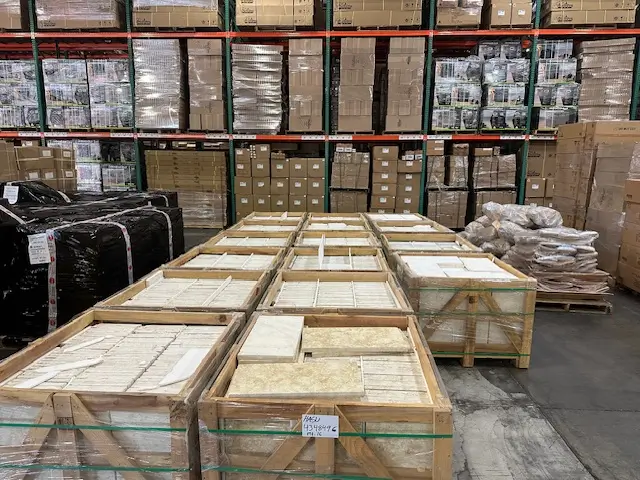
When your container arrives at the Arizona warehouse, you’re making decisions about immediate use versus inventory holding. Most granite wholesale dealers Arizona offer two receiving options: direct delivery to your job site or warehouse storage with future pull. Direct delivery works when your installation schedule aligns perfectly with container arrival, but that synchronization rarely happens in practice. You’ll typically warehouse at least 40-60% of container contents for staged installation or future projects.
Your warehouse storage costs run $0.15-0.35 per square foot per month depending on facility and access requirements. This seems minor until you calculate the carrying cost for a full container. A 40-foot container holding 4,500 square feet of material costs $675-1,575 monthly in storage fees. Over a 90-day holding period, you’re adding $2,025-4,725 to project costs. These carrying costs need to factor into your wholesale granite wholesale suppliers Arizona direct pricing analysis — the lowest slab price doesn’t guarantee lowest total cost if extended storage erodes your savings.
Professional inventory management becomes critical when you’re holding material for multiple projects. You need to track:
- You maintain bundle integrity by keeping factory strapping intact until actual use, preventing color mixing between bundles
- Your storage conditions protect against staining from adjacent materials, particularly if warehouse also holds limestone or marble
- You rotate stock using FIFO principles to prevent extended aging of specific bundles
- Your inventory system tracks which bundles came from which container, essential for warranty claims or color matching
The decision to maintain standing inventory versus order-per-project depends on your volume and project mix. If you’re installing 15,000+ square feet annually of standard colors like Absolute Black or Kashmir White, standing inventory makes economic sense. You achieve better pricing through volume commitments and eliminate lead time risk. For exotic colors or lower-volume applications, order-per-project minimizes capital tie-up and storage costs. At Citadel Stone, we help you model the break-even analysis based on your specific volume patterns and project timelines.
Material Specifications and ASTM Standards
Your technical specifications for granite should reference ASTM C615 (Standard Specification for Granite Dimension Stone) to establish baseline performance requirements. This standard addresses physical properties, finish quality, and dimensional tolerances that professional fabricators understand. When you specify granite through our granite marble wholesale channels, you’re getting material that meets or exceeds these standards, but you need to verify compliance rather than assume it.
ASTM C615 establishes four classification grades (I, II, III, IV) based on physical properties. Grade I represents premium material suitable for exterior cladding and high-stress applications. Your granite wholesale suppliers Arizona direct should provide test reports documenting:
- You require minimum compressive strength of 19,000 PSI for structural applications, though most granite exceeds 25,000 PSI
- Your specifications should address water absorption below 0.4% by weight, ensuring freeze-thaw durability in northern Arizona
- You verify flexural strength exceeds 1,500 PSI for unsupported spans or cantilevered applications
- Your abrasion resistance requirements ensure Hardness of 25 or higher on ASTM C241 testing for flooring applications
The finish specifications you establish affect both aesthetics and performance. Polished finishes achieve 85+ gloss units but show scratches more readily than honed finishes. Honed granite measures 10-30 gloss units and provides better slip resistance for flooring applications. Your choice between finishes should consider maintenance expectations and traffic patterns rather than appearance alone. Polished granite in commercial lobbies requires annual professional restoration to maintain appearance, while honed granite maintains consistent appearance with basic cleaning protocols.
Dimensional tolerances matter more than most specifiers realize. ASTM C615 allows thickness variation of ±3/16″ for slabs under 3/4″ thick, but quality fabricators hold tighter tolerances. When you source from Wholesale Granite Arizona factory partners who maintain modern facilities, you should expect ±2mm thickness tolerance, improving installation efficiency and reducing lippage risk. Your specifications should explicitly state expected tolerances rather than simply referencing ASTM standards, which represent minimum acceptable performance rather than best practice.
Color Consistency and Bundle Management
When you order granite from Natural Stone Importer & Distributor Arizona sources, you’re managing color variation that’s inherent to natural stone. No two slabs match perfectly, and variation within a single bundle can be substantial depending on quarry conditions. Your approach to color selection and bundle management determines whether your completed installation looks intentionally varied or poorly planned.
Granite quarries produce material from multiple levels and sections, each exhibiting color variations. A Kashmir White quarry might yield material ranging from nearly pure white with minimal veining to gray-white with substantial brown and burgundy veining. Both come from the same quarry and carry the same commercial name, but they look like different materials. Your granite wholesale dealers Arizona should photograph actual bundles available for your project rather than showing stock photos that may not represent current production.
Professional bundle management requires you to view and select specific bundles rather than ordering blind. The selection process works like this:
- You review photos of 3-5 bundles in your desired color range, understanding each bundle contains 8-12 slabs
- Your selection prioritizes bundles from the same quarry block when possible, minimizing variation
- You order 10-15% overage beyond calculated need to ensure sufficient material for color matching during installation
- Your installer should dry-lay slabs before setting, arranging them to distribute color variation intentionally rather than randomly
The granite wholesale price Arizona you pay doesn’t typically vary based on color consistency within a standard commercial color. Premium pricing applies to rare colors or exceptional consistency, but standard commercial grades come as-is. If your project requires exceptional color consistency, you need to specify first-choice bundle selection and accept that this premium service adds 15-20% to material cost. For most commercial applications, natural color variation is acceptable and even desirable, but you need to set client expectations during design phase rather than apologizing during installation.
Fabrication Considerations for Arizona Climate
Your granite performs differently in Arizona’s extreme climate compared to moderate zones, and fabrication details need to reflect these environmental stresses. Summer surface temperatures on dark granite exceed 165°F in direct Phoenix sun, creating thermal expansion that affects joint spacing, adhesive selection, and edge detail design. When you work with granite wholesale suppliers Arizona direct, you should discuss climate-specific installation requirements rather than following generic specifications developed for moderate climates.
Thermal expansion in granite measures approximately 4.7 × 10⁻⁶ per °F, which seems insignificant until you calculate actual movement. A 10-foot granite countertop experiencing 80°F temperature swing (common in covered outdoor kitchens) expands 0.045 inches. Your joint spacing needs to accommodate this movement, typically requiring 1/8″ expansion joints every 12 feet in Arizona applications versus standard 16-foot spacing in climate-controlled interiors.
Adhesive selection for Arizona installations differs from standard practice:
- You specify epoxy adhesives for outdoor applications where temperature cycling exceeds 60°F daily range
- Your thin-set mortar must be rated for exterior use with flexibility to accommodate thermal movement
- You avoid standard construction adhesives, which soften above 140°F and fail in direct sun exposure
- Your edge treatments require mechanical anchoring for unsupported spans exceeding 18 inches, as adhesive alone becomes unreliable in extreme heat
Edge detail design affects both aesthetics and durability in Arizona installations. Bullnose and ogee edges provide finished appearance but concentrate stress at the radius, where thermal cycling can initiate cracks over 8-12 years. Beveled or chamfered edges distribute stress more effectively and show less wear in high-use applications. Your edge selection should balance appearance preferences against expected service life and maintenance requirements.
Project Logistics and Lead Time Management
Your granite procurement timeline needs to account for multiple dependencies that extend well beyond simple material ordering. When you coordinate with Wholesale Granite Arizona factory sources, you’re managing production scheduling, ocean freight variables, customs clearance uncertainties, and fabrication lead times. Missing any of these coordination points delays your entire project.
The critical path for granite procurement typically spans 10-16 weeks from initial order to installation-ready material. Here’s how that timeline breaks down in practice:
- You finalize specifications and place factory order: 1 week
- Factory production and quality control: 3-6 weeks depending on color availability
- Ocean freight from origin to US port: 4-6 weeks
- Customs clearance and inland transport to Arizona: 2-3 weeks
- Your local fabrication (if required) adds 2-3 weeks for countertops, 1-2 weeks for tile calibration
Your project schedule needs buffer time for inevitable delays. Ocean freight experiences 2-3 week delays approximately 15% of the time due to port congestion, vessel scheduling changes, or weather events. Customs clearance occasionally extends to 3-4 weeks if containers are selected for physical inspection or if documentation issues arise. Professional project managers add 15-20% contingency time to granite procurement schedules rather than planning to best-case timelines.
The coordination between material arrival and installation readiness determines whether you incur storage costs or face idle crew time. Your ideal scenario has material arriving 5-7 days before installation begins — early enough to verify contents and manage any issues, but not so early that you’re paying warehouse fees. Achieving this synchronization requires you to track container status weekly and adjust installation scheduling based on actual transit progress rather than original estimates.
Quality Issues and Defect Management
When you discover quality issues with granite shipments, your response protocol determines whether the problem becomes a minor inconvenience or a project-threatening crisis. Professional granite wholesale dealers Arizona establish clear quality standards before ordering and document those standards in writing. You can’t effectively dispute quality if you never defined acceptable parameters.
Common granite defects fall into several categories, each requiring different remediation approaches. Natural characteristics like mineral deposits, color variation, or minor fissures are inherent to stone and generally not considered defects unless they exceed reasonable expectations. Manufacturing defects include uneven finish, incorrect dimensions, edge damage, or excessive resin fill. Transit damage involves cracks, chips, or breaks occurring during shipment. Your ability to claim credit or replacement depends on distinguishing between these categories and documenting issues promptly.
Your defect documentation should include:
- You photograph issues immediately upon discovery, including overall views and detailed close-ups
- Your photos include a scale reference (ruler or tape measure) to document size of cracks, chips, or other defects
- You create written description noting which slabs are affected, using bundle numbers and slab sequence numbers from factory marking
- Your documentation timeline matters — claims filed within 48 hours of delivery receive better response than claims weeks later
The resolution process with Natural Stone Importer & Distributor Arizona partners varies based on defect severity and timing. Critical defects affecting 10%+ of slabs typically warrant partial credit or replacement material at supplier cost. Minor issues affecting single slabs in a large order usually result in credit for affected pieces. Transit damage discovered at delivery falls under freight carrier liability rather than supplier responsibility, requiring separate claims process with trucking company.
Your leverage in defect negotiations depends on your relationship history and reasonableness. Suppliers respond well to customers who’ve accepted previous shipments without complaint when they raise legitimate concerns. Customers who claim problems with every shipment lose credibility. The professional approach involves accepting minor imperfections that don’t affect functionality while firmly addressing legitimate quality issues that impact project success.
Alternative Sourcing Strategies and Hybrid Approaches
Your granite sourcing doesn’t require all-or-nothing commitment to either direct import or local retail. Many successful contractors use hybrid approaches that balance cost savings against convenience and risk management. You might direct-import standard colors you use repeatedly while sourcing exotic or low-volume colors through local distributors who maintain diverse inventory.
The break-even analysis for direct import versus retail sourcing depends on several factors. Your project volume, color consistency requirements, schedule flexibility, and cash flow capacity all affect whether direct sourcing makes economic sense. Generally, projects under 2,000 square feet favor retail sourcing despite higher per-square-foot costs, because the absolute dollar savings don’t justify the coordination effort and lead time extension. Projects exceeding 5,000 square feet almost always benefit from direct sourcing, where savings reach $15,000-35,000 per project.
Hybrid sourcing strategies include:
- You direct-import standard commercial colors for stock inventory while retail-sourcing exotic colors for specific projects
- Your approach maintains relationships with both granite wholesale suppliers Arizona direct and local distributors, choosing sourcing method per project
- You coordinate with other contractors to share container costs, each taking bundles of different colors to achieve volume pricing
- Your company participates in buying groups that aggregate demand across multiple contractors to negotiate better direct-import terms
At Citadel Stone, we work with contractors using various sourcing strategies and provide guidance on which approach fits their specific business model. Our technical team helps you evaluate whether direct import makes sense for your volume patterns and project types. We maintain both direct factory relationships and domestic inventory to support different procurement approaches depending on project requirements and timelines.
Citadel Stone — Best Wholesale Granite Arizona in Arizona: Regional Specification Guidance
When you consider Citadel Stone’s wholesale granite Arizona materials for your projects, you’re evaluating premium granite options designed for diverse Arizona applications. At Citadel Stone, we provide technical guidance for hypothetical installations across Arizona’s distinct climate zones. This section outlines how you would approach specification decisions for six representative cities, addressing the unique environmental factors each region presents.
Arizona’s climate diversity requires you to modify granite specifications based on local conditions. Northern high-elevation cities experience freeze-thaw cycling that southern desert cities never encounter. Urban heat island effects in metro Phoenix create surface temperatures 15-20°F higher than surrounding desert areas. Your specification approach needs to reflect these regional differences rather than applying uniform standards statewide.
Phoenix Applications
In Phoenix, you’ll encounter extreme heat that requires careful attention to thermal mass properties and surface temperature management. Your granite selections for exterior applications should prioritize lighter colors that reflect solar radiation rather than absorbing it. Dark granite surfaces exceed 165°F during summer afternoons, creating safety concerns for pool decks and outdoor living areas. You would specify thermal expansion joints every 12 feet in covered outdoor kitchens and entertainment areas where granite experiences daily temperature swings of 80-90°F. Your adhesive selection needs to accommodate these temperature extremes, ruling out standard construction adhesives in favor of high-temperature epoxy systems. Commercial projects in downtown Phoenix require you to account for urban heat island amplification when selecting materials for plaza installations or building entry features.
Tucson Considerations
Your Tucson projects face similar heat stress to Phoenix but with higher elevation and distinct monsoon patterns that create additional moisture cycling. You would address water absorption characteristics more carefully here, as summer monsoons deliver intense rainfall that tests drainage systems and material porosity. Granite countertops in outdoor kitchens require proper sealing to prevent monsoon moisture intrusion that can lead to subsurface staining. Your specification for commercial plaza installations should account for Tucson’s coarser aggregate soils, which create more abrasive subsurface conditions than Phoenix’s finer desert soils. Installation details need to address the rapid thermal cycling that occurs during monsoon events, when surface temperatures can drop 40°F in 20 minutes as storms arrive.
Scottsdale Premium Projects
When you specify granite for Scottsdale’s luxury residential and resort projects, aesthetic consistency often takes priority over cost considerations. You would select premium-grade bundles with exceptional color consistency for high-visibility applications like resort lobbies or luxury home entries. Your edge details typically involve more complex profiles — ogee, dupont, or custom edges — requiring skilled fabrication and careful installation to prevent thermal stress cracking. Scottsdale projects frequently incorporate granite in outdoor living spaces where you need to balance heat management with design intent. You would recommend lighter-colored granites with honed finishes for pool decks and outdoor dining areas, providing both heat mitigation and slip resistance that polished surfaces can’t deliver.
Flagstaff Climate
Your Flagstaff specifications differ dramatically from southern Arizona approaches due to elevation and winter conditions. At 7,000 feet elevation, you’re addressing freeze-thaw cycling that occurs 100+ times annually, requiring granite with water absorption below 0.3% to prevent spalling. You would specify ASTM C615 Grade I material exclusively for exterior applications, as lower grades may not withstand the freeze-thaw stress. Interior applications in mountain homes need to address significant daily temperature swings, particularly in spaces with large windows facing south. Your installation details for Flagstaff outdoor projects require cold-weather adhesives and sealants that remain flexible below 0°F, which standard products don’t provide. The shorter construction season in Flagstaff requires you to coordinate material delivery timing carefully, as winter weather can delay access and installation for weeks.
Mesa Requirements
In Mesa, you would address similar environmental factors to Phoenix but with greater emphasis on residential rather than commercial applications. Your typical Mesa projects involve kitchen and bathroom countertops, outdoor kitchens, and patio installations in established residential neighborhoods. Street access considerations become important when you coordinate delivery of full slabs to residential sites with mature landscaping and limited truck clearances. You would recommend standard commercial granite colors that offer good availability and competitive pricing, as Mesa’s residential market typically emphasizes value over exotic appearance. Installation timing needs to avoid peak summer months when garage and outdoor workspace temperatures exceed safe limits for proper adhesive curing. Your specifications for Mesa pool deck applications should prioritize slip resistance and heat mitigation, as family use patterns require safe bare-foot surfaces throughout summer months.
Sedona Design Integration
When you specify granite for Sedona projects, you’re often working within design frameworks that emphasize integration with the natural red rock environment. Your material selections would complement rather than contrast with the distinctive regional color palette, suggesting beige, tan, and earth-tone granites over stark white or black options. High-end residential and resort projects in Sedona frequently incorporate granite in custom applications — fireplace surrounds, outdoor kitchen islands, spa installations — requiring detailed fabrication drawings and careful color selection. You would account for Sedona’s 4,500-foot elevation, which creates moderate freeze-thaw cycling requiring proper sealing and installation protocols. The tourism-focused economy means many projects involve vacation rental properties where durability and low maintenance take priority over cutting-edge design trends. Your specifications need to deliver 15+ year service life with minimal intervention, as property management companies prefer materials that withstand neglect better than alternatives.
Final Considerations
Your success with granite wholesale suppliers Arizona direct depends on understanding the complete supply chain rather than focusing solely on slab pricing. The contractors who achieve best results combine volume planning, quality verification protocols, and realistic lead time management into a comprehensive procurement strategy. You need to evaluate suppliers based on their factory relationships, customs compliance track record, and willingness to address quality issues promptly when they arise.
The decision to pursue direct sourcing versus retail channels should reflect your actual project volume and operational capacity. If you’re installing 20,000+ square feet annually across multiple projects, direct sourcing delivers substantial cost savings that justify the coordination effort and cash flow requirements. For contractors with lower volumes or highly variable project types, hybrid approaches that combine direct import for standard colors with retail sourcing for specialty materials often provide the best balance. For comprehensive pricing analysis, review bulk granite pricing structures for Arizona construction professionals before you finalize your procurement approach. Multi-material projects source from Citadel Stone’s granite marble wholesale in Arizona inventory.