
When you specify commercial paving slabs Arizona suppliers for hospitality, retail, or restaurant projects, you’re making decisions that affect 20-30 year performance cycles. The difference between successful installations and premature failure often comes down to supplier selection and material specification details that most generic procurement processes miss. You need suppliers who understand bulk project logistics, maintain adequate warehouse inventory, and provide commercial-grade materials tested for Arizona’s extreme thermal conditions.
Your bulk paving Phoenix contractors projects demand more than residential-grade products. Commercial applications expose materials to concentrated foot traffic, thermal cycling that exceeds 100°F daily variation in summer months, and UV exposure that degrades inferior materials within 5-7 years. When you source from commercial grade suppliers Arizona, you’re accessing material specifications that address compressive strength minimums of 8,000 PSI, slip resistance coefficients appropriate for public access, and dimensional tolerances that facilitate large-format installations.
Commercial Specification Requirements for High-Traffic Applications
You need to understand what separates commercial-grade materials from residential products. Compressive strength represents the primary differentiator—commercial paving slabs Arizona suppliers should provide materials meeting or exceeding 8,000 PSI, with premium grades reaching 10,000-12,000 PSI for vehicular applications. Your specification must also address flexural strength, which determines crack resistance under dynamic loading. Professional installations require minimum 1,200 PSI flexural strength for pedestrian plazas, increasing to 1,800+ PSI for areas with occasional vehicle access.
Slip resistance becomes critical for hospitality paving dealers serving hotels and restaurants. You should specify DCOF (Dynamic Coefficient of Friction) ratings between 0.50-0.60 for dry conditions, with wet DCOF no lower than 0.42. What catches many specifiers off-guard is how surface finish affects these values—flamed finishes typically provide 0.52-0.58 DCOF, while honed surfaces measure 0.45-0.52. Your pool deck and outdoor dining applications need the higher end of this range.
Porosity specifications matter more than most procurement teams realize. You’re targeting 3-8% porosity for Arizona conditions—below 3% prevents adequate drainage, while above 8% accelerates weathering in areas with monsoon exposure. Your material selection should account for how porosity interacts with local water chemistry. In areas with high mineral content groundwater, higher porosity materials show efflorescence patterns within 18-24 months unless you implement proper sealing protocols.
Bulk Ordering Logistics for Commercial Projects
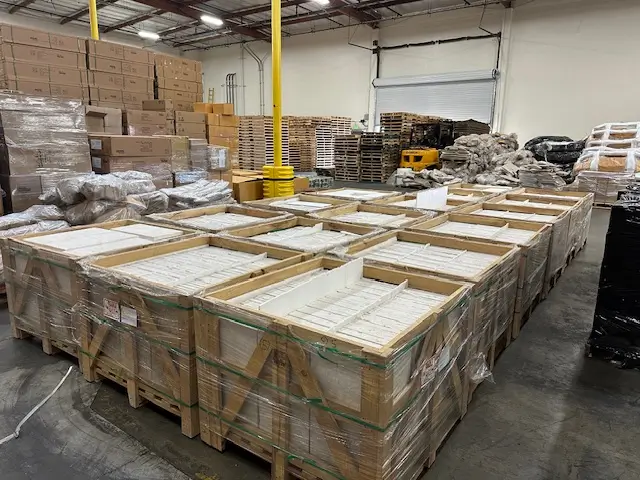
When you coordinate large project paving near me installations exceeding 5,000 square feet, lead times and material availability become project-critical factors. Commercial grade suppliers Arizona with adequate warehouse capacity can typically fulfill 10,000-15,000 square foot orders within 2-3 weeks. Projects exceeding 20,000 square feet may require 4-6 week lead times unless you’re working with suppliers who maintain regional distribution networks.
Your truck access planning needs to account for delivery vehicle requirements. Standard commercial deliveries utilize 26-foot box trucks for urban sites with restricted access, while larger projects may receive semi-trailer deliveries requiring 60-foot turning radius and 14-foot overhead clearance. You should coordinate with suppliers to verify delivery vehicle specifications match your site constraints—this detail often gets overlooked until delivery day creates expensive delays.
- You need to verify warehouse stock levels before finalizing project schedules and purchase commitments
- Your delivery staging areas should accommodate 8-12 pallets per 1,000 square feet of installation area
- You should confirm whether suppliers provide jobsite delivery or require contractor pickup from distribution yards
- Your project timeline must account for material acclimation periods of 24-48 hours before installation begins
Material consistency across bulk orders represents a significant quality concern. When you order 15,000 square feet from commercial paving slabs Arizona suppliers, you’re potentially receiving material from multiple production runs. Professional suppliers lot-match materials and provide samples from actual delivery stock. You should request written confirmation that all materials ship from the same production lot, or at minimum, adjacent lots with verified color consistency.
Arizona Climate Performance Factors
You’re specifying for one of the most demanding thermal environments in North America. Surface temperatures on dark-colored materials regularly exceed 165°F during June-August peak periods in Phoenix metro areas. Your material selection must address thermal expansion coefficients of 5.3 × 10⁻⁶ per °F—this translates to 0.032 inches of expansion per 10-foot span across a 100°F temperature swing. Professional specifications require expansion joints every 12-15 feet, with narrower spacing in areas receiving direct solar exposure exceeding 7 hours daily.
UV degradation affects inferior materials within 5-8 years in Arizona installations. You’ll observe surface chalking, color fading, and progressive loss of surface integrity in materials not formulated for high-altitude UV exposure. Flagstaff installations at 7,000 feet elevation experience 15-20% higher UV intensity than Phoenix installations, requiring enhanced UV-stable materials. When you work with hospitality paving dealers for resort applications, specify materials with documented UV resistance testing per ASTM G154 with minimum 2,000-hour exposure without visible degradation.
Thermal mass properties create performance implications most specifications don’t adequately address. Dense materials with thermal mass above 140 lb/ft³ absorb heat during daytime hours and release it gradually over 4-6 hour periods after sunset. This creates surface temperatures 15-25°F above ambient air temperature during evening hours—a critical consideration for restaurant patios and hotel pool decks where guest comfort directly affects business operations. For guidance on balancing thermal performance with aesthetic requirements, see Citadel Stone’s paving slab headquarters for detailed thermal performance comparison data across material types.
Material Thickness and Structural Specifications
Your thickness selection directly determines long-term performance and installation costs. Pedestrian applications typically require 1.25-inch minimum thickness, while vehicular applications demand 2-inch minimum with proper base preparation. What often surprises project managers is how thickness affects installation labor costs—2-inch materials require 30-40% more labor hours due to weight handling and precision requirements during placement.
- You should specify 1.25-inch thickness for pedestrian plazas with foot traffic only
- Your vehicular crossings and emergency access lanes require 2-inch minimum thickness over engineered base
- You need 1.5-inch thickness for areas with occasional maintenance vehicle access
- Your pool decks and water feature surrounds benefit from 1.5-inch thickness for enhanced durability
Dimensional tolerances affect installation efficiency and final appearance quality. Commercial paving slabs Arizona suppliers should guarantee ±1/8 inch thickness tolerance and ±1/16 inch dimensional tolerance on length and width. When you receive materials exceeding these tolerances, installation labor increases 25-35% as crews compensate for dimensional variation through shimming and base adjustment. Your specifications should explicitly state acceptable tolerance ranges and include provisions for material rejection if tolerances exceed stated values.
Evaluating Commercial Suppliers for Large Projects
When you assess bulk paving Phoenix contractors supplier options, inventory depth represents the primary selection criterion. Suppliers maintaining 50,000+ square feet of warehouse inventory across multiple product lines can accommodate schedule changes and provide material continuity for phased projects. You should verify whether suppliers stock the specific products you’re specifying or rely on special-order fulfillment that extends lead times by 4-6 weeks.
Technical support capabilities separate professional suppliers from commodity distributors. Commercial grade suppliers Arizona should provide on-site consultation for large projects, helping you address substrate preparation questions, drainage design verification, and installation detail troubleshooting. This support becomes invaluable when you encounter field conditions that don’t match design documents—experienced supplier representatives can recommend solutions that maintain specification compliance while accommodating site realities.
- You need suppliers who maintain consistent stock of specified products throughout project duration
- Your supplier should provide material testing documentation including compressive strength and absorption rates
- You should verify whether suppliers offer site delivery or require contractor pickup arrangements
- Your selected supplier must accommodate phased deliveries aligned with construction schedules
Base Preparation for Commercial Installations
Your base preparation determines whether installations achieve 20+ year service life or require remediation within 8-12 years. Commercial applications require minimum 6-inch compacted aggregate base for pedestrian areas, increasing to 8-10 inches for vehicular applications. You’re targeting 95% compaction using modified Proctor density testing—anything below 92% creates settlement conditions that telegraph through surface materials within 3-5 years.
Drainage design requires more attention than typical residential installations. You need minimum 2% slope for positive drainage, with consideration for how base permeability relates to surface material porosity. Professional installations incorporate base materials with permeability rates 3-4 times higher than surface materials, preventing subsurface saturation that causes efflorescence and freeze-thaw damage. Your drainage calculations should account for Arizona monsoon events delivering 1-2 inches of precipitation in 60-90 minute periods.
Edge restraint systems prevent horizontal migration that creates joint opening and surface irregularities. You should specify commercial-grade edge restraints with minimum 1/4-inch thickness and corrosion-resistant coatings appropriate for alkaline soil conditions common across Arizona. Installations without proper edge restraint show visible joint widening of 1/8-1/4 inch within 2-3 years, creating trip hazards and accelerating joint material loss.
Joint Spacing and Maintenance Considerations
When you establish joint spacing for commercial paving slabs Arizona suppliers materials, you’re balancing aesthetic preferences against thermal expansion requirements. Standard joint spacing ranges from 1/8 inch to 3/8 inch, with narrower joints providing superior visual continuity but requiring more careful thermal expansion accommodation. Your Arizona installations should trend toward 3/16-1/4 inch joints to accommodate thermal expansion without creating compression failure conditions during peak summer temperatures.
Joint material selection affects long-term maintenance requirements. Polymeric sand provides superior joint stability compared to traditional silica sand, reducing weed growth and ant colonization by 80-90%. You should specify polymeric sand products formulated for wide-joint applications in high-temperature environments—standard polymeric sands can fail in joints exceeding 1/4 inch or in climates where surface temperatures exceed 160°F. Your maintenance specifications should include joint material replenishment every 3-4 years, as even premium polymeric products experience 15-20% volume loss over this period.
- You need to maintain joint sand at 85-95% capacity for optimal performance
- Your maintenance program should include annual joint inspection and spot replenishment
- You should avoid pressure washing at pressures exceeding 1,200 PSI to prevent joint material displacement
- Your specifications must address how cleaning protocols affect joint integrity
Color Selection and Heat Island Mitigation
Your color choices directly impact surface temperatures and guest comfort in hospitality applications. Light-colored materials reflect 60-70% of solar radiation, maintaining surface temperatures 25-35°F cooler than dark materials during peak afternoon hours. When you specify for hospitality paving dealers projects serving restaurants with outdoor dining, this temperature differential determines whether spaces remain usable during extended seasons or become vacant during summer months.
Color consistency across large projects requires careful supplier coordination. Natural stone exhibits inherent color variation, with typical range spanning 15-20% from lightest to darkest pieces within a single lot. You should request sample sets representing the full range of variation and establish written acceptance criteria defining allowable color range. Professional installations blend materials from multiple pallets simultaneously, preventing color clustering that creates visually distinct zones within finished projects.
Heat retention properties vary significantly across color options. Dark gray and charcoal materials retain heat 4-6 hours after sunset, maintaining surface temperatures 20-30°F above ambient. Light beige and cream materials release heat within 2-3 hours, creating more comfortable evening conditions. Your restaurant patio and hotel pool deck applications benefit from lighter colors that maximize evening usability when commercial value peaks.
Budget Considerations and Value Engineering Options
When you develop budgets for projects sourced through commercial grade suppliers Arizona, material costs typically range from $8-16 per square foot for premium commercial-grade products, with installation adding $12-18 per square foot depending on complexity. Your total installed costs land between $20-34 per square foot for professional commercial installations. Projects exceeding 10,000 square feet often qualify for volume pricing that reduces material costs by 12-18%.
Value engineering opportunities exist without compromising performance. You can reduce costs by 15-25% through strategic thickness optimization—specifying 1.25-inch material for verified pedestrian-only areas while maintaining 2-inch thickness only where vehicular access occurs. Your edge and border treatments represent another optimization opportunity. Full-depth borders using the same material as field areas increase costs; transitioning to concrete edges with material caps reduces border costs by 40-50% while maintaining visual quality.
- You should evaluate whether phased installation reduces financing costs for large project paving near me developments
- Your specifications can incorporate value-engineered base preparation using recycled concrete aggregate where appropriate
- You need to assess whether simplified joint patterns reduce installation labor without affecting performance
- Your material selection should consider how maintenance costs over 20-year cycles affect total ownership costs
Installation Timing and Seasonal Scheduling
Your installation timing affects both labor productivity and material performance. Arizona’s extreme summer temperatures create challenging installation conditions—surface temperatures exceeding 130°F make material handling difficult and affect setting material cure rates. Professional installations schedule major work during October-April periods when daytime temperatures remain below 90°F. You’ll achieve 20-25% higher labor productivity during these moderate temperature periods compared to summer installations.
Monsoon season considerations affect July-September scheduling. Even though temperatures moderate slightly during monsoon period, unpredictable afternoon storms create work stoppages and can compromise partially completed installations. Your project schedules should incorporate weather contingency buffers of 15-20% for work planned during monsoon months. When you coordinate with bulk paving Phoenix contractors for large commercial projects, scheduling flexibility becomes essential for maintaining timeline integrity.
Material acclimation requirements often get overlooked in project schedules. You should allow materials to reach thermal equilibrium with ambient conditions before installation begins—this typically requires 24-48 hours of on-site storage. Installing materials immediately after truck delivery from climate-controlled warehouse storage can result in dimensional changes during the first 72 hours post-installation, affecting joint spacing consistency and creating lippage conditions at material edges.
Citadel Stone Commercial Paving Slabs Arizona — Professional Specification Guidance for Arizona Cities
When you evaluate Citadel Stone’s paving slabs for your commercial projects across Arizona, you’re considering materials engineered specifically for extreme desert thermal cycling and high-altitude UV exposure. At Citadel Stone, we provide technical specification guidance for hospitality, retail, and restaurant applications throughout Arizona’s diverse climate zones. This section outlines how you would approach material selection and specification development for six representative Arizona cities, demonstrating the climate-specific considerations that affect commercial paving performance.
Your Arizona commercial projects encounter thermal conditions ranging from high-desert temperature extremes to elevated UV exposure in mountain communities. You need to account for how daily temperature swings of 40-50°F affect joint spacing requirements, how monsoon precipitation patterns influence drainage design, and how elevation-dependent UV intensity determines material selection criteria. Professional specifications for commercial paving slabs Arizona suppliers must address these regional variables to ensure 20-30 year performance cycles.
Phoenix Metro Specifications
In Phoenix, you’ll encounter the most extreme thermal conditions in Arizona, with surface temperatures regularly exceeding 165°F during June-August periods. Your commercial paving slabs Arizona suppliers material specifications should prioritize light-colored options that reflect 65-70% of solar radiation, reducing surface temperatures by 25-30°F compared to darker alternatives. You would specify expansion joints every 12 feet for materials in full sun exposure, narrowing from the standard 15-foot spacing used in moderate climates. Your base preparation requires special attention to expansive clay soils common in Phoenix metro areas—you’d typically specify geotextile separation fabric and minimum 8-inch engineered aggregate base to prevent substrate movement that telegraphs through surface materials. When you coordinate warehouse deliveries for projects in Phoenix, Scottsdale, and surrounding communities, you should verify lead times of 2-3 weeks for bulk orders exceeding 10,000 square feet.
Tucson Desert Applications
Tucson’s slightly more moderate summer temperatures still demand materials capable of withstanding 155°F surface temperatures and UV exposure comparable to Phoenix. You would specify similar thermal expansion accommodations, with particular attention to how Tucson’s caliche soil layers affect drainage patterns. Your installation specifications should address the calcium carbonate-rich subsoils that create efflorescence risks if drainage design doesn’t prevent subsurface water migration. You’d typically recommend enhanced base permeability using 3/4-inch crushed aggregate with minimal fines content, ensuring water moves through the base layer rather than wicking upward through capillary action. For hospitality paving dealers serving Tucson’s resort and restaurant markets, you should specify slip resistance ratings toward the higher end of acceptable ranges—DCOF 0.55-0.60—to accommodate pool deck and outdoor dining applications where water exposure creates additional safety considerations.
Flagstaff High-Altitude Considerations
Your Flagstaff specifications need to address freeze-thaw cycling that doesn’t affect lower-elevation Arizona installations. At 7,000 feet elevation, you’re encountering 60-80 annual freeze-thaw cycles that demand materials with maximum 5% absorption rates and minimum 10,000 PSI compressive strength. You would specify materials from commercial grade suppliers Arizona who can document freeze-thaw testing per ASTM C666, showing less than 2% strength loss after 300 freeze-thaw cycles. UV exposure at this elevation exceeds Phoenix levels by 15-20%, requiring enhanced UV-stable materials for applications with southern exposure. Your joint specifications should incorporate polymeric sand products specifically formulated for freeze-thaw environments, avoiding standard products that fail under repeated freezing. When you plan large project paving near me installations in Flagstaff, you’d need to account for shortened construction seasons—professional installations typically occur May-October, with winter months unsuitable for setting material installation.
Scottsdale Luxury Hospitality Standards
Scottsdale’s concentration of luxury resorts and high-end restaurants demands materials meeting the highest aesthetic and performance standards. You would specify premium-grade commercial paving slabs Arizona suppliers materials with tight dimensional tolerances of ±1/16 inch and color consistency within 10% variation across the project. Your specifications for hospitality paving dealers serving Scottsdale’s resort market should emphasize surface finish quality—honed finishes providing 0.50-0.54 DCOF while maintaining the refined appearance luxury properties require. You’d typically recommend 1.5-inch thickness even for pedestrian-only applications, as the enhanced thickness provides superior sound dampening and perceived quality that aligns with luxury positioning. Base preparation specifications would include minimum 8-inch depth with 98% compaction to ensure zero settlement over 20+ year service life. When you coordinate bulk paving Phoenix contractors deliveries for Scottsdale projects, you should verify whether warehouse locations can fulfill specialized color selections that may require 4-6 week lead times.
Sedona Red Rock Integration
Your Sedona specifications require color selections that complement the iconic red rock landscape while meeting commercial performance requirements. You would typically specify warm earth tones in the beige, tan, and light terracotta range that harmonize with natural surroundings without attempting direct color matching that appears artificial. At 4,500 feet elevation, you’re encountering moderate freeze-thaw exposure of 30-40 annual cycles, requiring materials with 6-7% maximum absorption rates and documented freeze-thaw durability. UV exposure at this elevation demands materials tested to ASTM G154 standards with verified color stability. Your drainage specifications need to account for Sedona’s red soil geology—you’d specify enhanced base filtration to prevent iron-oxide staining that occurs when red soil particles migrate upward through base layers during precipitation events. For commercial projects serving Sedona’s tourism-focused restaurant and retail markets, you should coordinate truck access carefully, as many properties have constrained delivery access requiring smaller delivery vehicles or specialized scheduling.
Mesa Value Engineering
Mesa’s large-format commercial developments often prioritize value engineering without compromising performance. You would specify materials from commercial paving slabs Arizona suppliers who offer volume pricing for projects exceeding 15,000 square feet, potentially reducing material costs by 15-18%. Your specifications can incorporate cost optimization through strategic thickness variation—1.25-inch material for verified pedestrian areas with 2-inch thickness reserved for vehicular access points and loading zones. Base preparation specifications might utilize recycled concrete aggregate for lower base layers where appropriate, reducing costs by 20-25% while maintaining structural performance. You’d need to verify that value-engineered materials still meet minimum commercial standards of 8,000 PSI compressive strength and 0.50+ DCOF slip resistance. When you work with bulk paving Phoenix contractors on Mesa projects, coordination of warehouse delivery scheduling becomes critical for controlling costs—consolidated deliveries reduce per-square-foot delivery charges by 12-15% compared to multiple small deliveries.
Quality Control and Acceptance Testing Protocols
Your quality assurance program should begin before materials leave the supplier warehouse. You need to establish pre-delivery inspection protocols verifying dimensional tolerances, color consistency, and surface finish quality match approved samples. Professional specifications include provisions for third-party testing of compressive strength, absorption rates, and slip resistance on random samples drawn from each delivery lot. This testing typically costs $800-1,200 per project but provides documentation protecting you against substandard materials.
Field inspection during installation catches problems before they become expensive remediation projects. You should verify base compaction using nuclear density gauge testing at 5,000 square foot intervals, confirming achievement of specified 95% modified Proctor density. Joint spacing requires systematic verification—measurements at 100 square foot intervals ensure consistency within specified tolerances. Your inspection protocols should document any materials exceeding dimensional tolerances, surface defects, or color variations outside acceptable ranges before installation proceeds.
- You need to establish clear acceptance criteria in specifications before material ordering begins
- Your testing protocols should include verification of slip resistance on finished installations
- You should document base preparation through photographic records at each layer before coverage
- Your punch list process must address joint material consolidation and surface cleaning before final acceptance
Long-Term Performance and Maintenance Planning
When you specify materials from commercial paving slabs Arizona suppliers meeting professional-grade standards, you’re targeting 20-30 year service life with appropriate maintenance. Your maintenance planning should incorporate biennial resealing using penetrating sealers that don’t create surface film. Surface film-forming sealers fail within 3-5 years under Arizona UV exposure, creating expensive removal and reapplication cycles. Penetrating sealers maintain effectiveness for 4-6 years while allowing material to breathe naturally.
Joint maintenance represents the most critical ongoing requirement. You should plan for joint material replenishment every 3-4 years, as even premium polymeric sand experiences 15-20% volume loss over this period due to weathering and cleaning operations. Annual inspection should identify areas where joint material has dropped below 85% capacity, triggering spot replenishment before joint widening occurs. Your cleaning protocols need to limit pressure washing to maximum 1,200 PSI to prevent joint material displacement—higher pressures remove 30-40% of joint material requiring immediate replacement.
Surface cleaning frequency depends on application intensity and environmental exposure. Restaurant patios and hotel pool decks typically require monthly cleaning to maintain slip resistance and appearance standards. Retail plaza installations may require only quarterly cleaning unless specific staining events occur. You should establish cleaning protocols using pH-neutral cleaners that don’t attack joint materials or accelerate sealer breakdown. Acidic cleaners commonly used for efflorescence removal can damage certain materials and should only be used under controlled conditions with immediate neutralization.
Professional Specification Development
Your specification documents need to address performance requirements, material standards, installation protocols, and acceptance criteria with precision that protects project quality. You should reference relevant ASTM standards including C1528 for slip resistance, C170 for compressive strength, and C97 for absorption rates. Professional specifications include detailed base preparation requirements, joint spacing tolerances, edge restraint systems, and drainage design criteria specific to project conditions.
Material substitution provisions require careful consideration. You might specify that any substitutions must meet or exceed specified performance criteria with documentation provided minimum 10 days before delivery. Your specifications should explicitly state whether you’ll accept equivalent materials or require specific products from named suppliers. For projects sourced through bulk paving Phoenix contractors representing multiple supplier lines, substitution flexibility can provide cost advantages without compromising performance if equivalency standards are clearly defined.
When you finalize your commercial specification process, coordination between design intent, budget parameters, and supplier capabilities determines project success. For comprehensive guidance on material selection addressing Arizona’s specific climate challenges, review Selecting durable paving materials for Arizona desert climate conditions before you complete your project documentation. Citadel Stone manufactures frost- and heat-tested mixes and distributes paving slabs across Arizona for climates like ours.