
When you call a limestone supplier inventory Arizona dealer to ask about stock levels, you’ll often hear vague responses like “we have plenty” or “lead times vary.” That lack of specificity creates real problems for your project timeline. You need to understand what inventory really means in the Arizona stone supply chain because dealer stock levels directly affect your ability to meet construction schedules, coordinate subcontractors, and avoid costly delays.
Most Arizona limestone dealers operate on a hybrid model that combines warehouse stock with just-in-time ordering from regional quarries. The distinction matters because available inventory limestone Arizona facilities keep on-site typically represents only 20-30% of what they claim to “have access to.” The remaining 70-80% requires coordination with suppliers, which introduces lead times ranging from 10 days to 6 weeks depending on material type and current demand cycles.
Understanding Dealer Inventory Models
The limestone supply chain operates differently than most construction materials because of the product’s weight, bulk, and quarry-specific sourcing requirements. When you evaluate limestone dealer stock levels, you’re actually looking at three distinct inventory categories that affect your procurement timeline in different ways.
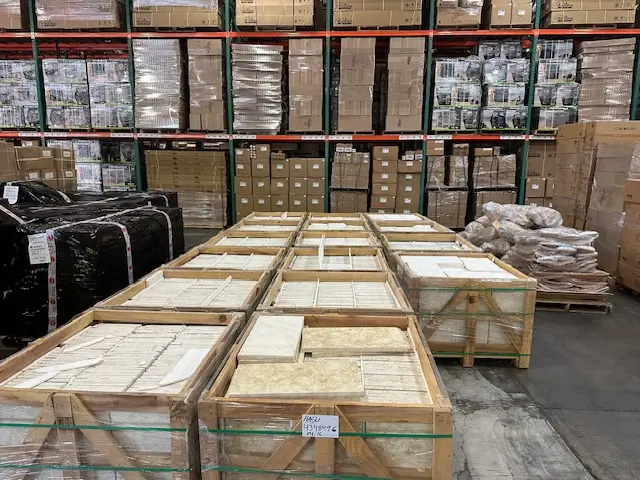
Physical warehouse inventory represents material a dealer has paid for and stored on-site. This typically includes popular sizes and finishes that move quickly in the local market. For Phoenix-area dealers, you’ll usually find 12×24 honed pavers, pool coping, and tumbled outdoor tiles in stock because these specifications match 60-70% of residential and commercial demand patterns. Warehouse quantities for these common items typically range from 2,000 to 8,000 square feet per dealer location.
Consignment inventory sits on dealer property but remains owned by the quarry or importer until sold. This arrangement allows dealers to display wider product ranges without the capital investment of outright purchase. You should understand that consignment material can be redirected to other dealers if another customer commits first, which creates risk during your specification and procurement phase. Always verify whether quoted stock is owned inventory or consignment when you’re planning material orders.
Virtual inventory represents material the dealer can access through distribution networks but doesn’t physically control. When you hear “we can get that,” you’re usually discussing virtual inventory that requires coordination with suppliers. Lead times for virtual inventory typically run 14-35 days depending on whether the source is a regional warehouse in California or Nevada, or requires direct quarry shipment from overseas.
Typical Warehouse Stock Levels
In-stock limestone near me searches reveal significant variation in what Arizona dealers actually warehouse. Physical inventory levels depend on dealer size, market focus, and capital availability. Understanding these patterns helps you identify which suppliers can support your project timeline without requiring you to accept substitutions or delays.
Large-format dealers serving commercial markets typically maintain 15,000 to 40,000 square feet of limestone inventory across multiple finish types and sizes. These operations warehouse:
- You’ll find popular pool coping profiles in 2,000-4,000 linear foot quantities
- Standard paver sizes like 12×24 and 16×24 stocked in 5,000-10,000 square foot lots
- Specialty items like bullnose steps or custom profiles in limited 500-1,000 square foot quantities
- Your commercial projects requiring single-lot color consistency need dealers who purchase full containers
Mid-size dealers focusing on residential markets maintain more modest inventories of 5,000 to 15,000 square feet. You’ll encounter more limited size and finish options, with stock concentrated in the fastest-moving residential specifications. These dealers often cannot accommodate large commercial orders from existing warehouse inventory alone.
Specialty importers sometimes maintain the deepest inventories of specific stone types, with 20,000 to 60,000 square feet of select materials. However, their range typically focuses on premium imported varieties rather than broad selection across multiple stone types.
Seasonal Inventory Fluctuations
Arizona’s construction seasonality creates predictable patterns in limestone supplier inventory Arizona availability. You need to account for these cycles when planning procurement because limestone supply levels Phoenix and Tucson dealers maintain fluctuate by 40-60% between peak and off-peak periods.
Spring inventory levels peak between March and May as dealers stock up for the busy summer installation season. During this window, you’ll find the widest selection and deepest stock levels across all product categories. Dealers anticipate high demand and often purchase multiple containers of popular specifications to avoid mid-season stockouts.
Summer months see steady inventory depletion as installation activity reaches its annual peak. By July and August, limestone dealer stock levels for popular items may drop to 30-40% of spring levels. You’ll encounter more frequent backorder situations and longer lead times as dealers wait for container shipments to arrive and clear customs.
Fall represents a transition period when dealer purchasing decisions depend heavily on market forecasts. Conservative dealers reduce orders and allow inventory to decline, while aggressive operations maintain stock levels to capture late-season projects. Your procurement strategy should account for this uncertainty if your project timeline extends into October or November.
Winter inventory reaches annual lows as dealers minimize carrying costs during the slowest construction period. Available inventory limestone Arizona suppliers maintain from December through February often represents 25-35% of peak spring levels. However, lead times for special orders may actually improve during winter because quarries and importers have excess capacity and shorter production queues.
Lead Time Realities
Understanding the difference between in-stock limestone near me inventory and order fulfillment timelines prevents the specification mistakes that derail project schedules. When dealers quote “availability,” you need to clarify whether they mean physical warehouse stock or order fulfillment capability.
True warehouse stock should be available for pickup or delivery within 2-5 business days, depending on your project location and the dealer’s delivery schedule. This represents material physically present at the dealer facility that you can inspect before purchase.
Regional distribution fulfillment typically requires 10-18 days when the dealer sources from a partner warehouse in California, Nevada, or Texas. The material exists in North American inventory but needs to be consolidated, loaded, and trucked to Arizona. You should add 3-5 days to quoted lead times to account for coordination delays and transit variables.
Container direct fulfillment introduces 28-45 day lead times for material shipped directly from overseas quarries or processing facilities. Your order may need to wait for container consolidation, ocean transit, port clearance, and final delivery. For detailed material sourcing options, see Citadel Stone’s limestone repository for comprehensive supplier network information.
Custom fabrication adds additional time beyond base material lead times. When you specify custom edge profiles, specialized finishes, or non-standard sizes, expect 14-21 days of processing time after the base material arrives at the fabrication facility.
Verification Questions
Before you commit to a limestone supplier inventory Arizona dealer based on claimed stock availability, you need to ask specific questions that reveal actual inventory status and fulfillment capability. Generic assurances about product availability often mask significant timeline risks.
Ask these verification questions to assess real inventory status:
- You should confirm whether quoted material is physical warehouse stock or requires ordering from suppliers
- Your timeline depends on knowing the exact location of the material today
- You need to verify whether sufficient quantity exists to fill your entire order from single-lot inventory
- You’ll want to confirm the material can be held with a deposit or if it remains available to other buyers
- Your project requires knowing whether delivery can be scheduled for a specific date or only estimated
- You should ask whether the dealer will provide written confirmation of stock status and delivery timeline
Dealers who maintain accurate inventory systems can answer these questions specifically with lot numbers, current footage counts, and definitive delivery schedules. Vague responses typically indicate the dealer is discussing virtual inventory or capability rather than physical stock.
Container Purchase Considerations
For commercial projects requiring 5,000+ square feet of limestone from a single production lot, you may need to consider full container purchases. Understanding container economics helps you evaluate whether this approach offers advantages over purchasing dealer warehouse stock.
Standard shipping containers hold approximately 18-24 tons of limestone pavers, representing 2,200-3,500 square feet depending on material thickness and density. The cost advantage of container-direct purchasing typically ranges from 12-18% compared to dealer warehouse pricing because you eliminate middleman markup and regional distribution costs.
However, container purchases introduce complexity you need to evaluate:
- You’ll need to arrange receiving and offloading at your job site or a storage facility
- Your timeline must accommodate 6-8 week lead times from order to delivery
- You assume all risk for material quality, color consistency, and specification compliance
- Your project needs material quantities that justify full container purchase to achieve cost benefits
- You should verify import documentation, customs clearance, and delivery coordination responsibilities
For most projects under 4,000 square feet, purchasing from dealer warehouse stock proves more practical despite higher per-unit costs. The ability to inspect material before purchase and receive delivery within days rather than weeks outweighs the 12-18% price premium.
Quality Consistency Factors
Limestone dealer stock levels affect more than just availability—they directly impact your ability to source material from single production lots that ensure color and texture consistency. This consideration becomes critical for visible applications where material variation creates aesthetic problems.
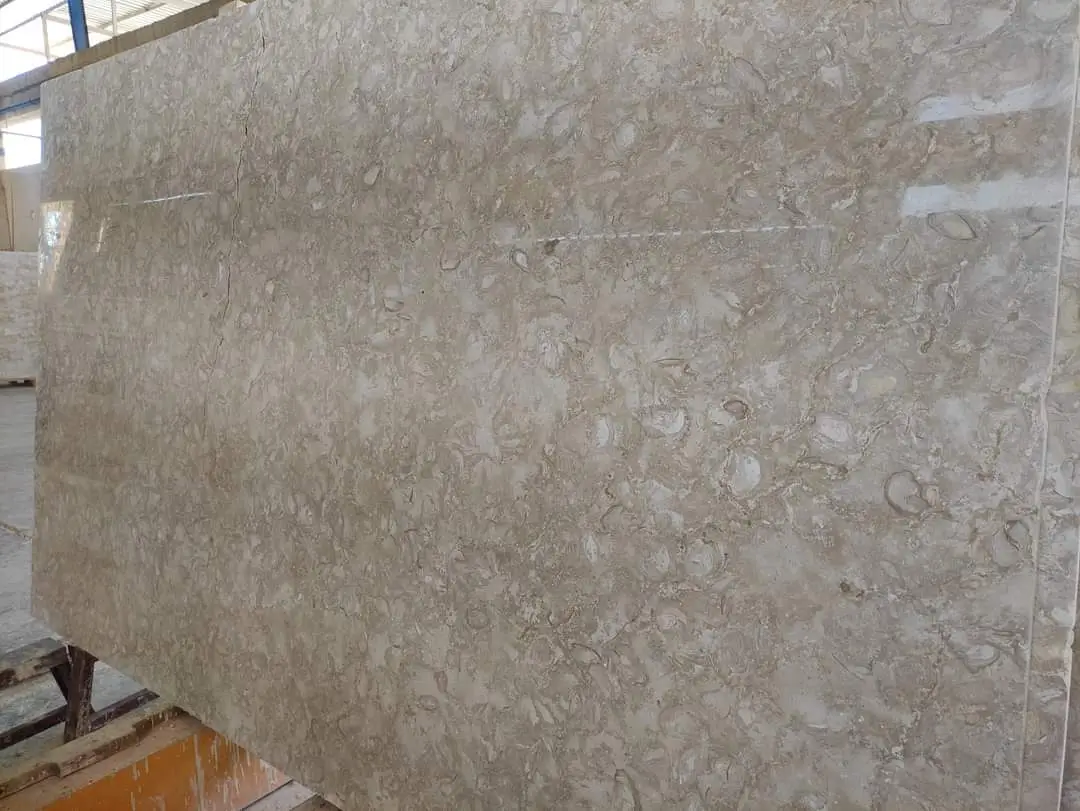
Natural stone varies in color, veining, and surface characteristics between quarry locations and even between extraction levels within the same quarry. When you purchase from dealer warehouse inventory assembled from multiple production lots, you risk noticeable variation that becomes obvious after installation.
Your specification should address single-lot sourcing requirements:
- You need to verify the dealer can supply your entire quantity from one production lot
- Your project benefits from reviewing sample pieces from the actual lot that will fulfill your order
- You should request lot numbers and production dates to confirm consistency
- Your installation crew needs to blend material from different crates within the lot to minimize any subtle variations
Dealers with deeper limestone supply levels Phoenix operations maintain can more readily accommodate single-lot sourcing requirements because they purchase full containers rather than mixed pallets. This capability matters most for projects exceeding 2,000 square feet where color consistency becomes visually critical.
Backup Supplier Strategy
Professional procurement practice requires you to identify secondary suppliers before you commit to project timelines and client deliverables. Relying on single-source availability creates unnecessary risk when available inventory limestone Arizona dealers maintain fluctuates constantly.
Develop relationships with at least two qualified suppliers who can fulfill your material requirements. This redundancy protects your project timeline when primary suppliers experience stockouts, delivery delays, or quality issues that require material rejection.
Your backup supplier strategy should include:
- You need to verify secondary suppliers stock comparable material that meets your specifications
- Your timeline protection requires confirming current inventory levels with backup suppliers before finalizing primary orders
- You should establish pricing agreements with secondary suppliers so you understand cost implications of switching sources
- Your risk management benefits from maintaining communication with multiple dealers throughout the procurement cycle
The cost of maintaining backup supplier relationships proves minimal compared to the schedule impact and cost penalties of material delays. Most dealers understand professional buyers maintain multiple sources and don’t expect exclusivity for projects under $50,000.
Cost Implications of Inventory
Understanding how inventory carrying costs affect dealer pricing helps you negotiate more effectively and identify opportunities for cost savings. Limestone supplier inventory Arizona dealers maintain represents significant capital investment that influences their pricing strategies and negotiation flexibility.
Dealers face carrying costs of 18-25% annually on warehouse inventory when you account for capital costs, storage facility expenses, insurance, shrinkage, and obsolescence risk. These costs create incentive for dealers to move inventory quickly, particularly for slower-moving specialty items or material that’s been in stock for extended periods.
You can leverage inventory dynamics for cost advantage:
- You’ll find better pricing on material that’s been in warehouse stock for 4-6 months or longer
- Your purchasing power increases significantly for orders that help dealers clear slow-moving inventory
- You should inquire about remnant lots and partial containers that dealers need to liquidate
- Your project timing affects negotiating leverage—end of quarter and year-end periods often yield better pricing
Conversely, newly arrived containers of popular specifications during peak season offer limited negotiating opportunity. Dealers know these items will sell quickly at full markup, reducing incentive to discount for early commitment or volume purchases.
Specification Flexibility
Your willingness to consider alternative specifications dramatically improves inventory availability and often delivers cost savings without compromising project requirements. Rigid specifications that call out single stone types, specific finish methods, or exact dimensions create unnecessary procurement risk.
Most project requirements can be satisfied by multiple material options that achieve equivalent performance and aesthetics. When you specify “white limestone pavers, 12×24, honed finish” rather than “Turkish Denizli marble, 12×24, premium honed,” you expand available inventory options from perhaps two dealers with limited stock to a dozen suppliers with adequate inventory.
Performance-based specifications offer the most flexibility while ensuring project requirements are met. Instead of specifying exact stone origin or trade names, define required characteristics:
- You should specify minimum compressive strength ratings rather than specific stone types
- Your specification benefits from defining acceptable color ranges using objective measurements
- You need to establish slip resistance requirements using DCOF standards rather than finish descriptions
- Your absorption rate limits ensure freeze-thaw durability without restricting material options
- You can define acceptable thickness tolerances that multiple stone types satisfy
This approach lets dealers propose in-stock limestone near me alternatives that meet performance criteria while accelerating delivery and potentially reducing costs. You maintain control over project requirements while eliminating artificial constraints that limit supply options.
Best Limestone Supplier in Arizona — How Citadel Stone Would Specify for Arizona
When you evaluate limestone supplier inventory Arizona options for your project, you’re assessing material availability across dramatically different climate zones and application requirements. At Citadel Stone, we provide technical guidance for hypothetical applications throughout Arizona’s diverse regions, from desert valleys to high-elevation pine forests. This section outlines how you would approach specification decisions for six representative cities based on their unique environmental conditions and typical project requirements.
Phoenix Valley Applications
In Phoenix installations, you would need to address extreme heat exposure that regularly exceeds 115°F during summer months. Your material selection should prioritize light-colored limestone with high solar reflectance to minimize surface temperatures that can reach 145-160°F on darker stone. You’d specify thermal expansion joints every 12-15 feet rather than the standard 20-foot spacing to accommodate the 40-50°F daily temperature swings common from May through September. For pool decks and outdoor living spaces, you should verify slip resistance ratings exceed 0.50 DCOF when wet, as these surfaces receive intense use during extreme heat periods when residents seek cooling opportunities.
Tucson Desert Specifications
Your Tucson specifications would account for similar heat challenges as Phoenix but with additional consideration for the area’s higher elevation and slightly greater temperature extremes. You’d need to address monsoon moisture patterns that create rapid wet-dry cycling from July through September, requiring material with absorption rates below 3% to prevent moisture-related degradation. The region’s caliche-rich soils require you to specify enhanced base preparation with proper drainage layers to prevent subsurface salt migration that causes efflorescence. You should recommend sealed finishes for any limestone applications within landscape areas that receive irrigation, as Tucson’s hard water contains dissolved minerals that create persistent staining on unsealed stone surfaces.
Scottsdale Luxury Applications
For Scottsdale’s high-end residential and resort markets, you would emphasize aesthetic consistency and premium finishing. Your specifications should address single-lot sourcing requirements for projects where color and texture uniformity matter critically to the overall design intent. You’d recommend honed or brushed finishes rather than polished surfaces for outdoor applications, as polished limestone becomes hazardous when wet and shows wear patterns quickly in high-traffic areas. When you specify for resort pool decks or entertainment areas, you need to account for heavy foot traffic combined with constant moisture exposure, requiring limestone with compressive strength exceeding 10,000 PSI and proven durability in similar applications.
Flagstaff Climate Considerations
In Flagstaff’s high-elevation environment, you would confront Arizona’s only significant freeze-thaw climate zone. Your limestone selection must prioritize freeze-thaw durability with absorption rates below 2% and proven performance in climates experiencing 60+ annual freeze-thaw cycles. You’d need to specify proper base preparation with 6-8 inches of compacted aggregate over well-draining subgrade to prevent frost heave that destroys paving installations. When you plan projects in Flagstaff, your installation timeline becomes constrained to May through October when ground conditions support proper base preparation and joint sand installation. You should avoid limestone applications in areas receiving road salt application, as the material’s calcium carbonate composition reacts with deicing chemicals to create surface degradation.
Sedona Aesthetic Integration
Your Sedona specifications would emphasize color coordination with the region’s iconic red rock formations. You’d typically recommend warm-toned limestone in buff, gold, or light brown ranges that complement rather than contrast with the natural landscape. The area’s tourism-focused commercial applications require you to specify slip-resistant finishes that maintain safety with heavy pedestrian traffic while preserving aesthetic appeal. You should account for the region’s strict building codes and design review requirements, which often mandate natural material palettes and restrict contemporary architectural elements. At Citadel Stone, we maintain warehouse inventory of warm limestone tones specifically to support Sedona-area projects requiring these earth-tone specifications.
Yuma Desert Conditions
For Yuma applications, you would address the most extreme heat conditions in Arizona, with summer temperatures consistently exceeding 110°F and occasional peaks above 120°F. Your specifications must prioritize maximum solar reflectance through light-colored stone selection, as darker materials become unusable during daylight hours when surface temperatures exceed 170°F. You’d need to account for minimal annual rainfall—only 3-4 inches—which eliminates many moisture-related concerns but creates dust accumulation issues requiring sealed surfaces for easier maintenance. When you specify limestone for Yuma’s agricultural service areas, you should address chemical exposure from fertilizers and pesticides that can stain or etch calcium carbonate stone, requiring protective sealing and maintenance protocols.
Common Availability Mistakes
Even experienced specifiers make procurement errors that create project delays and budget overruns. Understanding these common mistakes helps you avoid the inventory assessment failures that compromise timelines and force acceptance of suboptimal material alternatives.
Assuming verbal stock confirmation guarantees availability represents the most frequent error. You cannot rely on phone assurances without written documentation that includes lot numbers, specific quantities, and price locks. Material dealers face dynamic inventory situations where stock status changes daily as orders ship and new inventory arrives. Your verbal confirmation from Monday may be obsolete by Wednesday when you’re ready to issue a purchase order.
Other critical mistakes include:
- You risk delivery delays when you fail to distinguish between warehouse stock and order-fulfillment capability
- Your project timeline suffers when you assume lead time quotes include delivery to job site rather than terminal pickup
- You encounter consistency problems when you purchase from multiple small lots rather than requiring single-production-lot sourcing
- Your installation quality declines when you accept “similar” substitutions without verifying equivalent performance specifications
- You create budget surprises when you don’t confirm whether quotes include delivery, offloading, and return of pallets
Professional procurement practice requires written documentation for all material commitments, including confirmed inventory status, pricing with all associated costs, delivery timeline, and cancellation or return policies.
Final Guidance
Your success in navigating limestone supplier inventory Arizona challenges depends on understanding the distinction between dealer claims and verified availability. You need to approach procurement with professional skepticism that demands specific documentation rather than accepting vague assurances about stock levels and lead times.
The most reliable dealers maintain accurate inventory systems that let them provide specific lot numbers, current square footage counts, and definitive delivery schedules for warehouse stock. When you encounter dealers who can’t answer basic questions about physical inventory location and quantities, you’re likely discussing virtual inventory that introduces timeline risk.
Start your procurement process 4-6 weeks earlier than your required delivery date to accommodate realistic lead times for available inventory limestone Arizona suppliers maintain. This buffer protects your construction schedule from the inevitable delays that affect stone supply chains, including transportation disruptions, customs clearance delays, and quality issues requiring material rejection.
Your professional practice should include maintaining relationships with multiple qualified suppliers who can fulfill your specifications. For comprehensive information about warranty protection and long-term support, review Warranty coverage terms provided by Arizona limestone suppliers before you finalize major material commitments. Citadel Stone is one of the service-forward limestone suppliers near you in Arizona that provides clear, itemized quotes.