
How suppliers price limestone pavers: the cost components
Understanding the building blocks of a limestone paver quote helps you spot where DIY pickup and delivered orders diverge. Every supplier breaks costs into unit price, usable yield, fabrication, finishing, transport and ancillary fees—but not every supplier itemizes them clearly.
Unit price is typically quoted per square foot, per slab or per ton. When comparing Arizona limestone paver cost per square foot, confirm whether the supplier measures usable surface area or gross slab dimensions; some slabs include non-usable edges that inflate the quoted square footage. Usable yield accounts for natural fractures, resin-filled veins and trimmed edges that reduce the installable area below the slab’s nominal size.
Fabrication and cutting covers straight cuts, miter edges, radius work and cutouts for drains or posts. Edge work—bullnose, chamfer or honed—adds labor and machine time. Sealing may be bundled or quoted separately; penetrating sealers for outdoor pavers range widely in cost and longevity.
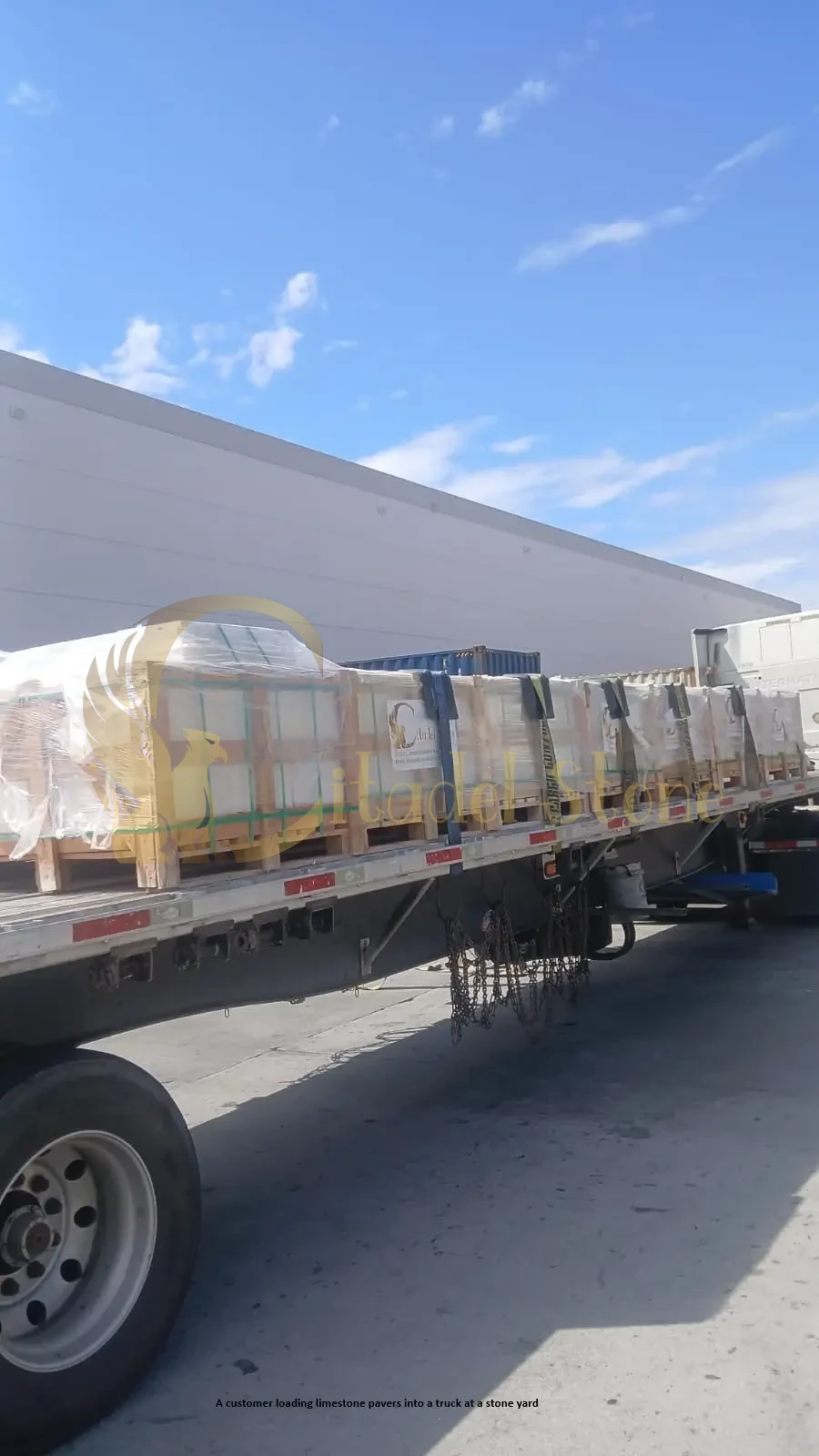
Delivery depends on truck type (flatbed, boom, crane truck), mileage from the yard, fuel surcharges and whether the driver will stage material beyond the curb. Crane and rigging fees apply when slabs must be lifted over walls, onto rooftops or into tight courtyards. Staging is sometimes free for a few days, but extended hold periods trigger storage fees. Sales tax in Arizona applies to materials and fabrication; rates vary by city and county. Local surcharges for gated-community access, after-hours delivery or oversized slab handling appear most often in delivered quotes—DIY pickup eliminates many of these line items but shifts labor and equipment rental onto the buyer.
Retail vs wholesale limestone pricing Arizona — what changes
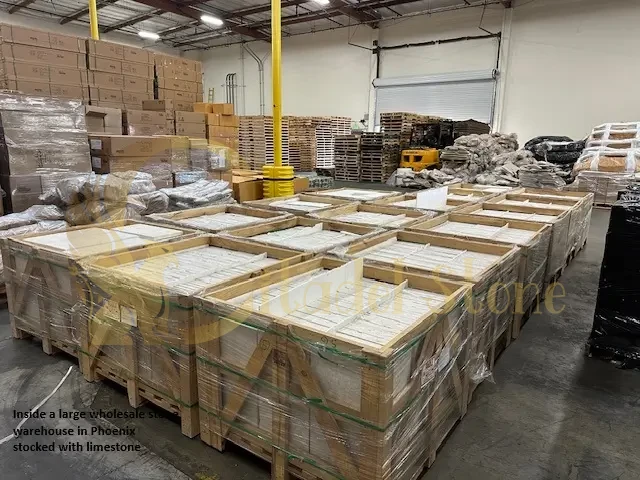
Retail pricing serves walk-in homeowners and small contractors who purchase in modest quantities, pay by credit card and expect immediate or next-day pickup. Retail stores build in showroom overhead, sales commissions and flexible return policies. Wholesale pricing targets trade accounts—licensed contractors, landscape architects and builders who open credit lines, meet minimum order thresholds (often 500 to 1,000 square feet) and accept limited return windows. Direct-from-dealer pricing sits between retail and wholesale; local stone yards that import or quarry their own material often offer competitive unit costs without requiring resale licenses, but they may lack showroom displays and demand cash or wire payment.
Typical wholesale vs retail limestone pricing Arizona discounts range from 15 to 35 percent off retail for trade buyers, with deeper cuts on volume orders above 2,000 square feet. Remnant packs—odd-lot slabs from previous jobs—can deliver 40 to 50 percent savings but require flexibility on color matching and slab sizes. Volume breakpoints commonly appear at 500, 1,000 and 2,500 square feet; each tier unlocks incremental discounts on unit price, fabrication and delivery.
Decision rules for selecting retail vs wholesale:
- Choose retail if you need fewer than 300 square feet, want to inspect every slab in person before purchase, or lack a contractor license and resale account.
- Choose wholesale if you hold a valid contractor license, order 500+ square feet, can commit to specific slab IDs without extensive showroom browsing, and accept Net-30 or wire-transfer payment terms.
- Consider direct dealers for mid-size projects (400–800 sqft) where you want competitive pricing without trade-account paperwork, especially if you can pick up material yourself and waive delivery fees.
DIY store pickup vs delivery: total cost comparison method
Calculating true landed cost requires adding every expense—material, waste, transport, labor, equipment and time—not just the unit price. Use this step-by-step method to compare DIY limestone paver purchase Phoenix pickup against delivered orders.
Step 1: Calculate usable material cost
Multiply unit price by total usable square feet. If the supplier quotes per slab, multiply usable square feet per slab by the number of slabs, then multiply by price per square foot. If quoted per ton, convert tons to square feet using the supplier’s thickness and density chart.
Step 2: Add waste allowance
Standard waste for rectilinear pavers is 5 to 8 percent; Versailles or Ashlar patterns require 10 to 15 percent. Multiply material cost by the waste percentage.
Step 3: Add fabrication and finishing
Sum itemized charges for cuts, edge profiles and sealing. Request line-item pricing so you can compare across suppliers.
Step 4: Add transportation
For DIY pickup: truck or trailer rental, fuel, insurance, helper labor to load and unload, equipment rental (forklift, pallet jack, straps). For delivery: flat delivery fee, per-mile charges beyond a base radius, crane or boom-truck fees, driver wait time if staging isn’t ready.
Step 5: Factor labor and time cost
DIY pickup demands your time and muscle; estimate hours and assign a dollar value. Delivery may include curbside drop or white-glove placement; clarify in the quote.
Step 6: Sum the project line total
Add material with waste, fabrication, transport, labor and any ancillary fees (permits, access charges, storage).
Run this method for both pickup and delivery scenarios from at least two suppliers to identify the lower landed cost. The Cost Calculator Formula block in the templates section provides a copy-ready formula for spreadsheet use.
How to request apples-to-apples quotes (itemized request checklist)
Fair price comparisons require identical line items from every supplier. Without itemization, you’re comparing apples to oranges—one quote may bundle fabrication while another separates it, or one includes delivery while another assumes pickup.
Itemized quote request checklist:
- Unit of measure: Confirm square foot, slab or ton, and whether usable or gross area.
- Slab identification: Request slab IDs or photos so you can verify color, veining and finish consistency.
- Usable square feet per slab: Ask for net installable area after trimming unusable edges.
- Waste allowance percentage: Confirm the supplier’s recommended overage for your pattern.
- Fabrication detail: Line-item every cut, edge profile and hole; specify linear feet or per-cut pricing.
- Sealing: Yes or no, product type, cost per square foot, warranty.
- Delivery vehicle and distance: Flatbed, boom truck or crane truck; base radius included; per-mile rate beyond base; fuel surcharge.
- Crane or rigging charges: Boom reach, tonnage limits, hourly minimums, site-access fees.
- Lead time: Days from order to delivery; any rush fees.
- Hold and storage policy: Free staging period, daily or weekly fees thereafter.
- Payment terms: Deposit percentage, Net terms for trade accounts, credit-card surcharges.
Use the Itemized Quote Request Email template (included in the templates section) to send a uniform request to every supplier. Collecting identical data points ensures your comparison spreadsheet reflects true cost differences, not formatting inconsistencies.
Pricing examples and scenario comparisons
These three scenarios illustrate how costs shift across project sizes, purchase channels and delivery methods. Use placeholder percentages and your own supplier quotes to build accurate estimates.
Scenario A: Small patio DIY pickup (homeowner, 200 sqft)
A homeowner in Scottsdale selects tumbled limestone pavers for a courtyard entry. The retail store quotes $[X] per square foot; usable yield is 95 percent per slab. Waste allowance is 8 percent for a running-bond pattern. Fabrication includes straight cuts at $[Y] per linear foot. The homeowner rents a truck for $[Z], drives 15 miles round-trip, and spends three hours loading and unloading with a helper. Sealing is DIY. Total pickup cost includes material, waste, fabrication and truck rental—but eliminates the $[delivery fee] and $[crane charge] a delivered order would carry. This scenario favors DIY when the homeowner has access to a capable vehicle, helper labor and time flexibility.
Scenario B: Mid-size backyard delivered (contractor, 800 sqft, retail pricing)
A Mesa contractor orders honed limestone pavers for a pool deck. Retail pricing applies because the contractor lacks a trade account with this supplier. Unit price is $[A] per square foot; usable yield 93 percent; waste allowance 10 percent for a Versailles pattern. Fabrication totals $[B] for radius cuts around the pool coping. Delivery via flatbed is $[C] flat fee within 25 miles; no crane needed because the backyard has direct driveway access. Sealing by the supplier adds $[D] per square foot. The contractor values time saved by delivery and professional staging, offsetting the limestone paver delivery cost Arizona against labor diverted from installation tasks. This scenario favors delivered retail when project timelines are tight and the site permits truck access.
Scenario C: Large project wholesale purchase (contractor, 2,500 sqft)
A Gilbert contractor with a wholesale account orders tumbled pavers for a resort courtyard. Wholesale unit price is 25 percent below retail; usable yield 96 percent; waste allowance 7 percent for rectilinear layout. Bulk fabrication discount reduces per-cut fees by 15 percent. Delivery requires a crane truck to lift material over perimeter walls; crane fee is $[E] flat, negotiated and capped in the contract. Wholesale terms include Net-30 payment, eliminating credit-card fees. Total delivered cost per square foot drops significantly below retail due to volume discounts, wholesale pricing and consolidated delivery. This scenario highlights when wholesale channels and delivery offer the lowest landed cost, especially when crane logistics are unavoidable regardless of purchase method.
Each scenario shows that the lowest unit price does not guarantee the lowest total cost—transportation, labor, waste and fabrication swing the outcome. Run your own numbers using the Cost Calculator Formula to compare your specific project.
Negotiation levers and procurement tips for Arizona buyers
Smart negotiation reduces costs without sacrificing quality or reliability. Deploy these tactics when requesting quotes and signing contracts.
Consolidate deliveries: If ordering pavers, coping and step treads, request a single delivery window to avoid multiple truck fees. Suppliers often waive or reduce delivery charges for combined orders above a minimum tonnage.
Negotiate capped crane fees: Crane charges can escalate if the operator encounters site delays. Request a fixed hourly rate with a three-hour cap, and confirm the boom reach and tonnage limits in writing before delivery day.
Ask for remnant credits: If your project uses full slabs with minimal cuts, ask whether the supplier will buy back or credit large offcuts for their remnant inventory. This tactic works best with direct dealers who resell remnants.
Combine fabrication with slab purchase: Bundling edge work, sealing and installation with the material order can unlock package discounts—suppliers prefer one-stop transactions that reduce administrative overhead.
Request staged photo proof: Before delivery, ask the yard to send time-stamped photos of your slabs staged in their lot, confirming color consistency and finish quality. This prevents job-site surprises and reduces the risk of rejected loads.
Secure Net terms for large contractors: Established contractors should negotiate Net-15 or Net-30 payment terms to preserve cash flow during multi-phase projects. Wholesale accounts routinely offer Net terms; retail rarely does.
When to choose DIY pickup: Small projects under 300 square feet, accessible storage at your site, flexible schedule, capable vehicle and helper labor available. DIY shines when delivery fees and crane charges exceed truck-rental and labor costs.
When delivery is safer: Pool decks, rooftop terraces, gated estates with long driveways, projects above 500 square feet, or when your installation crew’s time is more valuable on-site than driving to the supplier.
Hidden fees to watch for in Arizona quotes
Unanticipated charges erode budgets and delay projects. Question suppliers directly to surface these common fees before signing.
Gated-community access fees: Many Scottsdale and Paradise Valley suppliers add $50 to $150 per delivery for guard-gate clearance and HOA coordination. Ask: “Do you charge extra for gated or HOA-managed communities?”
Oversized slab handling: Slabs over 8 feet or 1,200 pounds may trigger handling surcharges for special equipment. Ask: “Is there a handling fee for slabs over [dimension/weight]?”
After-hours delivery charges: Deliveries before 7 a.m. or after 4 p.m. often cost 25 to 50 percent more. Ask: “What are your standard delivery hours, and what is the after-hours fee?”
Short-notice rush charges: Orders confirmed fewer than three business days before delivery may incur expedite fees. Ask: “What is your standard lead time, and is there a rush fee for shorter windows?”
Small-cut multipliers: Fabrication shops sometimes charge double or triple rates for cuts under 12 inches because setup time equals labor for full cuts. Ask: “Do you charge a minimum or multiplier for cuts shorter than one foot?”
Extra resin-fill labor: Natural limestone often requires resin filling of voids and fissures; if your slabs need extensive fill, the supplier may add labor beyond the base price. Ask: “Is resin fill included in the slab price, or is it itemized separately?”
Each question forces the supplier to disclose the fee structure upfront, preventing invoice surprises at project close.
Explore Our Paver Selection Across Arizona!
Metro Pricing Signals — Phoenix through Tempe
Phoenix
Phoenix’s size and competitive supplier density create favorable pricing for large projects, but summer heat drives demand spikes in spring and fall when contractors stockpile inventory. Delivery fees within the metro core (zip codes 850xx) are typically lower than outer suburbs; expect $100 to $200 base delivery for flatbed within 20 miles, with per-mile charges beyond. Crane access is common for midtown renovations where narrow lots and perimeter walls restrict truck positioning. Wholesale accounts flourish because of high contractor volume, offering 20 to 30 percent discounts on orders above 1,000 square feet. When requesting quotes in Phoenix, ask: “What is your delivery base radius and per-mile rate beyond it, and do you offer staging photos before delivery day?”
Tucson
Tucson suppliers serve a mix of residential remodels and hospitality projects near resorts and golf communities. Limestone paver delivery cost Arizona calculations here must account for elevation changes and monsoon-season road closures that can delay deliveries in July and August. Many local yards carry Cantera limestone imported from Mexico, offering competitive pricing on tumbled and chiseled finishes. Wholesale minimums are often lower than Phoenix—around 500 square feet—because Tucson’s contractor market is smaller but steady. Remnant availability peaks in late fall after summer project completions. Ask suppliers: “Do you have remnant packs available, and what is your policy on delivery delays during monsoon weather?”
Mesa
Mesa’s sprawl and auto-dependent layout mean longer average hauls from central supplier yards, particularly for projects in Power Road and Val Vista corridors. Delivery fees reflect mileage; budget an additional $0.50 to $1.50 per mile beyond a 15-mile base radius. DIY pickup is popular among Mesa homeowners because many own trucks and trailers suited to hauling pavers. Retail stores in Mesa often stock tumbled travertine and limestone side-by-side, allowing in-person color matching. Arizona limestone paver cost per square foot at Mesa retail outlets trends 5 to 10 percent below Scottsdale showrooms due to lower overhead. Ask: “What is your base delivery radius from this yard, and do you charge for staging material in my driveway overnight?”
Chandler
Chandler’s newer housing stock and master-planned communities create consistent demand for high-end limestone finishes—honed, brushed and sandblasted. Many suppliers service Chandler from Phoenix and Tempe yards, so delivery windows may be limited to specific weekdays to optimize route efficiency. Gated-community access fees are common; clarify whether the supplier handles HOA paperwork or expects the buyer to obtain delivery authorization. Wholesale pricing is accessible to licensed landscape contractors who dominate Chandler’s commercial-build market. When quoting Chandler projects, ask: “Do you charge a fee for gated-community delivery, and can you coordinate HOA clearance, or is that my responsibility?”
Scottsdale
Scottsdale’s luxury market drives demand for premium limestone—book-matched slabs, hand-selected veining and custom edge profiles—resulting in higher average Arizona limestone paver cost per square foot than other metros. Delivery logistics are complicated by narrow desert-lot driveways, decorative landscaping and strict HOA delivery-hour restrictions (often 8 a.m. to 3 p.m. weekdays only). Crane and boom-truck fees are standard for North Scottsdale hillside properties where material must be lifted over retaining walls. Wholesale vs retail pricing gaps widen in Scottsdale because high-end designers maintain trade accounts and negotiate volume discounts on multi-property projects. Ask: “What are your delivery-hour restrictions for Scottsdale HOAs, and do you offer book-matched slab selection for an upcharge?”
Glendale
Glendale suppliers benefit from proximity to industrial corridors along Grand Avenue, where stone importers and fabrication shops cluster. This geography supports competitive wholesale pricing and shorter lead times for large orders. DIY pickup is straightforward—many yards offer forklift loading during business hours at no extra charge. Glendale’s mix of older residential neighborhoods and new developments creates steady remnant inventory turnover; contractors often find 200 to 400 square feet of discounted material suitable for smaller patios and walkways. Delivery fees to West Valley zip codes (853xx, 854xx) are lower than cross-metro hauls to East Valley cities. Ask: “Do you have remnant inventory I can inspect, and is forklift loading included if I pick up myself?”
Gilbert
Gilbert’s rapid residential growth fuels demand for limestone pavers in backyard entertaining spaces—outdoor kitchens, fire-pit seating and pool decks. Suppliers serving Gilbert from Chandler and Mesa yards often bundle delivery with installation services, offering turnkey packages that include material, fabrication, sealing and labor. Limestone paver delivery cost Arizona to Gilbert zip codes (852xx) is competitive when ordering through Mesa-based dealers. Wholesale pricing requires contractor licenses, but direct dealers near Gilbert offer mid-tier pricing without trade-account paperwork. Ask: “Do you offer bundled delivery and installation packages, and what is the price difference versus material-only orders?”
Tempe
Tempe’s dense mix of ASU campus projects, downtown infill and residential remodels creates year-round supplier activity. Delivery fees are among the metro’s lowest because many yards operate within Tempe city limits or adjacent Guadalupe. Small-lot access challenges—particularly near downtown and older neighborhoods south of University—mean crane fees appear more often in Tempe quotes than in suburban markets. Retail stores near Mill Avenue cater to DIY homeowners and small contractors, stocking 12×12 and 16×16 tumbled pavers for quick pickup. Wholesale accounts are common among ASU facility contractors and multifamily developers. Ask: “What is your crane fee for small-lot access, and do you stock standard-size pavers for same-day pickup?”
See 50+ Real Arizona Backyard & Patio Installations in Our Complete Design Gallery!
Cost comparison templates & tools (copy-ready)
Pricing Comparison Template (copy-ready)
Use this template to capture consistent data from every supplier and identify the true lowest cost.
| Field | Supplier 1 | Supplier 2 | Supplier 3 |
|---|---|---|---|
| Supplier name | |||
| Unit of measure (sqft/slab/ton) | |||
| Unit price | |||
| Usable sqft per slab | |||
| Waste allowance % | |||
| Fabrication (cuts/edges) itemized | |||
| Sealing (Y/N & price) | |||
| Delivery (truck type, distance, fee) | |||
| Crane/rigging fee | |||
| Hold/storage fee | |||
| Lead time | |||
| Total delivered cost (formula cell) |
Cost Calculator Formula (copy-ready)
Inputs:
Unit Price (UP)
Slab Usable Sqft (US)
Quantity Slabs (Q)
Waste% (W)
Fabrication Cost (F)
Delivery Fee (D)
Crane Fee (C)
Sealing Cost (S)
Other Fees (O)
Calculations:
Total Usable Area = US × Q
Material Cost = UP × Total Usable Area
Waste Allowance = Material Cost × (W)
Total Material with Waste = Material Cost + Waste Allowance
Project Fabrication = F
Delivery & Rigging = D + C
Sealing & Other = S + O
Project Line Total = Total Material with Waste + Project Fabrication + Delivery & Rigging + Sealing & Other
Itemized Quote Request Email (copy-ready)
Subject: Itemized Quote Request — [Project City, AZ] — [Approx sqft]
Hello [Supplier Name],
Please provide an itemized quote for limestone pavers for a project in [City, AZ]. Please include: unit (sqft/slab), unit price, usable sqft per slab, waste allowance %, itemized fabrication/edge work, sealing (if offered), delivery fee (truck type & distance), any crane/rigging charges, lead time, and hold/storage policy. Please attach clear slab photos and identify slab IDs if available.
Thank you,
[Name | Company | Phone]
Phone Script — Quick delivery & staging check (copy-ready)
Hi — I’m calling about limestone pavers for [City]. Is the material staged and available? Can you confirm shaded staging photos and next available delivery window with truck type?
Conclusion & immediate buyer checklist
Smart limestone paver procurement in Arizona hinges on comparing total landed costs—not just unit prices—across DIY pickup, delivered retail and wholesale channels. Hidden fees, delivery logistics and fabrication variables shift the true cost per square foot significantly between Phoenix, Scottsdale, Tucson and the other metros.
Immediate action checklist:
- Request itemized quotes from one retail store, one local direct dealer and one wholesaler (if you hold a contractor license). Use the Itemized Quote Request Email template.
- Run the Pricing Comparison Template for all three quotes, capturing unit price, usable yield, waste allowance, fabrication, delivery and crane fees.
- Apply the Cost Calculator Formula to compute total landed cost per square foot for both DIY pickup and delivered scenarios.
- Decide feasibility of DIY pickup: Do you have a capable vehicle, helper labor, time flexibility and accessible storage? If yes, compare total pickup cost (including truck rental, fuel, labor) against the delivered quote.
- Lock delivery windows in writing: Confirm date, time range, truck type, driver contact, and whether staging beyond the curb is included. Request staged photos 48 hours before delivery.
- Negotiate caps on crane fees, after-hours charges and storage holds before signing the purchase order.
Armed with itemized data, clear formulas and city-specific insights, you can confidently select the limestone paver purchase channel that delivers the best value for your Arizona project. Citadel Stone distributes precision-cut limestone pavers to job sites across Arizona with reliable scheduling.