
What “On-Site Fabrication” Really Means for Limestone Projects
“On-site fabrication” encompasses multiple service models with dramatically different capabilities and cost implications.
True on-site fabrication: Suppliers bring CNC routers, bridge saws, polishing equipment, and skilled operators directly to job sites performing cutting, edge finishing, and fitting operations where material will be installed. This model suits complex installations requiring real-time adjustments, projects with restricted yard access preventing pre-fabrication, or luxury applications demanding field seam approval before permanent placement.
Mobile templating with off-site fabrication: Technicians visit sites with laser or 3D scanners capturing precise measurements, then return to centralized shops for cutting and finishing. This hybrid model balances accuracy and controlled shop quality but offers less flexibility for field changes than true on-site cutting.
Off-site fabrication only: All cutting, finishing, and preparation occurs at supplier yards or fabrication shops. Material arrives job-ready requiring only installation. This traditional model provides superior finish consistency and dust control but demands accurate advance templating and offers no field-adjustment capability.
Common on-site services Arizona suppliers offer: On-site cutting and dry-fitting for seam verification before permanent installation, small-format CNC routing for intricate architectural details impossible to pre-fabricate accurately, field edge-finishing adjusting profiles to match existing conditions, on-site seam placement and alignment using direct sunlight to verify color continuity, crane and hoist coordination staging heavy slabs for complex multi-story placements.
When on-site work is necessary in Arizona: Large exterior terraces where thermal expansion requires field-fit tolerances, irregular site access (narrow gates, tight stairwells) preventing delivery of pre-cut oversized pieces, urgent repairs to occupied buildings where shop turnaround delays project completion, complex site mock-ups for high-visibility installations where clients demand seam approval under actual lighting conditions. Arizona’s extreme heat (115°F+ summers) and monsoon season (July–September) create job-site challenges—dust suppression, water management, early-morning work windows—requiring sophisticated on-site operational protocols.
Key Equipment & Capability Checklist Suppliers Must Have
Comprehensive custom limestone fabrication dealer capability requires specific equipment, skilled operators, and process controls contractors must verify before engagement.
Equipment & Capability Verification Checklist (Copy-Ready)
Bridge saws and cutting capacity:
- Maximum slab dimensions the saw accommodates (standard 120″×70″ minimum for full slabs)
- Blade types and diameters for limestone versus granite or harder stones
- Wet-cutting systems with integrated water recycling preventing dust and overheating
- Precision: verify ±1mm tolerances for straight cuts, ±2mm for angled cuts
Why it matters: Arizona’s heat expands blade guides; temperature-compensated saws maintain tolerances. Wet systems suppress dust critical in Arizona’s residential neighborhoods.
CNC router and table capacity:
- CNC bed dimensions (minimum 10’×6′ for architectural work; 12’×8’+ for large panels)
- Spindle power (18,000–24,000 RPM for clean limestone edges)
- Tool-change capability (automatic tool changers enable complex profiles without manual intervention)
- Software: CAD/CAM integration allowing client drawings to drive cutting paths
- Tolerances: ±0.5mm achievable for precision architectural details
Why it matters: Limestone CNC cutting Arizona projects demand precision matching existing structures. Underpowered spindles produce ragged edges requiring hand-finishing doubling labor costs.
Waterjet cutting availability:
- Cutting pressure (50,000–90,000 PSI for limestone)
- Abrasive systems (garnet or alternative) and flow rates
- Maximum cutting thickness (2cm standard; verify 3cm+ capability if needed)
Why it matters: Waterjet produces zero heat avoiding thermal stress in delicate limestone. Essential for intricate cutouts (circles, curves, irregular shapes) impossible with blade saws.
Polishing lines and edge-finishing equipment:
- Number of polishing passes available (minimum 4–6 passes for mirror finish)
- Grit progression (120→220→400→800→1500→3000 for high-polish)
- Edge-profile capability (bullnose, bevel, ogee, custom profiles)
Why it matters: Arizona sunlight reveals inconsistent edge polish. Multi-pass lines ensure uniform sheen matching slab faces.
Point-drilling and dowel insertion capability:
- Precision drilling for mechanical anchors and dowel pins
- Depth-control systems preventing breakthrough on thin slabs
Why it matters: Exterior Arizona installations require secure mechanical fastening resisting wind loads and thermal cycling.
In-house measurement and templating systems:
- Laser templating (accurate to ±2mm over 20-foot spans)
- 3D scanning for complex surfaces and irregular conditions
- Digital file delivery (DXF, DWG formats for client review)
Why it matters: Arizona’s gated communities and custom homes have unique architectural details. Precise templating prevents costly field rework.
Resin fill and repair shop:
- Color-matching capability for Arizona limestone varieties
- Controlled application (not field-applied uncontrolled resin)
- Curing systems maintaining consistent hardness
Why it matters: Natural limestone contains voids requiring professional filling. Arizona heat accelerates improper resin curing causing discoloration.
Crane, hoist, and rigging coordination capacity:
- Owned equipment versus subcontractor relationships
- Operator certifications and insurance coverage
- Multi-story placement experience in Arizona gated communities
Why it matters: Many Arizona installations require hoists navigating HOA restrictions and narrow access paths. Integrated rigging simplifies coordination.
On-site cutting permits and compliance:
- Understanding of municipal noise ordinances and dust regulations
- Portable containment systems for on-site work
Why it matters: Phoenix, Scottsdale, and other cities restrict construction hours and dust emissions. Suppliers must navigate regulations.
Safety and containment procedures:
- Dust suppression (water systems, HEPA vacuums, containment barriers)
- Water runoff management preventing job-site contamination
- PPE requirements for crews (respirators, hearing protection, safety glasses)
Why it matters: Arizona residential sites demand strict dust and water control. Neighbors and HOAs file complaints forcing project shutdowns without proper containment.
Service Offerings: Common On-Site Workflows
Understanding operational sequences helps contractors anticipate requirements and coordinate subcontractors effectively.
Step-by-Step On-Site Workflow
Step 1 — Site survey and templating (1–3 hours on-site): Technicians visit with laser or 3D scanning equipment capturing measurements, photographing existing conditions, and noting access constraints (doorways, stairwells, crane zones). Digital files go to shop for cutting-path programming. Arizona heat requires early-morning surveys (6–9 AM) when thermal expansion is minimal.
Step 2 — Slab selection and staging (shop-based, 1–3 days): Based on templates, supplier pulls slabs matching specifications, photographs options, and stages for client approval. Contractors review slab IDs and photos remotely or visit yard for in-person selection.
Step 3 — Field mock-up and seam placement (on-site, 2–6 hours): For high-visibility installations, supplier delivers slabs to site positioning them dry (uninstalled) allowing client to view seams, color transitions, and overall appearance under actual lighting. Arizona’s intense sun reveals undertones invisible in indoor showrooms—mock-ups prevent costly post-installation dissatisfaction.
Step 4 — On-site cutting and alteration (on-site, varies): If field conditions differ from templates or design changes occur, suppliers with mobile CNC or bridge-saw capability cut on-site. Simple straight cuts: 30–60 minutes per piece. Complex profiles or intricate details: 1–3 hours per piece. Dust suppression and water management required.
Step 5 — Hoist, placement, and installation (on-site, 4–12 hours): Crane or hoist lifts slabs into position. Installers set, level, grout, and secure per specifications. Multi-story placements or gated-community restrictions extend timelines requiring early-morning windows (6–10 AM) common in Arizona HOA neighborhoods.
Step 6 — Final polishing and sealing (on-site, 1–3 hours): After installation, crews polish edges, clean surfaces, and apply protective sealers. Arizona UV and mineral-rich irrigation water demand high-quality sealers—verify products resist calcium deposits and chlorine if near pools.
Equipment selection by task: CNC routers handle intricate profiles, decorative edges, and precision cutouts (±0.5mm tolerances). Bridge saws perform straight cuts, simple angles, and rough-dimensioning (±1mm tolerances). Waterjets cut curves, circles, and delicate materials without thermal stress. Polishing equipment applied on-site or in-shop depending on finish requirements and dust-control capabilities.
Tolerances to expect: Shop-based CNC: ±0.5mm for critical dimensions. On-site CNC: ±1mm due to environmental variables (temperature, humidity, substrate levelness). Bridge saw (shop or field): ±1–2mm. Hand-finishing: ±3–5mm requiring skilled craftsmanship.
How to Verify True On-Site Fabrication Capability
Distinguishing genuine on-site capability from marketing claims requires systematic verification preventing costly mid-project discoveries.
Request recent project photos with timestamps: Ask: “Please email photos from three projects within the past six months showing your equipment and crew performing on-site cutting or templating, with date stamps visible.” Photos should show CNC or bridge-saw operation, crew performing work, and recognizable job-site conditions (not generic shop images).
Require project list with client contacts: “Provide names and phone numbers for three clients where you performed on-site fabrication in [your city] within the past year.” Call references asking: “Did supplier bring cutting equipment to your site or was all fabrication done off-site? Were you satisfied with quality and timeline?”
Request equipment specifications in writing: “Email your CNC bed dimensions, spindle power, software platform, and achievable tolerances. Include bridge-saw model, blade diameter, and maximum slab capacity.” Compare specifications against project requirements—undersized equipment cannot deliver promised results.
Declare in-house versus contracted services: “Confirm whether on-site fabrication uses your owned equipment and employees or subcontracted services.” Subcontractors add communication layers and reduce control over quality and scheduling.
Request live demonstration or video call: “Can you arrange a video call showing your CNC in operation, or can I visit your shop to see equipment running?” Live verification prevents stock-photo misrepresentation.
Copy-Ready Questions for Supplier Verification
- “What is your CNC bed size, spindle RPM, and achievable tolerances for limestone?”
- “Do you own your on-site cutting equipment or subcontract mobile fabrication?”
- “Can you provide three recent project references where you performed on-site cutting in [City]?”
- “What dust-suppression and water-management systems do you use for on-site work?”
- “Do you perform resin fills and edge polishing on-site or only at your shop?”
- “What’s your typical lead time from templating to on-site cutting completion?”
- “Can you email photos of your CNC and bridge-saw equipment with date stamps showing recent use?”
- “What safety certifications and insurance do your on-site crews carry?”
- “Have you obtained on-site cutting permits for [specific City] projects, and do you handle permitting or do I?”
- “Can I schedule a shop visit to see your equipment in operation before committing?”
Direct, specific questions force honest disclosure or reveal evasive responses signaling unverified capability.
Quality Checks: What to Look for in Sample Pieces and On-Site Cuts
Systematic inspection at multiple project stages prevents accepting substandard work requiring expensive remediation.
Quality Inspection Checklist (Copy-Ready)
Cut-edge thickness consistency: Measure slab thickness at multiple points along cut edges using calipers. Variance exceeding ±1mm indicates blade wander or inadequate saw rigidity. Consistent thickness ensures proper fitting and professional appearance.
Verify square and parallel faces: Place straightedge along cut edges checking for gaps. Edges should be perfectly straight (±1mm over 3-foot span). Check corners with framing square—90° angles shouldn’t deviate more than 1–2mm. Out-of-square pieces create visible gaps in installations.
Inspect resin and patch finishing quality: Examine filled voids under bright light and sunlight. Professional fills match surrounding stone color with smooth surface transitions. Amateur fills appear glossy, discolored, or raised above the surface. Arizona sun amplifies poor resin work.
Verify edge-profile uniformity: Run finger along bullnose, bevel, or custom edges feeling for irregularities. Profiles should be consistent within ±0.5mm across entire edge length. Variations create visible undulations catching Arizona’s low-angle morning/evening light.
Check polish tones match across pieces: View multiple slabs side-by-side under identical lighting. Polish sheen should be uniform—some areas appearing matte while others mirror-polished indicates incomplete finishing. Arizona showrooms use fluorescent lights; insist on outdoor inspection under natural sun.
Inspect undersides and back faces for fissures: Flip slabs examining unpolished backs for hairline cracks, delamination, or structural weaknesses. Back-side issues invisible on polished faces can propagate causing failures after installation.
Photograph seams in shaded and direct light: Document seam quality under both conditions. Arizona sun reveals color mismatches invisible in shade. Take photos at different times of day (morning, midday, late afternoon) capturing how changing light affects appearance.
Verify water-absorption test if specified: Place water drops on unpolished edges or backs. High-quality limestone absorbs slowly (30–60 seconds before soaking). Immediate absorption indicates high porosity accelerating staining in Arizona’s irrigation-heavy landscapes.
Arizona’s environmental conditions—intense UV, temperature extremes (115°F summer, 30°F winter), mineral-rich water—stress limestone more than moderate climates. Quality standards acceptable elsewhere may fail in Arizona; inspect rigorously.
Pricing & Quotation: How to Request an Honest On-Site Fabrication Quote
Structured quote requests prevent vague estimates that balloon during project execution.
Request itemized line items: “Please separate templating costs, cutting charges, CNC hours at specified shop rate, field edge-finishing labor, crane and hoist mobilization, permit fees, and travel/mobilization charges. Do not bundle into lump-sum pricing.”
Require estimated CNC hours and shop rates: “For this project requiring [describe cuts], estimate CNC hours and provide your shop rate ($/hour). Itemize simple cuts versus complex profiles separately.”
Include remnant and waste allowances: “Quote should specify waste percentage (typically 8–15% for cutting loss) and clarify whether remnant pieces remain my property or return to you.”
Ask for lead times and travel windows: “Confirm days from templating to on-site cutting completion. Specify mobilization windows (e.g., ‘crew arrives 7–9 AM, completes by 2 PM’) so I can coordinate other trades.”
Clarify what’s included versus extra: “Does your quote include dust containment, water management, site cleanup, and haul-away of cut-offs? Or are these additional?”
Pricing Request Template (Copy-Ready)
Subject: On-Site Fabrication Quote Request – [Project Name/Location]
Hello [Supplier Contact],
I’m requesting an itemized quote for custom limestone cutting and on-site fabrication for [project description] in [City, Arizona].
Project specifications:
- Material: [limestone variety, finish, thickness]
- Quantity: [square footage or number of pieces]
- Cutting requirements: [straight cuts / edge profiles / curves / cutouts]
- Installation location: [address with access notes]
- Timeline: [desired completion date]
Please provide itemized pricing for:
- Templating: On-site measurement, 3D scanning if needed, digital file delivery
- Material cost: Per SF or per slab with slab IDs
- Fabrication: CNC hours (estimate) × shop rate, or per-cut pricing
- Edge finishing: Linear-foot pricing for [specified profile]
- On-site cutting: Mobilization, equipment setup, cutting time, crew labor
- Polishing/sealing: On-site or shop-based, products used
- Crane/hoist: Equipment rental, operator, insurance
- Permits: Any required city permits for on-site work
- Travel/mobilization: Fees for bringing equipment to site
- Waste allowance: Percentage and how remnants are handled
- Cleanup: Site cleanup and cut-off removal
Additionally, please provide:
- Equipment specifications (CNC bed size, bridge-saw capacity, waterjet if needed)
- Recent photos of your equipment performing on-site work (with date stamps)
- Three project references where you performed on-site fabrication in [City]
- Lead time from templating to completion
- Payment terms and deposit requirements
We’re comparing multiple supplier on-site fabrication Phoenix [or your city] options and will decide within [timeframe].
Thank you,
[Your Name, Company, Contact Info]
Health, Safety & Environmental Controls for On-Site Cutting in Arizona
Regulatory compliance and neighborhood relations demand rigorous on-site operational protocols.
Dust suppression requirements: Arizona municipalities enforce dust-control ordinances. On-site cutting must use water-fed saws with integrated suppression or HEPA-filtered vacuum systems. Dry-cutting violations result in fines ($500–$5,000) and stop-work orders. Verify: “What dust-suppression systems do you use for on-site work, and can you provide documentation showing compliance?”
Water management and runoff controls: Cutting slurry (water, limestone particles, abrasive residue) cannot enter storm drains or landscaping. Suppliers must use containment systems—berms, tarps, vacuum recovery—collecting and properly disposing of wastewater. Ask: “How do you manage water runoff, and do you provide disposal documentation?”
Noise and neighbor considerations: Residential neighborhoods restrict construction noise to specific hours (typically 7 AM–7 PM weekdays, 8 AM–5 PM Saturdays, no Sundays). Verify: “What are your working hours, and do you coordinate with neighbors or HOAs before starting?”
Severe-heat work windows: Summer temperatures exceeding 110°F create crew safety hazards. Responsible suppliers limit outdoor work to early morning (6 AM–11 AM) or late afternoon (4 PM–7 PM) during June–August. Confirm: “What are your summer work-hour policies, and do you provide crew hydration and cooling breaks?”
PPE and crew safety requirements: On-site crews must wear respirators (dust exposure), hearing protection (saw noise), safety glasses (flying debris), steel-toe boots, and high-visibility vests. Request: “What PPE do your crews use, and can you provide safety training documentation?”
Local permit expectations: Phoenix, Scottsdale, and other cities may require permits for on-site cutting, especially in residential zones. Clarify: “Who obtains necessary permits—you or me? What’s the permit cost and processing time?”
On-Site Containment Checklist (Copy-Ready)
- Dust suppression active during all cutting operations
- Water containment (tarps, berms) preventing runoff into landscaping or storm drains
- Noise levels monitored; work limited to permitted hours
- Crew wearing appropriate PPE (respirators, hearing protection, safety gear)
- Site cleanup completed daily before crew departure
- Cut-off materials staged for approved disposal
- Neighbor notification completed 24 hours before work begins
- Emergency contact numbers posted on-site
On-Site Production Capacity vs Off-Site Fabrication: Decision Rules
Strategic channel selection balances quality control, flexibility, and cost efficiency.
Insist on on-site fabrication when: Field conditions are irregular or unknown until installation begins (old buildings, remodels, complex retrofit scenarios). Last-minute design changes are likely due to client indecision or architect revisions. Large mock-ups are required for client seam approval under actual lighting conditions. Limited site access prevents delivering large pre-cut pieces (narrow gates, tight stairwells, crane-restricted locations). Timeline is urgent and shop fabrication queue delays exceed acceptable windows.
Prefer off-site shop fabrication when: Controlled finish quality is critical (mirror-polished edges, complex profiles requiring multiple passes). High-volume repeat pieces with identical specifications benefit from assembly-line efficiency. Dust and water control on-site is impossible or severely restricted (occupied buildings, sensitive electronics nearby). Cost efficiency matters—shop fabrication typically costs 15–30% less than on-site due to equipment efficiency and reduced mobilization. Weather conditions (monsoon season, extreme heat) make on-site work unsafe or impractical.
Arizona-specific examples: Phoenix luxury estate with custom exterior terrace requiring seam approval under Arizona sun: on-site mock-up essential. Tucson apartment complex with 50 identical bathroom thresholds: off-site fabrication delivers consistency and cost savings. Mesa gated community with 32-inch entry gate preventing full-slab delivery: on-site cutting enables installation. Scottsdale commercial lobby with mirror-polished architectural feature: off-site shop produces superior finish under controlled conditions.
On-Site Fabrication Playbook — Phoenix to Tempe
Phoenix
Phoenix’s extreme summer heat and sprawling metro area create on-site fabrication challenges demanding early-morning work windows and mobile equipment logistics. Schedule templating and on-site cutting between 6 and 9 AM avoiding temperatures exceeding 100°F that stress crews and equipment—blade guides expand in heat reducing cut precision. Verify supplier maintains mobile crane availability for early-window lifts common in Phoenix residential neighborhoods where HOAs restrict commercial activity to morning hours. Ask: “Can you mobilize equipment and crew to my Phoenix site by 7 AM, and do you charge premiums for early starts?” Phoenix’s competitive market means multiple suppliers offer on-site services; request three quotes comparing CNC bed sizes, tolerances, and mobilization fees. For limestone cutting near me Arizona searches filtering Phoenix results, prioritize suppliers operating multiple yard locations (north, south, east, west) reducing travel time to your site. Verify dust-suppression systems meet Phoenix’s strict ordinances—violations halt projects. Confirm water-management protocols preventing runoff into Phoenix’s desert landscaping common in residential developments.
Tucson
Tucson’s fine desert dust and isolation from Phoenix create on-site fabrication requirements emphasizing containment and local capability. Require dust-protected staging throughout on-site operations—Tucson’s airborne particulates infiltrate cutting areas contaminating slabs and equipment faster than Phoenix. Confirm water runoff controls prevent slurry from entering desert landscaping or storm systems—Tucson’s environmental regulations enforce strict containment. Ask Tucson suppliers: “What portable dust-containment systems do you deploy for on-site work, and can you provide photos from recent Tucson projects?” Tucson’s smaller fabrication market means fewer suppliers offer true on-site CNC capability; verify equipment ownership versus subcontracting: “Is your CNC owned and operated by your crew or provided by subcontractor?” For University of Arizona or hospitality projects common in Tucson, confirm suppliers understand campus delivery restrictions and hotel-occupied-space protocols requiring after-hours work minimizing guest disruption. Tucson’s monsoon season (July–September) severely impacts on-site work—schedule critical cutting phases for May–June or October–November avoiding weather delays.
Mesa
Mesa’s active residential construction and peak-season shop backlogs make on-site fabrication lead-time verification critical. During spring and fall surges (March–May, September–November), shop fabrication queues extend 3–4 weeks while on-site capability enables 7–14 day turnarounds. Ask Mesa-area suppliers: “What’s your current on-site fabrication lead time, and do you run late shifts or weekend crews to meet peak-season demand?” Confirm whether suppliers maintain dedicated on-site fabrication crews or pull from shop staff creating scheduling conflicts. For Mesa gated communities (Power Ranch, Eastmark), verify supplier experience coordinating HOA delivery windows and narrow-access streets common in master-planned developments. Request: “Provide examples of Mesa gated-community projects where you performed on-site cutting, including HOA coordination details.” Mesa’s east-valley location means some Phoenix suppliers charge travel premiums; negotiate flat mobilization fees rather than hourly travel charges when distance exceeds 20 miles.
Chandler
Chandler’s master-planned subdivisions and production-builder activity create on-site fabrication demand focused on confirming genuine on-site CNC capability versus sales promises. Verify whether suppliers use owned on-site CNC equipment or subcontract mobile fabrication services—subcontracting introduces coordination delays and quality variability. Request proof: “Can I visit your yard to see the CNC you’ll bring to my Chandler site, and can you provide video showing it in operation?” For Chandler’s gated neighborhoods (Ocotillo, Fulton Ranch), confirm suppliers handle HOA permit requirements for on-site cutting—noise restrictions, dust control, and limited work hours require documentation. Ask: “Do you obtain Chandler HOA permits for on-site work or do I handle this?” Chandler’s outdoor limestone installations (pool coping, patio systems) often require on-site trimming adjusting pre-cut pieces to actual pool dimensions—verify suppliers provide field-finishing capability: “Can your crew perform final edge polishing on-site after installation adjustments?”
Scottsdale
Scottsdale’s luxury residential and high-visibility commercial markets demand on-site fabrication capabilities supporting premium finishes and client mock-up requirements. For architectural limestone installations in Scottsdale estates, ask suppliers to provide seam mock-up appointments where clients view dry-laid slabs on-site under natural lighting before permanent installation. Request: “Can you deliver slabs for 4-hour on-site mock-up allowing client seam approval, and what’s the fee?” Verify on-site polishing capability—Scottsdale clients expect mirror-finish edges matching slab faces; confirm suppliers bring portable polishing equipment: “Do you perform final edge polishing on-site or only in your shop?” Scottsdale’s design-focused market means suppliers should coordinate directly with architects and designers—ask: “Can you attend on-site meetings with our architect to review templating and cutting plans?” For Scottsdale gated estates requiring white-glove service, verify protective staging protocols—tarps, padding, designated work zones—preventing damage to premium landscapes and hardscapes. Confirm suppliers carry elevated insurance limits ($2M+ general liability) meeting Scottsdale luxury-project requirements.
Glendale
Glendale’s mix of tight-access older homes and newer developments demands on-site cutting expertise handling narrow-entry constraints. For properties with 32-inch doorways, tight stairwells, or limited crane access, confirm suppliers pre-plan split-slab cutting creating manageable sections with numbered reassembly sequences. Ask: “Can you perform on-site analysis of access paths, then cut slabs into sections fitting our constraints while maintaining seam integrity?” Verify crane mobilization fees for Glendale’s varied terrain—some older neighborhoods have underground utilities, mature trees, or overhead power lines restricting crane placement: “What’s your crane mobilization fee for Glendale sites with [describe access constraints]?” For Glendale properties near schools, confirm work-hour restrictions avoiding morning drop-off (8–9 AM) and afternoon pickup (2:30–3:30 PM) traffic congestion. Request: “Can you schedule on-site work 6–8 AM or 10 AM–2 PM avoiding school traffic?” Glendale yards serving retrofit contractors should maintain experience with older-home challenges—settling foundations, out-of-square walls, non-standard dimensions requiring on-site adjustment capability.
Gilbert
Gilbert’s outdoor limestone applications and irrigation-heavy landscape require on-site fabrication scheduling coordinating with sprinkler systems and pool operations. Request scheduling around irrigation cycles—many Gilbert properties run systems 5–7 AM and 7–9 PM; confirm: “Can you coordinate on-site work windows avoiding landscape irrigation times?” For poolside installations, verify on-site sealing capability—factory-sealed limestone exposed to cutting requires edge resealing before exposure to pool water. Ask: “Do you provide on-site edge sealing after field cuts, and what products do you use for pool-adjacent applications?” Gilbert’s master-planned communities enforce strict HOA delivery and work-hour protocols; confirm suppliers maintain relationships with Gilbert HOA management companies expediting permits and access approvals. For Gilbert production-builder projects requiring consistent edge profiles across 20–50 homes, verify CNC programming saves templates enabling identical cuts for future phases: “Can you save our edge-profile programs for reuse on subsequent building phases six months from now?”
Tempe
Tempe’s fast-paced rental-turnover and student-housing markets create demand for short-notice templating and on-site quick-finishing capability. For rental-property renovations with fixed tenant move-in dates, verify suppliers offer expedited templating slots—request: “What’s your shortest lead time from templating call to on-site cutting completion, and what premium applies?” Confirm on-site quick-finishing capacity—ability to polish edges, apply sealers, and complete installations within single-day windows minimizing tenant displacement. Ask: “Can your crew template, cut, install, and finish limestone within 8-hour window for occupied-building projects?” Tempe’s urban density and ASU-adjacent locations create parking and access challenges for equipment trucks; verify suppliers scout sites before mobilization: “Will you conduct pre-work site visit confirming equipment access and parking before scheduled work date?” For Tempe mixed-use developments combining residential and commercial, confirm suppliers handle multiple building codes and permit requirements varying by occupancy type. Tempe’s compact job sites often lack staging space; confirm suppliers transport only daily-required material rather than delivering full project inventory overwhelming limited storage.
Templates & Copy-Ready Blocks
On-Site Fabrication Verification Checklist (Copy-Ready)
☐ Supplier provides recent project photos showing on-site equipment and crew with date stamps
☐ Three project references supplied with client names and phone numbers
☐ Equipment specifications documented: CNC bed size, spindle power, bridge-saw capacity
☐ In-house versus subcontracted service declared in writing
☐ Dust-suppression and water-management systems described with compliance documentation
☐ Safety certifications and insurance certificates provided (general liability, workers’ comp)
☐ Permit-handling process clarified (who obtains, cost, timeline)
☐ Lead time from templating to on-site completion confirmed in writing
☐ Itemized quote received separating templating, cutting, mobilization, finishing
☐ Payment terms and deposit requirements documented
☐ Site visit scheduled to view equipment in operation at supplier yard
☐ Crew qualifications verified (CNC operator certifications, years experience)
CNC & Equipment Capacity Request (Copy-Ready)
Please provide the following equipment specifications:
CNC Router/Table:
- Bed dimensions (length × width): ____
- Spindle power (RPM): ____
- Tool-change capability (manual / automatic): ____
- Software platform (CAD/CAM integration): ____
- Achievable tolerances for limestone: ____
- Maximum slab thickness: ____
Bridge Saw:
- Maximum slab dimensions: ____
- Blade diameter and type: ____
- Wet-cutting system (yes / no): ____
- Precision tolerances: ____
Waterjet (if applicable):
- Cutting pressure (PSI): ____
- Maximum material thickness: ____
- Abrasive system: ____
Polishing Equipment:
- Number of polishing passes: ____
- Grit progression available: ____
- Edge profiles offered: ____
Templating Systems:
- Laser measurement (yes / no): ____
- 3D scanning (yes / no): ____
- Digital file formats delivered: ____
Sample Request Email (Copy-Ready)
Subject: On-Site Fabrication Capability Inquiry – [Your Project]
Hello [Supplier Contact],
I’m evaluating custom limestone fabrication dealer options for [project description] in [City, Arizona] and need to verify on-site cutting capability.
Please provide:
- High-resolution photos of your CNC/bridge-saw equipment with recent date stamps
- Photos from 2–3 projects showing your crew performing on-site work (with client permission)
- Equipment specifications (CNC bed size, spindle power, tolerances achievable)
- Three project references where you performed on-site fabrication in [City] within past year
- Itemized quote for on-site services (templating, cutting, mobilization, finishing)
- Lead time from templating to on-site completion
- Safety and dust-control systems you deploy for on-site work
I’m available to visit your yard to see equipment in operation. Please suggest 2–3 times within the next week.
Thank you,
[Your Name, Contact Info]
Phone Script for Scheduling On-Site Templating (Copy-Ready)
“I need on-site templating for a limestone project in [City, address]. What’s your earliest available date? What mobilization fee applies, and does that include templating equipment and crew time? If crane or hoist is needed for installation, can you coordinate that service, and what’s the cost? Please email confirmation of date, time window, mobilization fee, and services included.”
On-Site Safety & Containment Agreement (Operational Bullets)
Before commencing on-site work, supplier agrees to:
- Deploy water-fed dust suppression or HEPA vacuum systems during all cutting operations
- Install containment barriers (tarps, berms)
preventing water runoff into landscaping or storm drains
- Limit work to permitted hours per [City] ordinances and HOA restrictions
- Ensure all crew members wear appropriate PPE (respirators, hearing protection, safety glasses, steel-toe boots)
- Complete daily site cleanup removing cut-off materials, slurry, and debris
- Provide emergency contact numbers and post them visibly on-site
- Notify neighbors within 100 feet at least 24 hours before work begins
- Maintain insurance coverage (general liability $XM minimum, workers’ compensation)
- Obtain all required city permits before work commences
- Coordinate with on-site project manager for equipment placement and work-hour scheduling
Common Problems with On-Site Cuts and How to Mitigate Them
Anticipating failure modes enables proactive prevention and rapid remediation.
Inconsistent edge polish: On-site polishing equipment lacks multi-pass shop capacity producing uneven sheen. Mitigation: Specify shop-based edge finishing for high-visibility applications; reserve on-site polishing for hidden edges or rough-cut repairs.
Resin mismatch: Field-applied resin fills differ in color and texture from factory fills. Mitigation: Require suppliers complete resin work in controlled shop environments; reject field-applied fills unless emergency repairs.
On-site dust and polishing contamination: Arizona dust settles on wet limestone during cutting embedding particles into surfaces. Mitigation: Require sealed containment barriers and immediate surface cleaning post-cut; inspect slabs under bright light before accepting.
Poor seam alignment in direct sun: Seams appearing aligned indoors separate visibly under Arizona’s intense sun due to thermal expansion. Mitigation: Require staged on-site seam mock-up in direct midday sun before permanent installation; adjust seam gaps accounting for thermal movement.
Water staining from improper runoff control: Cutting slurry infiltrates porous limestone causing permanent stains. Mitigation: Inspect containment systems before cutting begins; reject work if slurry contacts uncured slabs; require immediate surface sealing protecting against contamination.
Immediate mitigation tactics: Require supplier provide staged seam mock-up before permanent installation—photograph mock-up under varying light conditions obtaining client sign-off. Demand delivery photos showing slab condition before and after on-site cutting—timestamp images establishing accountability. Reserve 10–15% final payment until on-site acceptance inspection confirms quality meeting specifications—holdbacks maintain leverage for remediation. Specify acceptance criteria in writing before work begins—define tolerances, finish quality, and rejection triggers preventing “good enough” disputes.
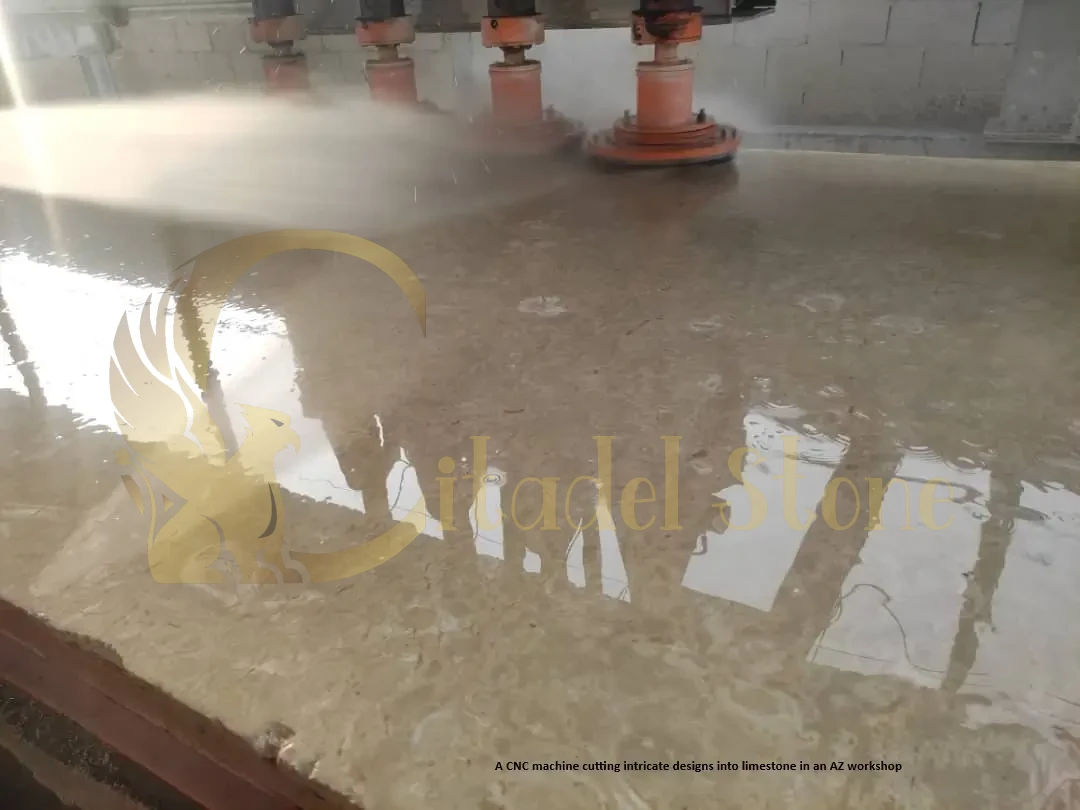
Our Arizona limestone quality standards — what “on-site fabrication” actually delivers
If a supplier promises on-site fabrication, ask what type of on-site service they mean — the phrase covers very different realities. Below is a compact, practical breakdown you can paste into your article so contractors and project managers understand capabilities, limits, and scheduling implications in Arizona (examples: Peoria, Surprise, San Tan Valley, Yuma).
Three practical on-site models (and when to pick each)
1) Full field fabrication (true on-site shop)
Supplier brings cutting & finishing machines to the job — CNC router, bridge saw, polishing units and the trained crew.
Best when: final fit must be exact in place (tight stairwells, retrofit interiors), client demands seam approval under real lighting, or access prevents moving full slabs into the building.
Arizona note: use for tricky Peoria remodels or Surprise custom retrofits where doorways/stairwells block pre-cut slabs.
2) Field templating + shop fabrication (hybrid)
Techs laser-measure or 3D-scan the site; cutting happens in a controlled shop; final touch-ups occur on site if needed.
Best when: you want shop quality with lower mobilization cost but still need high measurement accuracy. Ideal for San Tan Valley multi-unit builds where consistency plus reasonable speed are required.
3) Off-site fabrication only (shop delivered ready-to-install)
All work is performed at the shop; site receives finished pieces.
Best when: finish tolerance and polish consistency are paramount (Scottsdale lobbies) or weather/access make on-site cutting impractical (Yuma summer heat / monsoon season).
What to verify before you schedule on-site work
Short checklist contractors can use to separate marketing from capability:
Do they own the mobile gear (CNC, bridge saw) or subcontract it? (Owned = fewer coordination layers.)
Can they provide recent, dated photos/video of the same mobile equipment working on a job in Arizona?
Will they supply stamped slab photos and run IDs before cutting?
Are dust suppression, water containment, and slurry collection part of the mobilization scope?
Which permits (city, HOA) are needed and who obtains them?
Essential equipment & minimum specs (quick reference)
Mobile CNC: bed ≥ 10’×6′, spindle power adequate for limestone, tooling changes automated where possible.
Bridge saw: accepts full slab dimensions (standard full slab capacity). Wet cutting and blade guards mandatory.
Polishing kit: multi-head pass capability (not a single handheld polisher).
Dust/water control: integrated vac systems + containment tarps; no slurry discharged on site.
Rigging: rated crane/hoist or local partner with certifications and insurance.
Tolerances to demand in writing: ±1 mm for critical shop/CNC cuts; ±2 mm acceptable for most on-site adjustments. Anything looser should be flagged.
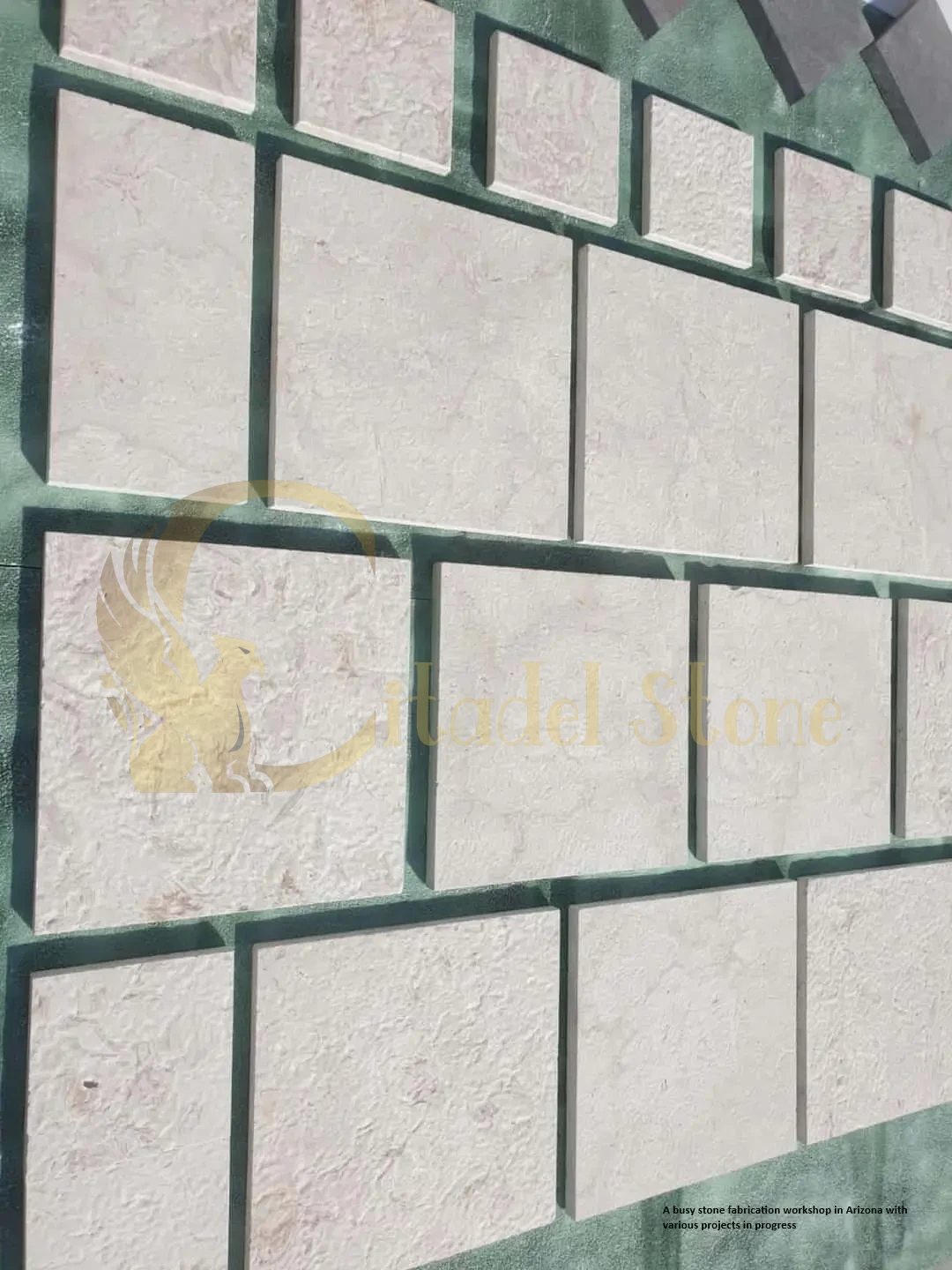
Typical on-site sequence (time & coordination expectations)
Pre-visit & access audit (1–2 hours): confirm gates, parking, crane placement, and any HOA windows.
Templating / digital scan (1–3 hours): produce DXF/DWG for the shop OR live CNC program.
Staging & mock-up (same day or next): dry-lay slabs on site for seam/lighting approval — essential under Arizona sun.
Cutting / field finishing (hours per piece depending on complexity). Plan labor windows early AM in summer.
Hoist/installation & final polish/seal (same day where possible; allow next-day curing for sealers).
Timing tip: in Phoenix-area heat or Yuma summers, insist on dawn starts (6–10 AM) and avoid midday cutting; for monsoon months schedule critical exterior work outside July–September.
Quality control & acceptance items to include in your PO
Supplier will email slab photos with run IDs and timestamps prior to shipment/loading.
All on-site cuts photographed before and after; buyer has 48 hours to register visible defects.
10% holdback retained until final acceptance (release after signed seam/finish approval).
Dust & water containment plan attached and confirmed before mobilization.
Short PO clause (copy-ready):
“Supplier shall provide dated slab photographs, perform cutting using contained wet systems, and prevent slurry discharge. Buyer retains 10% until written final acceptance. Visible defects reported within 48 hours will be remedied at supplier expense.”
Common Arizona pitfalls — plan for these now
Thermal effects: edges and seams can look different under low-angle morning sun versus shaded showroom light — always mock up in natural light.
Monsoon exposure: wet deliveries or unprotected staging lead to staining — require covered staging and elevated racks.
HOA / gated access windows: many subdivisions limit delivery times; if missed, re-delivery charges can be large. Schedule crane/hoist bookings 2–4 weeks out.
Dust & neighbor complaints: uncontained dry cutting often triggers stop-work orders. Confirm containment and neighbor notification responsibilities in advance.
Quick supplier interview questions (use these on the first call)
“Do you own the mobile CNC and bridge saw that will come to site?”
“Can you email dated photos of your crew cutting on an Arizona job in the last 90 days?”
“What is your containment plan for dust and slurry on site?”
“What are your earliest available mobilization windows for Peoria / Surprise / San Tan Valley / Yuma?”
“What tolerances will you guarantee in writing for on-site cuts?”
Final decision guide — when to insist on on-site work
Choose true on-site fabrication when final fit or seam approval cannot be validated in the shop (tight retrofits, complex façades).
Choose hybrid templating + shop cutting to get most of the quality benefits while reducing mobilization costs for medium-complexity builds.
Choose shop-only when finish uniformity, volume efficiency, and controlled polishing are the priority.
Quick next steps (copy-ready for project managers)
Add the supplier interview questions to your procurement script.
Require slab photos with run IDs before any mobilization deposit.
Block early-morning labor windows for any summer on-site cutting and confirm HOA/crane windows 2–4 weeks before mobilization.
Use these practices to protect quality and schedule on projects across Peoria, Surprise, San Tan Valley, Yuma — and anywhere Arizona heat, monsoon risk, or gated-community logistics could otherwise turn a simple cut into a costly delay.
Compare Arizona Limestone Pricing: Direct vs. Distributor vs. Importer!
Conclusion & Immediate Next Steps
Securing reliable limestone cutting service Arizona supplier partnerships with verified on-site fabrication capability requires systematic verification, detailed specifications, and proactive quality control preventing mid-project failures.
Three immediate actions:
- Send the Sample Request Email to 2–3 suppliers: Use the copy-ready template requesting equipment photos, project references, and itemized on-site fabrication quotes. Compare responses for completeness and transparency.
- Run the On-Site Fabrication Verification Checklist during yard visits: Systematically verify equipment ownership, crew qualifications, safety protocols, and insurance coverage before committing to partnerships.
- Obtain itemized on-site quotes including CNC hours and mobilization fees: Request quotes separating templating, cutting, edge finishing, mobilization, permits, and cleanup—avoid bundled pricing obscuring cost components.
Apply city-specific tactics from the Fabrication Playbook ensuring suppliers understand your metro area’s unique constraints—HOA restrictions, climate challenges, access limitations—delivering successful on-site limestone fabrication across Arizona projects. Citadel Stone is one of the smart choices among limestone suppliers near you in Arizona for value and longevity.