
Why “Trusted” Matters in Arizona — Quick Context
Arizona’s climate and logistics create amplified risk when sourcing natural stone. Summer heat exceeding 115°F damages improperly staged slabs, while monsoon rains stain unprotected limestone within hours. Long-haul imports from out-of-state quarries increase freight damage and delay resolution when problems surface. Gated communities in Scottsdale and Chandler enforce strict delivery windows; missed coordination wastes crew time and delays installations by days or weeks.
A reliable limestone supplier near you Arizona understands these constraints intimately. They protect inventory from heat and dust, coordinate HOA access in advance, and document every slab’s condition at loading and delivery. Unreliable dealers skip photographic proof, provide vague hold terms, and disappear when disputed slabs arrive with undisclosed defects. The cost difference between a trustworthy yard and a marginal one isn’t just dollars—it’s project timelines, crew productivity, and client satisfaction.
Arizona’s construction calendar compounds these risks. Spring and fall demand spikes strain even competent suppliers; marginal operators over-promise and under-deliver. Verifying trust upfront—through references, documentation requests, and field inspections—prevents expensive mid-project pivots when your original supplier fails to perform.
Core Qualities of a Trustworthy Limestone Dealer
Professional dealers demonstrate reliability through consistent, verifiable practices. Look for these attributes when evaluating any legitimate limestone yard Arizona source.
Inventory transparency: Every slab carries a unique identifier—numbered tags, engraved codes, or digital inventory systems. Dealers photograph both slab faces and email images upon request, allowing remote shortlisting and team review before site visits.
Documented hold and reserve policies: Written hold agreements specify deposit percentage (typically 10–25%), hold duration (7–21 days standard), refund terms, and slab identification. Verbal promises evaporate when disputes arise; insist on email or signed documentation.
In-yard viewing and remnant access: Trustworthy yards welcome scheduled appointments for slab inspection under natural light. They maintain organized remnant racks with visible pricing and allow contractors to browse inventory without pressure or access restrictions.
Fabrication capacity and shop quality assurance: Suppliers with in-house cutting capability document QA processes—incoming slab inspection, water suppression during cutting, and defect rejection protocols. Ask how they handle slabs with excessive resin fills or inconsistent finishes.
Photographic delivery proof: Professional operations photograph slab condition at loading, during transit when applicable, and upon job-site delivery. Time-stamped images protect both parties and streamline damage claims.
Insurance and transit coverage: Current general liability and cargo insurance certificates confirm financial stability and risk management. Legitimate dealers provide these documents within 24 hours of request—delays signal operational gaps.
Local project references: Two or three recent projects within 50 miles, complete with contact details, allow you to verify delivery timeliness, slab quality, and communication responsiveness. References older than six months may not reflect current service standards.
Transparent itemized quotes: Every cost component—material, cutting, delivery, rigging, hold fees—appears as a separate line item. Bundled or “all-in” pricing obscures markup and complicates budget reconciliation.
Clear warranty and return terms: Dealers specify what constitutes acceptable slab condition, who pays for rejected material return shipping, and the timeline for replacement or refund processing. Ambiguous terms favor the supplier in disputes.
Each quality reinforces the others—a dealer providing itemized quotes but refusing insurance proof raises red flags. Evaluate all attributes together for a complete trust picture.
Practical Red Flags
Identify risky suppliers quickly by testing for these warning signs during initial contact.
No slab identification system: If the yard can’t reference specific slabs by number or code, tracking your reservation becomes impossible. Corrective action: Request a numbered hold receipt or move to a different supplier.
Evasive answers about reserves: Vague responses to “How long will you hold this slab?” or “What’s your deposit policy?” signal unclear internal processes. Corrective action: Demand written hold terms before submitting payment.
Inability to show both slab faces: Legitimate dealers photograph front and back to reveal structural issues, resin application, or mesh reinforcement. Refusal suggests hidden defects. Corrective action: Walk away or insist on in-person inspection of both faces before reserving.
Non-itemized lump quotes: Bundled pricing prevents comparison shopping and hides margin stacking. Corrective action: Request line-item breakdowns; if refused, contact competing yards.
Refusal to provide proof of insurance: Delays beyond 48 hours or outright refusal indicate inadequate coverage or expired policies. Corrective action: Require current certificates before site visits or deposits.
No photographic delivery documentation: Yards that won’t commit to delivery photos lack accountability infrastructure. Corrective action: Include photographic proof as a written contract term or choose a different supplier.
These checks take five to ten minutes per supplier. Two or three simple questions—”Can you email your insurance certificate today?” or “Will you photograph both slab faces for me?”—separate professional operations from marginal ones instantly.
How to Verify Limestone Supplier Reputation
Limestone supplier reputation verification relies on concrete documentation, not marketing claims or generic testimonials.
Request local project references: Ask for two to three completed projects within 50 miles, installed in the past six months. Contact each reference and ask: “Did slabs arrive on the scheduled date?”, “Were there any quality issues?”, “How did the dealer handle disputes or changes?”, and “Would you use them again?” Consistent positive responses validate reliability; evasive or negative answers warrant caution.
Examine staged slab photos: Professional dealers maintain photo libraries showing inventory under natural light. Request images of three to five slabs matching your specifications. Assess image quality—blurry or poorly lit photos suggest minimal documentation standards. Look for slab-ID tags visible in each image.
Verify shop insurance and coverage limits: General liability coverage should meet or exceed $1 million; cargo insurance should cover full load value. Ask: “Can you email current certificates showing coverage limits and expiration dates?” Legitimate yards comply within one business day.
Review sample delivery photo policy: Request an example of their standard delivery documentation—loading photos, in-transit shots if applicable, and on-site delivery images. This preview reveals whether they use time-stamped formats, capture slab detail clearly, and maintain organized records.
Validate reseller versus direct quarry sourcing: Dealers importing directly from quarries often provide better pricing and origin transparency. Ask: “Do you source directly from quarries or through distributors?” and “Can you provide quarry-of-origin documentation?” Direct relationships typically yield shorter lead times and clearer chain-of-custody records.
Frame reference requests professionally: “I’m finalizing my shortlist and would appreciate contact details for two recent projects in the Phoenix area so I can verify delivery timeliness and quality. Can you email those today?” Direct, deadline-driven language encourages fast compliance and exposes delays that signal weak references.
On-Site Checks: What to Inspect at the Yard
Field inspections reveal quality issues photos can’t capture. Use this checklist during yard visits:
Face and back inspection: Examine the polished face for consistent sheen, uniform veining, and color distribution. Flip the slab or view the back to check for hairline fissures, excessive resin fills, or mesh reinforcement. Back-side cracks invisible on the finished face compromise structural integrity.
Porosity and absorption test: Place a few drops of water on an unpolished edge or the slab back. High-quality limestone absorbs slowly—water should bead for 30–60 seconds before soaking in. Instant absorption signals high porosity, which accelerates staining and weathering in Arizona’s desert environment.
Edge condition: Run your hand along cut edges to feel for chips, micro-cracks, or uneven surfaces. Pristine edges indicate careful handling and storage; damaged edges suggest rough inventory management.
Resin fill assessment: Hold a bright flashlight at a low angle across the slab face. Excessive resin fills appear as glossy patches or color variations under angled light. Minor fills are acceptable; widespread resin application (covering more than 5% of surface area) weakens the stone and affects long-term appearance.
Consistent batch coloring: If ordering multiple slabs, view them side by side under identical lighting. Limestone from the same quarry run should exhibit minimal color variation. Dramatic shifts suggest mixed batches that won’t produce seamless installations.
Remnant rack organization: Well-maintained remnant areas with clear pricing and accessible placement signal operational discipline. Disorganized piles with unlabeled pieces suggest poor inventory control.
Simple field tests checklist:
- Water drop test on unpolished areas
- Backlight examination for hairline fissures
- Edge integrity check by touch
- Resin fill detection with angled light
- Batch color comparison under natural sun
- Remnant area organization and labeling review
Failed tests indicate either material defects or poor supplier handling. Either way, they’re disqualifiers—move to the next yard on your list.
Requesting Proof: Sample Documents and Photos to Ask For
Documentary requests establish accountability before you commit funds. Ask for these items in writing:
Slab identification and run number: Each slab should carry a unique ID linking it to quarry origin and production batch. Request: “Please email the slab ID and run number for the three pieces I shortlisted.”
Quarry-of-origin documentation: Origin statements confirm provenance and help assess consistency for future orders. Use this phrasing: “Can you provide quarry-of-origin documentation for these slabs, including the quarry name and region?”
High-resolution staged photos: Both slab faces photographed under natural light, with ID tags visible. Try: “Please email high-res photos of both faces for slabs #4427 and #4429, taken outdoors in natural light with the ID tags visible.”
Lab testing or technical data: Absorption rates, density, compressive strength, and freeze-thaw cycle data validate performance claims. Request: “Do you have technical data sheets showing absorption percentage and density for this limestone variety?”
Insurance certificates: General liability and cargo coverage with current expiration dates. Say: “Please send current insurance certificates showing general liability and cargo coverage limits.”
Sample delivery photo set: Preview their standard documentation process. Ask: “Can you share a sample of your typical delivery photo package so I understand what documentation I’ll receive?”
Copy-ready request line: “Please email the slab ID and photos of both faces plus the run number before I visit. I’ll also need your current insurance certificate and any available technical data on absorption rate.”
Delays beyond 48 hours signal either disorganization or reluctance to provide verification—both are red flags. Professional dealers respond same-day or next-business-day with complete documentation.
Pricing Transparency & Reading Quotes
Understanding quote structure prevents surprises and enables fair comparison across vetted limestone dealers Phoenix and statewide suppliers.
Material cost per square foot: Baseline pricing tied to slab grade, finish type (honed, polished, brushed, flamed), and thickness. Expect $8–$25/SF for standard limestone, $30–$65/SF for premium or rare varieties. Verify whether pricing includes full slabs or accounts for yield loss during cutting.
Cutting and shop time: Custom dimensions, edge profiles, or hole drilling incur additional charges—$50–$150 per cut or hourly shop rates of $75–$125. Clarify whether simple rough cuts fall under this category or only complex fabrication.
Small-cut and handling fees: Remnant pieces under 8 square feet may carry $40–$75 handling surcharges. Ask upfront to avoid invoice surprises.
Delivery and rigging costs: Distance, slab weight, and placement complexity (ground-level drop versus crane hoist to third floor) drive fees from $150 to $800+. Gated communities, narrow access routes, and HOA coordination increase costs. Insist on separate line items for transport versus rigging so you can identify negotiation opportunities.
Hold and reservation deposits: Typical 10–25% deposits secure slabs for 7–21 days. Confirm whether deposits apply to final invoices or represent non-refundable administrative fees. Extended holds beyond standard periods may incur daily or weekly storage charges.
Remnant and volume discounts: Multi-slab orders or repeat-customer status unlock 5–15% savings. Ask directly: “Do you offer project discounts for orders over 150 square feet?” or “Is trade pricing available for licensed contractors?”
How to spot bundled markup: If material, cutting, and delivery appear as one “project total” without breakdowns, request itemization. Compare the sum of individual line items across three quotes to identify outliers. A suspiciously low material price paired with inflated delivery charges may equal or exceed a competitor’s transparent pricing.
Requesting apples-to-apples comparison: Provide all suppliers with identical specifications—dimensions, finish, delivery address, timeline—and ask each to itemize material, cutting, delivery, and hold fees separately. Normalize all quotes to cost per installed square foot for true comparison.
Transparent pricing signals operational confidence. Dealers hiding costs in bundled totals either lack cost-accounting discipline or inflate margins hoping buyers won’t notice. Find Your Local Directory: Limestone Suppliers Near Me in Arizona!
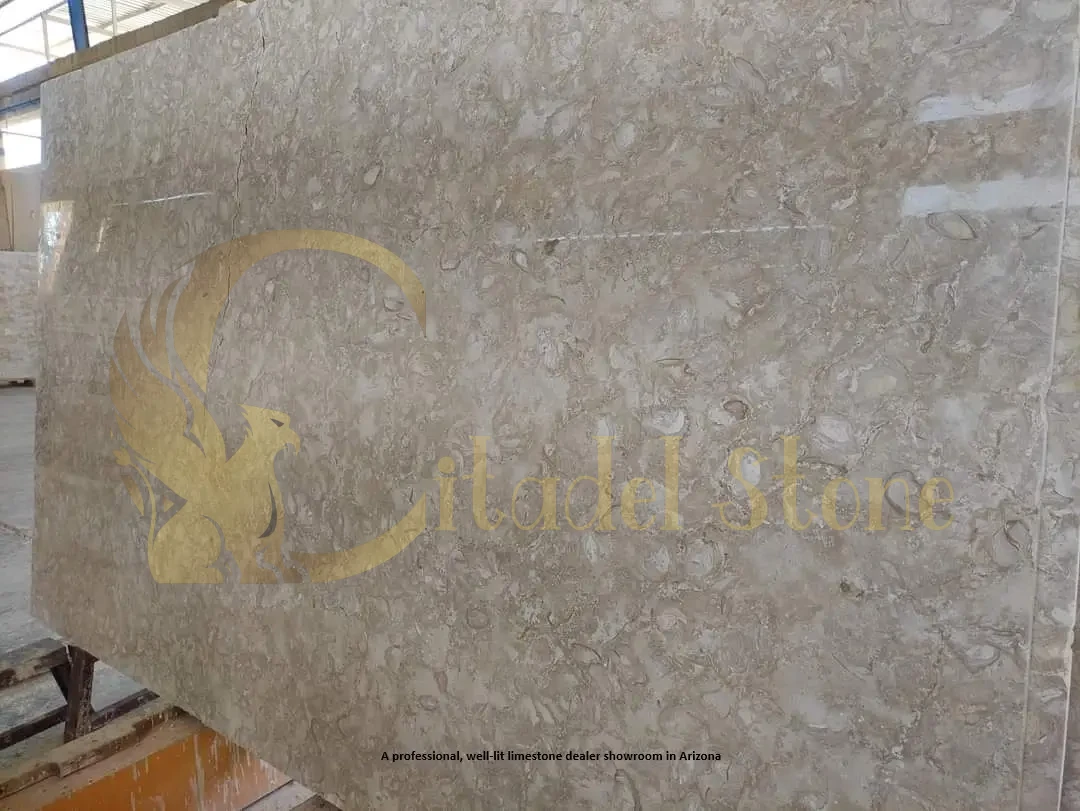
Local Trust Profiles — Arizona Cities
Phoenix
Phoenix’s size and heat create unique vetting challenges for buyers seeking trustworthy dealers. View slabs outdoors during morning hours—before 10 AM—when natural light reveals true color undertones and surface characteristics without temperature-induced distortion. Insist the yard stages your shortlisted slabs in direct sunlight for 10–15 minutes so you can assess how the stone appears under conditions matching your installation environment. Many Phoenix yards operate from industrial corridors near I-17 and I-10; confirm they maintain climate-controlled or covered storage to protect inventory from summer heat exceeding 115°F. Ask how frequently they rotate outdoor stock and whether they apply protective film to polished slabs during peak summer months. Request photographic proof that reserved slabs remain in covered storage until delivery, especially if your project timeline extends into monsoon season when water exposure can stain unprotected limestone within hours.
Tucson
Tucson’s desert environment and fine dust infiltration demand extra supplier diligence. When visiting yards, verify that inventory is staged indoors or under full dust-protection covers—prolonged exposure to airborne particulates degrades limestone surfaces and embeds contaminants into porous material. Examine the unpolished back side of each slab carefully to detect micro-fissures or surface degradation caused by intense UV exposure; small cracks invisible on the polished face often reveal themselves on rougher back surfaces. Ask dealers how they protect slabs from dust during monsoon wind events and whether they maintain humidity-controlled storage. Request two local project references from jobs completed in the past four months, focusing on whether delivered slabs matched inspection samples and arrived free of dust contamination. Tucson suppliers serving hospitality and residential remodel markets should provide clear remnant pricing and access—confirm whether you can browse remnant racks during regular hours or if appointments are required.
Mesa
Mesa’s active construction market creates high demand during spring and fall, making supplier reliability critical. Verify dealer reputation by requesting three recent project references within Mesa city limits, asking each: “Did slabs arrive on schedule?”, “Were there quality issues?”, and “How did the dealer resolve any problems?” Consistent positive responses validate dependability during peak seasons when yards juggle dozens of orders simultaneously. Ask about remnant-rack restocking schedules—trustworthy Mesa suppliers refresh inventory weekly or bi-weekly during high-volume periods, creating opportunities for 35–50% discounts on smaller architectural panels. Confirm whether the yard offers priority scheduling or extended hold periods for trade accounts; established dealers serving volume contractors often provide 14–21 day holds versus standard 7-day terms. For projects in gated communities, verify in writing that the supplier coordinates HOA delivery windows and crane access at least one week in advance—last-minute logistics failures signal poor operational planning.
Chandler
Chandler’s master-planned neighborhoods impose strict delivery protocols that test supplier competence. Vet dealers by asking: “How do you handle HOA delivery window coordination?” Professional yards maintain HOA contact lists, schedule deliveries during approved hours (often weekday mornings only), and provide advance notice to security gates. Request written confirmation that crane or hoist timing commitments include setup start time, estimated duration, and operator contact information—verbal assurances evaporate when delivery day arrives and equipment isn’t available. Ask the dealer to describe their most recent gated-community delivery in Chandler; detailed answers covering gate codes, HOA pre-approval, and rigging logistics signal experience with local constraints. Verify that delivery partners carry insurance covering gated-community placements—liability gaps discovered on delivery day delay projects by days or weeks. For exterior applications near pool decks or irrigation zones, confirm the dealer recommends specific sealing products and provides technical data sheets; generic advice suggests limited expertise in Chandler’s high-mineral water environment.
Scottsdale
Scottsdale’s luxury market demands meticulous supplier vetting focused on quality standards and service. Test dealer reliability by requesting seam mock-ups before finalizing slab selection—professional yards position adjacent slab edges together so you can evaluate vein continuity and color transitions under installation conditions. Ask for written finish tolerances (honed to 800-grit, polished to 3000-grit, etc.) and confirm the dealer will replace any slab arriving outside specified parameters at no additional cost. Verify their process for handling high-visibility installations: Do they offer white-glove delivery? Is installation support included or an upcharge? Can they coordinate directly with designers or architects? Scottsdale suppliers serving design-focused clients should maintain curated showrooms with natural-light viewing areas—tour the facility during your initial visit to assess organization and inventory quality. Request contact details for two luxury residential or high-end commercial projects completed in the past six months; follow up to confirm the dealer met elevated quality expectations and resolved any issues promptly and professionally.
Glendale
Glendale’s diverse housing stock—from older homes with tight access to newer subdivisions—requires suppliers experienced in retrofit logistics. Vet dealers by describing your specific access constraints: narrow doorways, tight stairwells, limited turn radii. Ask: “Have you delivered to similar homes in Glendale?” and “Can you pre-plan split-slab joins to fit our access path?” Professional suppliers offer job-site consultation before finalizing slab dimensions, preventing costly delivery failures when 70″×120″ slabs won’t fit through 32″ doorframes. Request photographic examples of past split-slab installations showing how pieces reassemble with minimal visible seams. Confirm whether the yard stocks thinner limestone options (3/4″ or 1cm) that reduce weight and simplify handling in confined spaces—this inventory signals experience serving Glendale’s remodel market. Ask about their approach to older homes’ unique challenges, such as uneven floors or settling foundations that affect stone installation; knowledgeable dealers provide solutions rather than disclaimers. Verify insurance coverage includes interior delivery and placement, not just curbside drop-off.
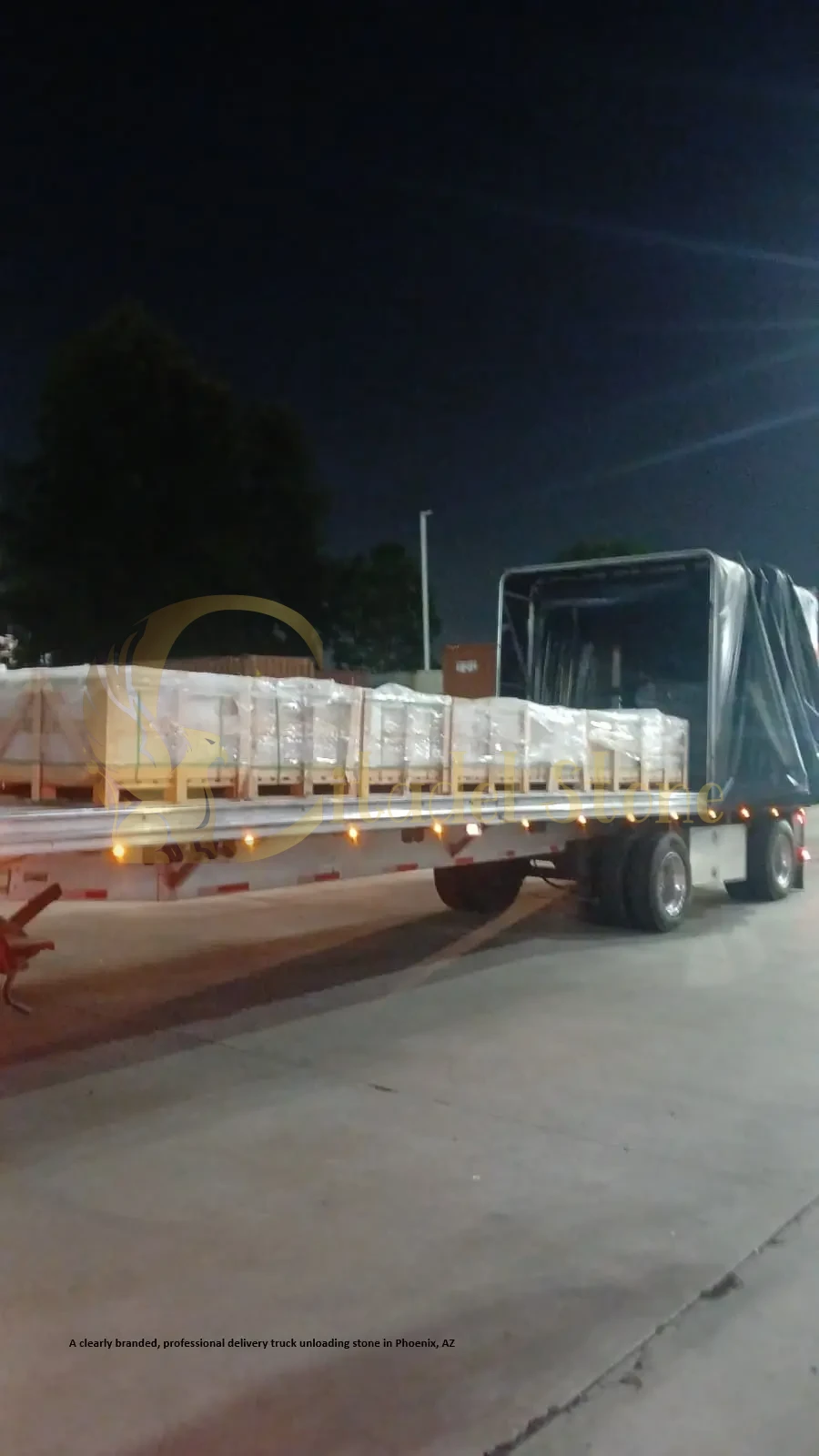
Gilbert
Gilbert’s rapid growth and outdoor limestone applications require suppliers knowledgeable about desert environmental factors. Vet dealers by asking: “What sealing products do you recommend for pool coping and patio pavers exposed to Gilbert’s high-mineral water?” Professional yards specify sealers by brand and chemistry, provide technical data sheets showing calcium-deposit resistance and chlorine tolerance, and calculate re-seal intervals based on sun exposure and irrigation frequency. Request two references for outdoor installations completed in Gilbert within the past year; follow up to confirm the limestone has resisted staining and weathering as predicted. Ask whether the supplier includes sealing cost estimates in initial quotes or treats them as owner-supplied items—transparent dealers address long-term maintenance upfront rather than after purchase. Verify that covered delivery is standard practice, not an upcharge, to protect slabs from dust during transport. For projects in production-builder subdivisions, confirm the yard offers small-lot pricing for single-family homes rather than forcing buyers into bulk-order minimums designed for volume contractors.
Tempe
Tempe’s fast-paced urban environment and university-area construction demand suppliers capable of quick turnarounds without sacrificing quality. Vet dealers by asking: “What’s your current on-hand inventory?” and “Can you provide lead-time guarantees in writing?” Professional yards specify exact stock quantities, commit to 24–48 hour delivery windows for ready inventory, and clarify any premiums for expedited service. Request examples of time-sensitive projects they’ve completed in Tempe’s commercial or student-housing sectors; detailed answers covering coordination with general contractors, phased deliveries, and schedule recovery signal operational agility. Confirm whether delivery fees account for ASU-campus-area navigation and parking restrictions—some drivers charge extra for university-adjacent job sites due to access constraints. Ask about their approach to phased or multi-unit projects common in Tempe’s mixed-use developments: Can they stage inventory for sequential releases? Do volume discounts apply across multiple delivery dates? Verify that the dealer maintains communication protocols ensuring you receive advance notice of any schedule changes—transparency during time-sensitive projects separates trustworthy suppliers from those who vanish when problems arise.
Vendor Vetting Checklist — Copy-Ready
Use this checklist for every supplier call or site visit:
- Does the dealer provide itemized quotes separating material, cutting, delivery, rigging, and hold fees?
- Will the supplier photograph both slab faces and email high-res images before you reserve?
- Can you schedule an in-person viewing appointment within 72 hours?
- Does the yard use slab identification tags or numbers for easy reference?
- Will the dealer confirm hold duration, deposit amount, and refund terms in writing?
- Can the supplier provide two local project references with contact details from the past six months?
- Does the yard carry current general liability and cargo insurance, and will they email certificates within 24 hours?
- Will delivery include time-stamped photographic documentation at loading and upon arrival?
- Does the dealer explain their process for handling damaged or mismatched slabs?
- Can the supplier provide quarry-of-origin documentation and technical data sheets?
Delivery & Staging Confirmation Script — Copy-Ready Templates
Phone script: “I’m confirming delivery for [date]. Please verify the two-hour window, driver’s direct contact number, hoist operator details if applicable, and that slabs will arrive in covered crates with photographic documentation at loading and delivery. Can you email written confirmation today?”
Email template:
Subject: Delivery Confirmation Request – [Project Name / Address]
Hello [Dealer Contact Name],
I’m writing to confirm the following for slab delivery scheduled [date]:
- Two-hour delivery window
- Driver’s cell phone number
- Hoist or crane operator name and contact (if applicable)
- Covered crate protection confirmed
- Time-stamped photographic documentation at loading and on-site delivery
- Slab IDs matching our hold agreement
Please reply with written confirmation by [date, typically 48 hours before delivery]. Let me know if you need additional job-site details or access instructions.
Thank you,
[Your Name, Company, Contact Info]
Procurement Milestone Timeline — Copy-Ready
Follow this timeline to keep limestone sourcing on track in Arizona conditions:
- Days 1–3: Shortlist and viewing. Visit two to three local yards, photograph shortlisted slabs, verify slab IDs, and request itemized quotes from each supplier.
- Days 4–5: Reference checks and vetting. Contact project references, verify insurance certificates, review sample delivery photos, and apply the vetting checklist to narrow to one dealer.
- Days 6–7: Hold and documentation. Submit deposit (typically 10–25%), obtain written hold agreement specifying slab IDs and hold duration, and request confirmation that slabs will remain in covered storage.
- Days 8–14: Fabrication coordination. Share delivery schedule with fabricator, confirm installation timeline, verify job-site readiness (staging area, access paths, crane coordination for gated communities).
- Days 15–16: Delivery booking. Use confirmation script to lock delivery window, hoist details, and photographic protocol. Obtain written confirmation including driver contact and slab IDs.
- Day 17: Delivery and acceptance. Inspect slabs on-site within 30 minutes of arrival, photograph any defects or discrepancies, and sign delivery receipt only after confirming condition matches hold agreement.
- Days 18–21: Installation and final payment. Coordinate fabricator access, monitor installation progress, and process final payment upon satisfactory completion and photographic project documentation.
Arizona-specific timing notes: Schedule steps 1–6 to avoid monsoon season (mid-June through mid-September) when possible. If summer delivery is unavoidable, confirm covered staging and early-morning delivery windows (6–9 AM) to minimize heat exposure. During spring and fall peak seasons, add one week to steps 3 and 4 to account for yard volume and extended lead times.
Common Disputes & How to Resolve Them Quickly
Post-delivery issues escalate quickly without proper documentation and clear resolution pathways.
Slab damage (chips, cracks, or finish defects): Photograph damage within 30 minutes of delivery from multiple angles, capturing slab ID tags in each image. Refuse to sign the delivery receipt or write “accepting with damage—photos attached” above your signature. Contact the dealer immediately by phone, followed by email with photos attached. Most professional yards arrange replacement or repair within 48–72 hours if damage is documented promptly. Hold final payment until replacement arrives or repair is completed to your satisfaction.
Mismatched slab (delivered piece doesn’t match reserved slab ID): Compare delivered slab against hold agreement and original photos. Document discrepancies photographically, including slab ID tags showing the incorrect piece. Contact the dealer immediately—professional suppliers acknowledge errors and schedule correct-slab delivery within 3–5 business days. Do not allow the incorrect slab to be installed; insist on exact ID match per your hold agreement.
Excessive resin fills not disclosed during inspection: If undisclosed resin fills covering more than 5% of surface area appear after delivery, photograph the affected areas with angled lighting to show extent. Reference your original inspection notes or photos if you documented the slab condition during yard viewing. Contact the dealer to request replacement or partial credit. Professional yards either replace the slab or offer 10–20% credit depending on severity and whether fills affect structural integrity or just appearance.
Standard remedy pathway: (1) Document issue with time-stamped photos within 30 minutes, (2) phone dealer immediately for verbal acknowledgment, (3) follow up with email including photos and requested remedy, (4) hold final payment pending resolution, (5) set 72-hour deadline for dealer response, (6) escalate to formal dispute if dealer is unresponsive. Maintaining documentation from initial hold agreement through delivery receipt creates the evidence trail needed for fast resolution or formal claims if necessary.
Discover nearby Arizona stone options
Why “Trusted” Matters in Arizona — Quick Context
Arizona’s climate and local logistics amplify ordinary supply risks into project-level headaches. High daytime temperatures (well above 110–115°F in parts of the state), sudden monsoon storms, and pervasive wind-blown dust change how stone must be stored, handled and delivered. In practical terms, a reliable local dealer reduces the chance that a visible slab arrives warped, water-stained or unusable just when crews are scheduled to begin.
Why this is different in Arizona
Heat stress on slabs. Prolonged sun exposure can create surface sweating, trapped heat under plastic covers, and accelerated resin discoloration. For places like Yuma and San Tan Valley, shaded staging and breathable protection are often recommended to avoid finish problems.
Monsoon-season risk. Heavy summer storms can stain porous limestone within hours if slabs are left unprotected; yards that stage material for Surprise or nearby desert towns usually keep covered storage and documented handling procedures.
Dust & abrasion. Fine desert grit (common around Peoria and many outer-belt suburbs) embeds in porous finishes and speeds abrasion; suppliers who manage dust control during cutting and storage reduce downstream maintenance and reseaming work.
Local delivery constraints. Gated subdivisions, HOA delivery slots and crane scheduling (frequent in Scottsdale/Chandler neighborhoods) mean a missed coordination can delay an install by days; local yards that understand these rules tend to avoid those problems.
What goes wrong with an unreliable supplier
Substituted or mixed lots that don’t match approved samples.
Slabs delivered with undisclosed resin fills, chips or micro-cracks on the back face.
No photographic record at loading or delivery, making claims harder to resolve.
Delivery windows missed in gated communities, costing crew standby time and overtime.
Long resolution times when the supplier is out-of-state—particularly costly when a replacement slab is needed quickly.
Why a nearby, trustworthy yard matters
Faster problem resolution. If a remnant or slab arrives damaged, a local yard in Peoria or Tucson would typically enable same-day inspection and a rapid replacement path rather than a multi-week international logistics loop.
Climate-aware handling. Local operators normally stage stock in ways suited to Arizona weather (ventilated racks, shaded indoors, covered transport) and would document that staging for your records.
Practical local knowledge. Experienced yards know HOA rules, common access bottlenecks, and the best time windows to schedule deliveries in each city—so coordination for Surprise or San Tan Valley jobs can be planned, not improvised.
Better procurement transparency. Reputable dealers would generally provide slab IDs, front-and-back photos, itemized quotes and written hold terms—documentation that lets you compare offers objectively.
Quick verification steps to reduce risk (two-minute checks)
Request time-stamped photos of both slab faces and the slab ID before you commit a deposit.
Ask for written hold/reserve terms (deposit %, hold days, refund policy) and confirm the storage condition (shaded, ventilated).
Verify current general liability and cargo insurance certificates—ask for emailed copies and check expiration dates.
Get two recent local references (projects within ~50 miles) and ask whether slabs matched samples and how delivery issues—if any—were handled.
Confirm the supplier’s delivery procedure for gated communities and whether they will provide photographic proof at loading and on arrival.
Bottom line: in Arizona the premium for a trusted, local limestone dealer is rarely just the slab price. It is the avoidance of schedule risk, fewer on-site surprises, and faster remedies when things don’t go to plan. For projects in Peoria, Surprise, San Tan Valley or Yuma, begin procurement by insisting on simple, verifiable documentation—photographs, slab IDs, itemized quotes and written hold terms—so that “trust” is demonstrable, not assumed.
Conclusion & Quick Action List
Identifying a limestone dealer Arizona trusted source requires verification, not faith. The checklists, scripts, and city-specific vetting tactics in this guide give you the tools to separate professional suppliers from risky operations before you commit funds or timelines.
Three immediate actions:
- Apply the vetting checklist. Print the copy-ready checklist and use it during every supplier call. Document responses to identify which dealers meet professional standards.
- Contact two to three local yards. Request slab IDs, staged photos of both faces, itemized quotes, and insurance certificates. Compare responses for thoroughness and speed.
- Require photographic delivery documentation. Make time-stamped loading and delivery photos a written contract term. Dealers who balk at this basic accountability measure aren’t worth your business.
Start your vetting process today—the time invested upfront prevents costly disputes and project delays later. Citadel Stone provides curated selections as one of the best limestone suppliers near you in Arizona for designers.