

Slab size determines more than aesthetics on an Arizona patio — it directly governs how your surface performs under the mechanical stress of monsoon-season wind loads, hail strikes, and the cyclical pressure of storm-driven moisture infiltration through joints. The 24×24 versus smaller patio stones Arizona debate comes down to surface area, joint frequency, and edge restraint geometry, and those three variables behave very differently when a Haboob rolls through at 60 mph. Most homeowners focus on looks first and discover the structural calculus later, usually after their first major weather event exposes a weak point in the installation.
Why Storm Performance Starts With Slab Size
Arizona’s storm season doesn’t just bring heat-related stress — it delivers genuine mechanical loading events. Straight-line winds, hail up to golf-ball diameter, and wind-driven rain that penetrates joints laterally are the real durability tests your patio faces each summer. The size of your paving unit controls how many joints exist across the surface and how much perimeter edge is exposed to uplift pressure.
A 24×24 slab covers four square feet with four edge lines. Four 12×12 pavers cover the same area with sixteen edge segments and a cross-joint directly in the center. Under lateral wind pressure, every joint is a potential infiltration and displacement point. Fewer joints means fewer failure initiation sites — which is why large versus small patio stone sizes in Arizona consistently resolves in favor of large-format stone in post-storm inspections across high-wind corridors.
- Wind-driven rain infiltrates joints and undermines compacted base material over multiple storm cycles
- Hail impact on small-format pavers transfers energy into joints rather than distributing it across a larger mass
- Uplift pressure acts on perimeter edges — larger slabs have proportionally less perimeter relative to their surface area
- Joint sand displacement accelerates in areas with prevailing storm wind exposure, particularly on west and south-facing patios
Edge Restraint Demands by Format Size
Edge restraint specification changes significantly depending on which format you choose. Small-format pavers — 12×12 and smaller — require continuous, rigid perimeter restraint to prevent lateral creep under loading. Large-format 24×24 slabs develop a different failure mode: corner lift rather than lateral migration. Both are manageable, but they demand different solutions.
For large patio stones in Arizona, you’ll want to pin corners with a minimum 6-inch concrete haunch at the perimeter rather than relying on flexible plastic restraint systems. Flexible edge restraint works adequately in mild climates but loses enough holding strength under the thermal cycling and wind pressure combination of an Arizona monsoon season to allow gradual surface migration over three to five years. Concrete haunches hold position through sustained lateral loading events that flexible systems cannot match.
- Concrete perimeter haunches should extend at least 6 inches below finished grade for stability
- Small-format installations require restraint spikes at 12-inch intervals maximum — 18-inch spacing is insufficient in high-wind zones
- 24×24 slabs benefit from a mortar-set perimeter course even when field-set slabs are dry-laid
- Restraint failure shows first at corners on exposed west-facing edges — inspect those areas after each storm season
Joint Integrity Under Wind-Driven Rain
The joint count difference between large and small format paving is where storm performance really separates. Comparing patio paver formats for AZ outdoor spaces means honestly accounting for how polymeric sand performs under sustained lateral moisture infiltration, because that’s exactly what Arizona monsoons deliver for 20-minute stretches at a time.
Polymeric sand sets with an activating water application and forms a semi-rigid binder between units. The problem is that repeated wind-driven rain events — especially those carrying fine particulate from haboobs — gradually abrade the sand surface layer and introduce dust contamination that degrades the binder. Larger slabs have 60 to 70 percent fewer linear feet of joint per square foot of coverage, which means proportionally less maintenance exposure and fewer opportunities for binder degradation.
Projects in Gilbert sit in a wind corridor that funnels storm energy from the southeast, consistently producing the kind of sustained lateral pressure that tests joint binder integrity more aggressively than single-direction wind events. Installations there with 12×12 small-format pavers often require joint recharge every three years versus the five-to-seven-year interval typical for 24×24 slabs with identical polymeric sand product.
Hail Impact Resistance and Surface Mass
Hail resistance is rarely listed in paving specifications, but in Maricopa County it’s a legitimate performance factor. Golf-ball-sized hail produces impact energy in the range of 4 to 6 foot-pounds per strike — enough to fracture edge-to-edge corners on thin small-format pavers, particularly those set at 1.25-inch nominal thickness.
The 24×24 stone slab benefits over smaller pavers in Arizona become immediately obvious after a severe hail event. A 24×24 slab at 2-inch nominal thickness distributes impact energy across a 576-square-inch mass, reducing peak stress at any single point. A 12×12 slab takes the same energy across 144 square inches — four times the localized stress concentration. Corner chipping and hairline fracture initiation at impact sites are almost exclusively a small-format phenomenon in post-hail site assessments.
- Specify 2-inch minimum thickness for any exposed outdoor application in Arizona hail zones
- Natural stone with crystalline structure (travertine, limestone) handles point-load impact better than materials with layered sedimentary cleavage planes
- Dark-colored stone absorbs impact energy slightly differently due to thermal mass variation — inspect dark materials more carefully for subsurface fractures that don’t show on the surface
- Hail damage at joint intersections is cumulative — small strikes that don’t visibly fracture individual units can progressively weaken the joint binder system
Base Preparation for Large-Format Slabs
Your base preparation protocol for 24×24 patio stones cannot follow the same specification as small-format pavers — the load distribution geometry is different enough to change aggregate depth requirements. Large-format slabs concentrate load at four corner points rather than distributing it across a smaller-unit grid, which means localized settlement at corners produces visible lippage faster than distributed settlement across a small-format field.
The standard recommendation for Arizona desert soils is a compacted Class II aggregate base at 6-inch minimum depth, but 24×24 slabs perform better on an 8-inch base in areas with expansive soil or clay content. You’ll achieve proper slab contact across the full 576-square-inch face by screeding your bedding sand layer to a tolerance of plus or minus one-eighth inch — tighter than the quarter-inch tolerance that’s workable for smaller formats. That precision matters because a rocking 24×24 slab under foot traffic is both uncomfortable and structurally damaging to the joint perimeter.
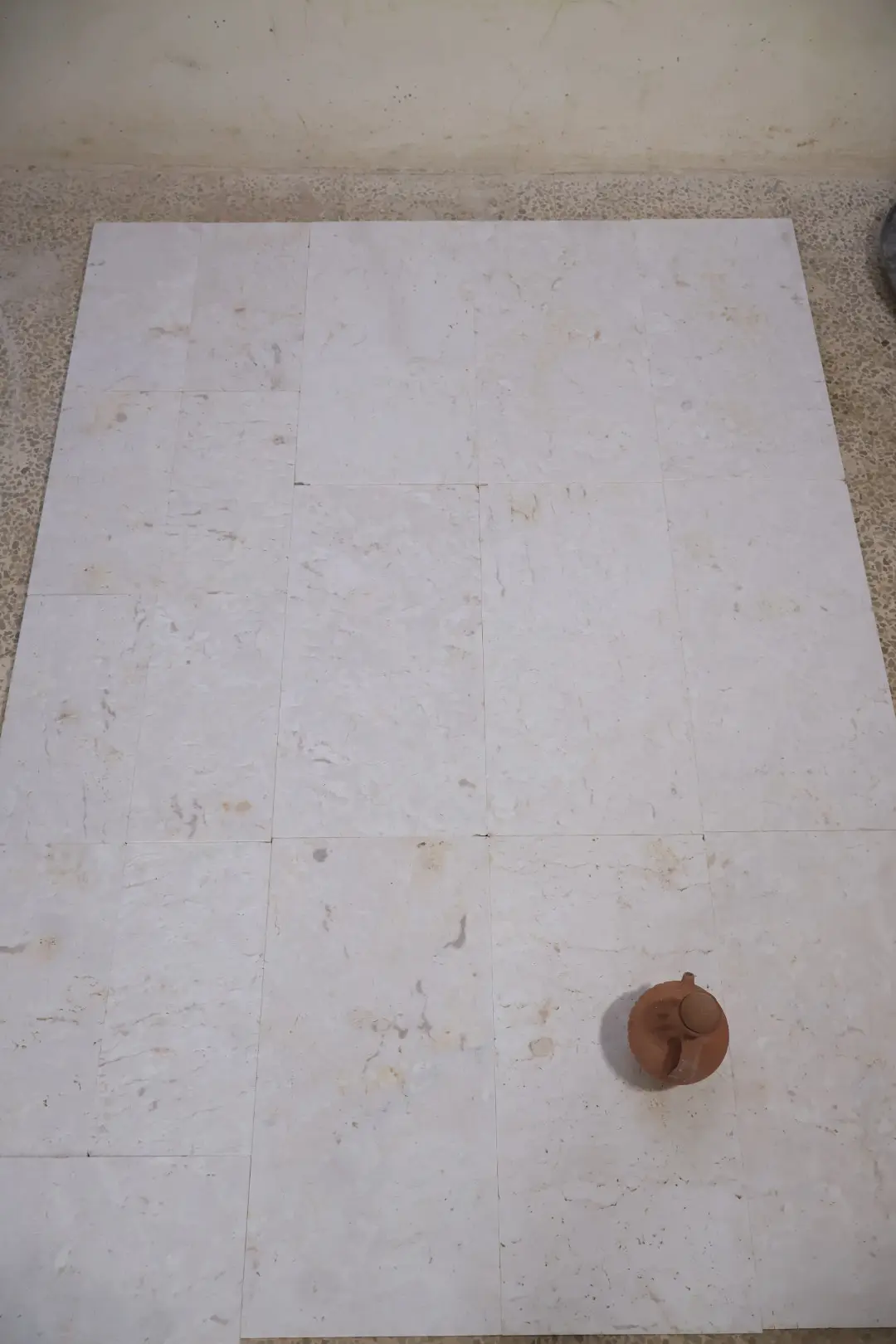
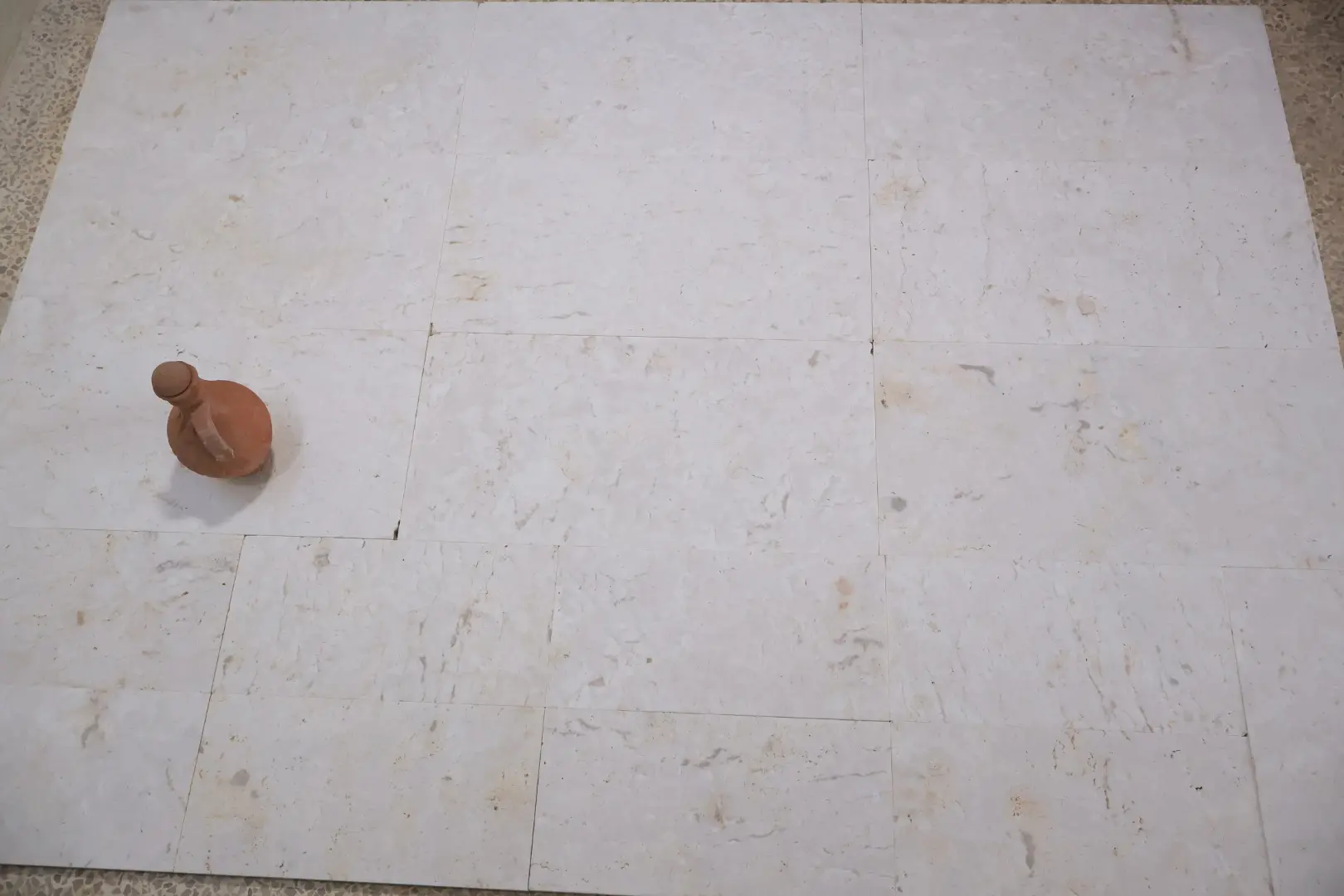
For a project-specific look at available large-format stone for your Arizona outdoor space, our Arizona 24×24 stone slab options provide specification details alongside thickness and finish availability that directly affect base design decisions.
Foot Traffic and Slab Size: Practical Performance
Any Arizona homeowner guide to patio stone size selection covers aesthetics and heat reflectivity, but foot traffic mechanics deserve equal attention — especially in outdoor entertainment spaces where the transition between paved and unpaved surfaces creates edge loading. Large-format slabs handle this better because the slab spans the transition zone rather than terminating at it.
Smaller pavers concentrate traffic wear at joints, which is why high-traffic paths through a 12×12 installation develop rocking units and joint erosion in defined tracks within five to seven years. The same traffic across a 24×24 surface distributes over the slab face and reaches the joint less frequently per square foot of travel. This isn’t a marginal difference — it’s the primary reason commercial outdoor applications transitioned toward large-format stone over the past two decades.
Installations in Chandler with pool decks and outdoor kitchen traffic patterns demonstrate this clearly: 24×24 stone surfaces in high-traffic zones adjacent to pool equipment access points consistently show less joint wear after ten years than small-format borders in the same installation, even when both receive identical maintenance and sealing schedules.
When Smaller Formats Make More Sense
Comparing patio paver formats for AZ outdoor spaces isn’t a one-sided exercise — smaller formats have genuine application advantages that 24×24 slabs can’t replicate. Curved layouts, irregular perimeter shapes, and grade transitions are all more naturally accommodated by smaller units that can follow curves without custom cutting.
Smaller pavers also offer better slip resistance in pool deck applications because the additional joint lines — which are typically filled with a higher-friction material than the stone surface itself — increase the surface friction coefficient across wet conditions. the ANSI A326.3 wet DCOF threshold (0.42) is the pool deck requirement; small-format installations often exceed this more easily than large polished slabs that require textured finish specification to compensate.
- Curved walkways and organic patio shapes are significantly easier to execute with 6×12 or 12×12 formats
- Sloped surfaces with cross-fall drainage require smaller units to maintain consistent joint width through grade changes
- Budget-constrained projects benefit from smaller-format natural stone that delivers stone aesthetics at lower per-unit cost
- Step treads and transition features often look proportionally better when bordered with smaller complementary formats
Thermal and Wind Interaction in Arizona Stone Patios
The mechanical stress from Arizona’s storm season interacts with thermal expansion in ways that compound joint stress beyond what either factor produces independently. Your patio surface expands during peak summer temperatures and contracts overnight — and joints that have been weakened by wind-driven moisture infiltration during monsoon season are then subjected to that thermal cycling with compromised binder integrity.
Natural stone exhibits a thermal expansion coefficient between 4.5 and 6.0 × 10⁻⁶ per degree Fahrenheit depending on mineral composition. Across a 24×24 slab spanning 24 inches, the linear expansion between a 70°F morning and a 140°F afternoon surface temperature is approximately 0.010 inches — small in isolation but cumulative across a large field of stone. With proper 3/16-inch joint spacing, 24×24 slabs accommodate that movement comfortably. Small-format installations with tight joints under 1/8 inch provide inadequate relief for accumulated thermal movement across long runs.
At Citadel Stone, we recommend a joint spacing review during the pre-installation phase for any project larger than 400 square feet — the compounding geometry of thermal expansion across a large field means joint calculations that look correct on paper occasionally need field adjustment based on actual stone dimension variation from the warehouse delivery.
Projects in Peoria on the northwest edge of the Phoenix metro experience slightly higher wind exposure than central valley locations, which makes the joint-plus-thermal interaction more consequential there. Specifying a polymer-modified sand with Class C designation (rated for high-traffic and climate-exposed applications) rather than standard polymeric sand is worth the additional cost in that corridor.
Ordering, Logistics, and Project Planning
Large-format 24×24 patio stones have different logistics requirements than smaller pavers, and those differences affect your project timeline in ways worth planning around. Each 24×24 slab at 2-inch thickness weighs 50 to 65 pounds depending on stone density — a standard truck delivery of 200 square feet means handling approximately 200 individual units that each require two-person lifts for safe placement.
Your project site needs truck access capable of supporting a loaded flatbed, and the unloading zone should be within 50 feet of the installation area to avoid excessive handling that risks edge chipping on natural stone. Citadel Stone maintains warehouse stock of 24×24 Arizona patio stones that typically ships within one to two weeks, which is substantially faster than the six-to-eight-week lead time common with custom-size imports. That lead time difference matters when you’re coordinating around monsoon season — you want material on-site and installation complete before July storms begin.
- Order 10 percent overage on large-format stone to accommodate cut units at perimeters and occasional damage during handling
- Confirm warehouse availability before finalizing your installation contractor’s schedule
- Plan delivery access before the ground crew begins excavation — heavy truck access becomes difficult once trenching begins around the perimeter
- Stage material in the shade to prevent surface temperature differential during installation in summer months
Making the Right Size Decision for Your Arizona Patio
The 24×24 versus smaller patio stones Arizona decision ultimately resolves around your site’s storm exposure, layout geometry, and traffic pattern — not aesthetics alone. For open, rectangular patios in wind-exposed locations, 24×24 slabs deliver measurable advantages in joint integrity, hail resistance, and edge restraint performance that translate directly to lower maintenance costs and longer installation life under Arizona’s genuine weather demands.
Smaller formats aren’t the wrong answer — they’re the right answer for curved layouts, pool deck slip-resistance requirements, and installations where layout complexity makes large-format cutting wasteful. The key is matching format to site conditions rather than defaulting to either size without a structural rationale. When flagstone is part of your broader Arizona stone specification, How to Choose Flagstone Paver Stones in Arizona: Buyer’s Guide covers material selection criteria that complement the size analysis here — useful context when you’re finalizing a complete outdoor stone scope with Citadel Stone. Homeowners in Phoenix, Tempe, and Sedona working with Citadel Stone can review 24×24 patio stone specifications alongside smaller formats to determine which slab size best suits their Arizona outdoor layout and foot traffic demands.